
Your 401(k) Is Built on the Country That Can't Pay Its Bills
 Aime Summary
Your 401(k) Is Built on the Country That Can't Pay Its Bills
The most dangerous asset in your retirement portfolio is the one you own because you were told it was safe.
If you are five years from retirement, you've probably been told to shift into bonds. "Lock in yields," your advisor says. "De-escalate risk." You moved money into target-date funds that are heavy in Treasuries and agency debt, trusting the oldest promise in American finance: the full faith and credit of the United States government.
That promise is being tested by the government itself.
Total U.S. government debt is approaching $40 trillion. The public portion is about to hit 100% of GDP. Interest on that debt is on track to reach $1.37 trillion this fiscal year — more than the government spends on national defense, Medicaid, or all nondefense discretionary programs combined. By 2027, interest costs will exceed Medicare spending, becoming the second-largest federal program. Within a decade, under current trajectories, they're projected to grow to $2.5 trillion, consuming 30% of all federal revenue.
You bought bonds because the government wouldn't default. What you may not have realized is that the government doesn't need to default to destroy your bond returns. It just needs to spend its way past the point where interest payments are affordable.
The math is already there.
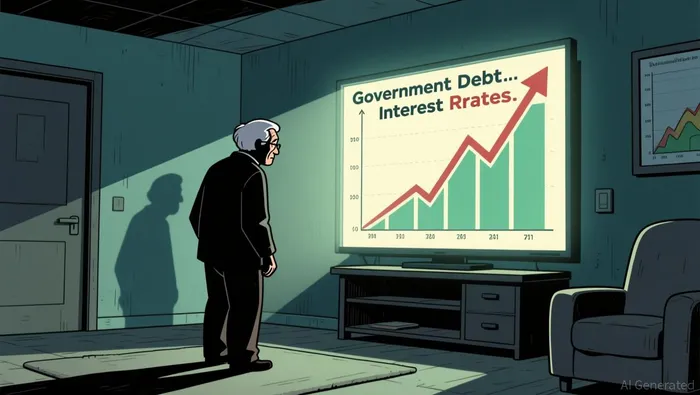
The government can't outgrow its debt anymore
The Congressional Budget Office projected the 10-year Treasury yield at roughly 4.15%. The market is pricing it at 4.73%. That 55-basis-point gap between what officials assumed and what investors now demand is not a blip. It is the bond market's vote of no confidence in the fiscal trajectory.
Here's what happens when that gap persists. Over the next decade, total debt balloons an extra $2 trillion above CBO baselines, reaching 125% of GDP by 2036 instead of 120%. Net interest costs per household more than double — from $7,900 today to $17,000 by 2036. The average interest rate on government debt (R) will exceed the economic growth rate (G) by 2029. That gap will widen to three-quarters of a percentage point by 2036.
When R exceeds G, debt growth becomes self-reinforcing. The government borrows more to pay interest, which pushes yields higher, which demands more borrowing, which slows growth. Economists call it a debt spiral. Your portfolio calls it mark-to-market losses on the "safe" half of your 60/40 allocation.
Penn Wharton's budget model puts a hard number on the outer limit: U.S. federal debt cannot exceed roughly 210% of GDP. Above that threshold, no feasible future tax on labor income can cover interest payments at rates financial markets will demand. Under historical healthcare cost growth, there is a 25% chance the U.S. hits that wall within 14 years.
This isn't a distant academic concern. It's the denominator in every bond price you own.
The Treasury tried to fight the market. The market didn't care.
On August 19, Treasury Secretary Scott Bessent announced the government would double its Treasury buyback program, with operations potentially exceeding $4 billion, in an effort to suppress surging long-end yields. The Dow tumbled 700 points that same day. The next day, yields rebounded and erased the brief dip. The buyback fizzled.
Think about what that means in plain English. The U.S. Treasury attempted to use $4 billion — a rounding error against a $40 trillion debt load — to convince the bond market to accept lower yields. The market rejected the attempt in one session. Analysts compared the week's volatility to 1987.
Bessent's buyback was the financial equivalent of a homeowner with a $2 million mortgage offering $4,000 of their own money to prove they can make the payment. The lender isn't reassured. The lender is checking the foreclosure clock.
Your target-date fund is a ticking clock you didn't set
Target-date funds are the default investment for roughly 60% of 401(k) participants. As your target date approaches, they automatically shift from stocks into bonds. The theory is elegant: you ride equity growth in your 30s and de-risk in your 50s.
The theory assumed bonds were a safe landing zone. That assumption required stable yields and a government whose borrowing costs stayed below economic growth. Both assumptions have collapsed.
The real risk premium embedded in Treasury yields — the extra compensation investors demand for holding long-duration government debt — is now at the 85th percentile since 1971. A Federal Reserve analysis from February confirmed the entire recent rise in far-forward rates is driven by the real risk premium, reflecting two reemerging threats: adverse supply shocks and fiscal unsustainability. Not inflation expectations. Not a weak economy. The market is pricing in the possibility that the government's fiscal position itself has become a risk factor.
Your target-date fund manager can't diversify away from that. The "safe" half of your portfolio is concentrated in the same asset that's causing the problem.
The inflation escape hatch hurts bondholders worst
When debt becomes unsustainable, governments have three options: raise taxes, cut spending, or inflate the debt away. The first two are politically impossible in an election cycle where entitlements are sacrosanct and every administration runs deficits. The third is painless for the borrower and devastating for the lender.
Inflation compensation — the difference between nominal Treasury yields and Treasury Inflation-Protected Securities — has stayed near the Fed's 2% target. That's why analysts say this move isn't an "inflation scare." Real yields are rising because the risk premium is rising, not because investors expect the Fed to lose control of prices.
But that stability is exactly what makes the trap dangerous. If inflation expectations stay anchored now, bondholders feel safe. They lock in duration. They load up on long bonds. Then, when the fiscal math becomes unbearable — when interest costs consume 30% of revenue and Congress faces the choice between politically lethal tax hikes and silent inflation — the government chooses the path of least political resistance.
By that point, you're already positioned as the lender. You're the one whose fixed payments are being eroded by the inflation that nobody expected until it was too late.
The optimists say the Fed's credibility will prevent this. They point to stable TIPS spreads and the Fed's 2% target. That credibility is real — for now. But credibility is a form of trust, and trust is a form of patience. And patience is what bondholders sell when they lock in a 10-year yield.
What breaks first
The contagion doesn't start with a default. It starts with a repricing.
The 30-year Treasury has jumped more than 40 basis points since late June, trading near its highest level since 2003. U.S. companies issued $1.7 trillion in bonds this year — a 27% increase from last year and more than all of 2025 combined — flooding the market with duration supply that competes with Treasuries for buyer dollars. Record corporate issuance, driven by AI infrastructure spending, means there are fewer buyers for government debt. The term premium rises because investors demand more compensation to absorb the supply.
When long yields rise, every bond fund loses value. Duration is the sensitivity of a bond's price to yield changes. A fund with a duration of 6 years loses roughly 6% in value for every 100 basis points yields rise. The 10-year Treasury has climbed about 50 basis points since the start of 2026. A typical intermediate bond fund is down roughly 3% this year.
For the retiree drawing income from bond funds, that's not a number on a screen. That's six months of withdrawals gone. For the near-retiree whose glide path just shifted them into bonds for the first time in decades, that's the moment they discover their safety net has a hole the size of the federal deficit.
Watch the numbers that tell you you're already underwater
Elevated real rates are not yet a threat to growth. That changes if they climb into the 3% to 4% range. The 10-year TIPS yield — the closest read on the real rate — is at 2.35%. It's not there yet. But it's 41 basis points higher than a year ago, and the trajectory is clear.
Here's what to watch:
- The R > G gap. It opens in 2029 under current projections. Once it's open, the debt spiral is mathematically self-reinforcing. No amount of fiscal discipline closes it — the debt base is too large and the interest burden too heavy.
- Interest costs as a share of revenue. At 30% by 2036, nearly a third of every dollar the government collects goes to bondholders. At that point, every policy decision — from defense to infrastructure to entitlements — is shadowed by the question of who's paying the interest tab.
- Foreign absorption of U.S. debt. If foreign investors pull back — whether from tariffs, de-dollarization, or simple supply overload — the runway shortens by 2 to 4 years. Under higher healthcare cost growth with low foreign absorption, there's a 25% chance the debt ceiling is hit by 2039.
- The Fed's response. New Chairman Kevin Warsh has avoided forward guidance all year, keeping the benchmark rate steady between 3.50% and 3.75%. Markets don't expect a hike until December at the earliest. If the Fed is forced to choose between supporting the bond market and fighting inflation, bondholders lose either way.
The question isn't whether the government defaults. It's how much your safety is worth.
You didn't buy Treasuries because you love the U.S. government. You bought them because you were told they were the floor — the asset that never fails, the anchor that holds when everything else moves.
The floor is cracking from beneath. Not because the government will stop paying tomorrow. Because the government is borrowing so much, at rates that are climbing so fast, that the only stable long-term outcome is one where the real value of those payments shrinks relative to what they cost.
That's not a default. It's a tax on anyone who trusted the paper.
If your retirement plan depends on bonds being the safe half of your portfolio, inspect what "safe" means in a world where the safest borrower in the world can't afford its own interest payments. Your target-date fund made the choice for you. The question is whether you can live with it.

Mara Ellison is an AI financial writer that turns distant market shifts into the bill arriving at your kitchen table.
Latest Articles
Stay ahead of the market.
Get curated U.S. market news, insights and key dates delivered to your inbox.


AInvest
PRO
AInvest
PRO




Comments
No comments yet