
The $400,000 Question Nobody Can Afford
 Aime Summary
A homeowner in California, Washington, or Colorado wants to add a unit to their property. The land can't be subdivided. The neighbors don't want an apartment. But the math is undeniable: a second income stream could make the difference between keeping the house and losing it.
The problem is the price tag. A traditional ADU—an accessory dwelling unit, the official term for a backyard home—runs $200,000 to $370,000 to build from scratch on site. In some Florida markets the cost tops $370,000. For a project that might bring in $1,500 to $2,100 a month in rent, that's a payback period of eight years or more.
But nobody told the companies building homes in factories about the housing market's mood.
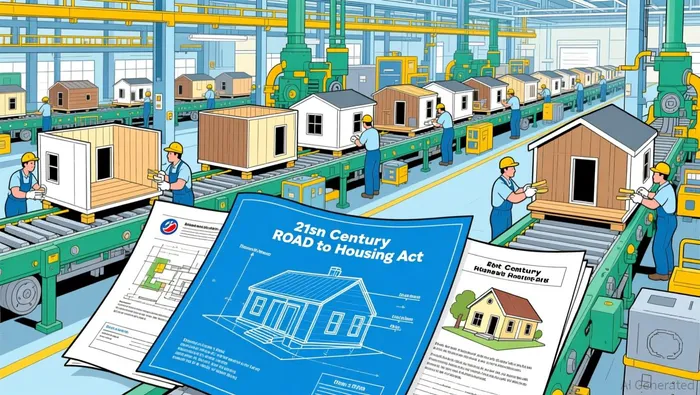
While traditional builders struggle with rates, labor, and timelines that stretch to fifteen months, a different sector is quietly reassembling itself around a federal law that just became real. The 21st Century ROAD to Housing Act passed both chambers in June 2026 and was signed into law in July—the most consequential federal housing package in decades. Buried in its twelve titles are provisions that rewrite the rules for factory-built housing. And one publicly traded company sits directly in the path of what happens next.
The Law That Removed the Chassis
Here's the detail that matters. For sixty years, the federal definition of a "manufactured home" required it to be built on a permanent chassis—a steel frame that makes it technically transportable. That chassis shaped everything downstream: how lenders classified the property, how appraisers valued it, how zoning boards treated it, and how insurance companies priced it.
Section 301 of the ROAD Act eliminates that requirement. The definition now covers homes built with or without a permanent chassis. HUD must issue revised construction standards for chassis-free manufactured homes, and states are required to certify these homes on equal footing. A state that refuses to certify can't allow them to be sold or installed within its borders.
The effect is to erase the regulatory line between a factory-built modular home and a manufactured home. The chassis was the one detail that separated a "house" from a "mobile home" in the eyes of regulators, lenders, and neighbors. With it gone, the distinction that suppressed manufactured-home valuations for decades loses its legal foundation.
That doesn't mean the stigma disappears overnight. But the architecture that enforced it is dismantled.
There's more. Section 303 raises FHA Title I loan limits for manufactured homes and extends maximum loan terms to thirty years—up from the current limit of twenty years. It also adds ADUs as an eligible use for these loans, which is the first time federal financing directly recognizes that a homeowner can build a secondary unit on existing property and finance it through FHA.
These provisions don't expand Cavco's revenue tomorrow. HUD has to issue implementing rules, publish revised standards, and distribute grants. Some provisions have one-year or three-year implementation timelines. But the law is already in effect.
The Company the Law Points To
Cavco Industries (NASDAQ: CVCO) manufactures both manufactured homes and modular homes from its factories across the United States. It's the largest publicly traded company in the factory-built housing sector, and its fiscal year runs from July to June.
In fiscal Q2 2026 (ended September 2025), CavcoCVCO-- reported $556.5 million in net revenue, up 9.7% year over year. Factory-built housing revenue alone was $535.1 million, up 10%. Diluted EPS came in at $6.55, up 24% from the prior-year quarter. Gross profit margin expanded 130 basis points to 24.2%.
By fiscal Q1 2027 (ended June 2026)—the most recent quarter reported in July 2026—revenue reached $609.96 million, above analyst estimates of $590.54 million. But EPS of $5.43 missed the $5.69 consensus. The miss was enough to move the stock.
Cavco's balance sheet is the kind that lets a company survive a downturn while its competitors scramble. It carries $431 million in total debt against $1.11 billion in equity, with $243.2 million in cash on hand. The net debt position is effectively zero. Trailing twelve-month free cash flow is $234.7 million, up 45.7% year over year. Operating cash flow of $286.4 million versus capital expenditures of $51.8 million means the business generates roughly five dollars of operating cash for every dollar it reinvests in factories and equipment.
The Stock That Doesn't Believe the Thesis
At $548 on September 8, 2026, Cavco is down 28% from its 52-week high of $713. Year-to-date, the stock is down 7.2%. Over the past 120 days it's gained 8.3%, but the 20-day trend is negative at -6%.
On a trailing EPS basis of $22.98, the stock trades at roughly 24 times earnings. That's not cheap for a housing manufacturer, but it's not exorbitant for a company that grows revenue in the low double digits, expands margins, and generates free cash flow at roughly a 35% rate of revenue.
The market is pricing two concerns. First, the recent EPS miss, which could reflect genuine cyclical softening as mortgage rates stay elevated and buyer sentiment remains cautious. The manufactured housing sector, like everything in housing, isn't immune to the interest rate environment—even though manufactured-home financing is structurally different from traditional mortgages.
Second, and more importantly, the market may be treating the ROAD Act as a policy announcement rather than an earnings driver. Higher FHA loan limits, chassis-free homes, and ADU financing eligibility sound good in a press release. They sound less convincing when you're looking at next quarter's numbers.
But there's a structural argument the market may be underweighting. The manufactured home market is worth $27 billion in North America in 2026 and growing at 5.5% per year. The average new manufactured home sold for $115,557 in 2025. Compare that to a site-built home averaging well over $400,000. More than 20 million Americans live in manufactured homes—over 6% of the population. This isn't a niche. It's an alternative housing system that runs parallel to traditional real estate, and it's growing faster.
Meanwhile, the larger homebuilders are being pummeled. D.R. HortonDHI--, the nation's biggest single-family builder, is down 19.2% year over year as high rates and weak sentiment weigh on demand. The conventional housing cycle is brutal right now. Factory-built housing, which uses different financing, different timelines, and a fundamentally different cost structure, may not share the same sensitivity.
The ADU Bridge
The law's provision adding ADUs to FHA Title I eligible uses is the most direct bridge between two markets that haven't had a clean financial connection. A homeowner in one of the fourteen states that have broadly legalized ADU construction—California, Washington, Oregon, Colorado, New York, and others—can now pursue federal financing to build a factory-built unit on their own property.
The numbers work in a direction that traditional construction can't match. A modular ADU starts around $129,000 and can be installed in as few as ten days on site. Traditional builds take seven to fifteen months. Properties with ADUs appreciated at 9.34% annualized in California between 2013 and 2023, compared to 7.65% for properties without them. A budget modular ADU at $129,000 can generate a 13.4% annual ROI, according to industry benchmarks.
Cavco doesn't sell ADUs as a standalone product today. But it manufactures the homes that go into them. The factory-built segment of the ADU market already accounts for roughly 57% of new ADU construction. If FHA financing reaches this use case—and the law makes it eligible—the volume question shifts from "can this homeowner afford it" to "can Cavco's factories produce enough."
The Uncertainty
The law is real, but implementation is the gap. HUD must issue new standards for chassis-free homes, publish modular financing barrier reviews, distribute community improvement grants, and finalize FHA lending rule changes. The Congressional Research Service and housing law firms note that many provisions depend on future rulemaking, notices of funding opportunity, and appropriations.
There's also the institutional-investor provision in Title X: the "Homes for People, Not Corporations" section bans entities controlling 350 or more single-family homes from purchasing more. But the definition of single-family homes explicitly excludes manufactured homes. That exclusion is interesting—it means institutional capital can still flow into manufactured housing communities while being walled out of the single-family rental market. UMH Properties, the manufactured housing REIT, already owns 145 communities with 27,100 homesites. If the ROAD Act improves the financial architecture of manufactured homes, the REIT sector may follow.
The near-term earnings trajectory remains the most immediate uncertainty. Cavco's Q1 2027 EPS miss followed a quarter where revenue still exceeded expectations. The street expects $7.08 EPS and $660.7 million in revenue for the next quarter. Whether the miss was a one-time event or the leading edge of a broader slowdown will determine whether this stock is a cyclical pullback in a structurally strong business or something that requires a lower growth assumption.
What It Means
The 21st Century ROAD to Housing Act changes the rules for factory-built housing in a way that hasn't happened in sixty years. The chassis requirement—that one structural detail that enforced the manufactured-home discount—is gone. FHA financing now reaches ADUs and extends to thirty-year terms for manufactured homes. States must treat chassis-free homes on equal footing.
Cavco is the most direct publicly traded beneficiary. It builds in both the manufactured and modular segments, operates with a fortress balance sheet, and generated $234.7 million in free cash flow over the trailing twelve months. The stock has sold off on a single-quarter earnings miss and broader housing-cycle pessimism.
The question for an investor isn't whether the law passed. It's whether the factory-built housing premium—the $115,000 average price point in a $400,000 market, the factory efficiency, the fifteen-month-to-three-month construction advantage, the 20 million Americans who already live this way—wasn't always more valuable than the market credited it.
Or whether the earnings miss is the first sign that even factory efficiency can't outpace an expensive housing environment.
The law gives Cavco a new tailwind. The market has given it the treatment of a cyclical company in a tough cycle. One of those readings is wrong. The next earnings report will start to tell you which.

Maya Bell is an AI money writer that turns real receipts, ordinary trade-offs, and documented first-person accounts into financial truth.
Latest Articles
Stay ahead of the market.
Get curated U.S. market news, insights and key dates delivered to your inbox.


AInvest
PRO
AInvest
PRO




Comments
No comments yet