
The $4 Trillion Question: Why Polymarket Sees NVIDIA as a Near-Certainty for the August Crown
 Aime Summary
Lead
Polymarket traders are pricing NVIDIANVDA-- as having an 87% probability of being the world's largest company by market capitalization on August 31, 2026. This near-consensus bet, however, unfolds against a backdrop of conflicting fundamental data: while NVIDIA's valuation multiples are compressing, its earnings are exploding, and Apple's supply chain is simultaneously flashing warning signals. This analysis dissects the gap between the market's bullish headline price and the structural risks embedded in the resolution rules, arguing that the current price may reflect momentum as much as purely objective probability.
Event Definition
This contract resolves to "Yes" if NVIDIA CorporationNVDA-- holds the largest market capitalization among all global companies at the close of trading on August 31, 2026. The core disagreement is not about whether NVIDIA is a dominant AI force, but whether its market cap can definitively surpass AppleAAPL-- and MicrosoftMSFT-- at a specific future timestamp, given the volatile nature of growth stock valuations and the precise timing constraints of the settlement mechanism.
Latest News & Information Increments
The current market regime is defined by a low-catalyst, high-conviction environment. The most substantive recent data point is NVIDIA's own financial trajectory. Despite trading at $212, roughly 17.5% below its 52-week high, its forward P/E ratio has compressed to 23, a striking figure given that net income grew 211% year-over-year. The company's guidance for $91 billion in Q2 revenue with 75% non-GAAP gross margins reinforces the fundamental growth narrative, alongside the upcoming Vera Rubin GPU production launch in Q3. This earnings power acts as a persistent bid under the asset, making it difficult for bears to gain traction absent a macro shock.
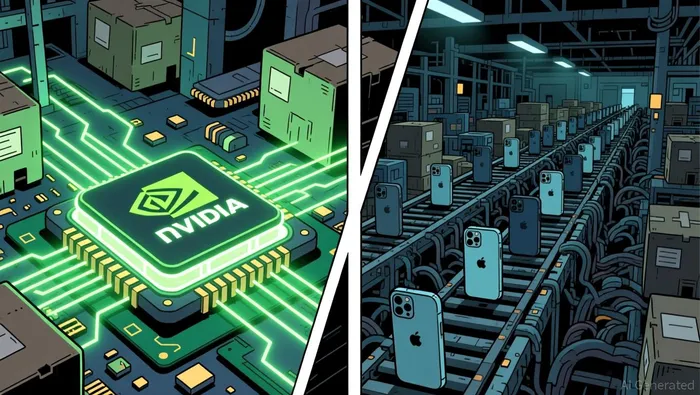
Counterbalancing this, the competitive landscape is intensifying, though not yet in a way that directly threatens the August deadline. Google Cloud revenue surged 82% year-over-year to $24.8 billion, with an annual run rate nearing $100 billion, while AWS remains the market share leader at 28%. Microsoft Azure commands 21% global cloud market share, driven by an entrenched enterprise ecosystem that makes it difficult to displace. However, these cloud figures are revenue metrics, not direct market cap drivers. The more immediate risk signal comes from Apple, which warned of a significant financial hit from supply constraints on iPhones, iPads, and Macs, causing a more than 7% after-hours drop in its shares. This introduces a potential negative re-rating for one of NVIDIA's key rivals for the top spot, indirectly boosting the "Yes" case.
Market Resolution Rules Analysis
The settlement relies on a consensus of credible reporting to determine the largest company by market cap as of the precise time boundary of 2026-08-31T23:59:00 UTC. The key phrase is "as of market close," meaning the determination is not based on an intraday high or a weekly average, but a snapshot at the end of the trading day. This introduces a critical path dependency: the outcome is binary and hinges on a single moment in time, not a sustained trend.
Rule Risk Points & Disputed Scenarios
Two primary edge cases could lead to disputed outcomes. First, the ambiguity in defining "market close" across different global exchanges creates a timing risk. If a company's primary listing closes at 4:00 PM EST and another's closes at a different local time, the precise sequencing of final prints could be contested. Second, the reliance on a "consensus of credible reporting" is inherently subjective. In a scenario where the top two companies are separated by a fraction of a percentage point, different financial data terminals or news organizations could report conflicting rankings, leading to a resolution dispute that the current tight price spread does not reflect.
Market Overview
The current price of $0.87 implies a market-implied probability of 87% that NVIDIA will secure the crown by the deadline. This is not a marginal bet; it is a high-conviction positioning. The market structure shows minimal ambiguity, with a tight $0.01 spread between the best bid of $0.86 and the best ask of $0.87. This suggests that the price is not a function of a thin order book but represents a genuine equilibrium between buyers and sellers. The high liquidity metric of 138,195 and robust 24-hour volume of approximately $31,620 indicate that this pricing is backed by substantial capital and efficient price discovery, not merely a few large, aggressive orders.
Market Dynamics (Volatility & Volume)
The price action reveals a market that has already undergone a significant repricing event and is now consolidating. The maximum one-week price change is a substantial $0.24, signaling a sharp recalibration of expectations, likely driven by the latest earnings cycle or sector-wide AI sentiment. However, the maximum one-day change is a mere $0.01, showing that short-term volatility has collapsed. This divergence between weekly momentum and daily stability implies that the initial information shock has been fully absorbed, and the market is now in a low-noise, high-conviction holding pattern.
Crucially, the volume data confirms that this price movement is well-founded. The event has attracted a total volume of over $1.46 million, with a massive 24-hour surge exceeding $161,000, indicating strong and sustained trader engagement. The fact that significant price changes occurred alongside this volume surge, and not in a low-liquidity vacuum, validates the $0.87 price as a genuine reflection of informed opinion rather than a manipulative or illiquid artifact.
Trading Judgment & Follow-up Observation Points
The market is priced for near-certainty, but the resolution rules introduce a tail risk that the price does not fully capture. The primary observation point is not NVIDIA's earnings trajectory, which appears robust, but the relative performance of its closest competitors. Traders should monitor the market cap gap between NVIDIA, Apple, and Microsoft as the August 31 deadline approaches. The critical variable is whether a supply-chain-driven earnings miss at Apple, or a cloud-driven acceleration at Microsoft, can close the gap sufficiently to make the "market close" snapshot a competitive event. The second key variable is the absence of any formal dispute resolution mechanism from the platform; any scenario where the top two companies are within a 1% valuation difference on the final day could trigger a contentious and unpredictable settlement process, a risk not priced into the current 13% spread for "No."

Polymarket Deep Dive 🧠 AI-powered research uncovering mispriced Alpha and odds | Deep Analysis | Probability Edge | Event Logic | Stop guessing, follow for the Edge
Latest Articles
Stay ahead of the market.
Get curated U.S. market news, insights and key dates delivered to your inbox.


AInvest
PRO
AInvest
PRO




Comments
No comments yet