
The $4.00 Heartbreak: The Math Behind Why Gas Prices Feel Like a Punch in the Gut
 Aime Summary
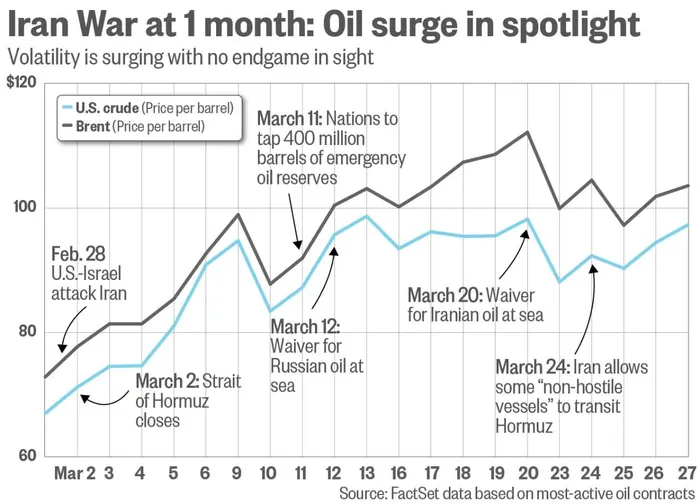
The giant, glowing LED signs at the corner gas station have officially crossed a psychological red line. This Tuesday, the national average for a gallon of regular gasoline hit $4.02, breaching a barrier that hasn't been touched since the global energy shocks of 2022. For President Trump, the timing is a political gut-punch; only a month ago, he was taking a victory lap as prices dipped below $3.00. But as the conflict with Iran escalates, that "cheap gas" winning streak has been incinerated. Today, as Google searches for "gasoline" rocket to their highest levels in twenty years, a fierce battle is emerging between cold, calculated economic data and the raw, visceral frustration of the American driver.
The Great Decoupling: Why Math is Losing to Reality
If you sit down with a Wall Street economist, they'll tell you that $4.02 is actually a bargain. They will point to a series of sophisticated charts showing that when adjusted for inflation, today's prices are a shadow of the past. The $5.00 peak of 2022 would be $5.56 in today's purchasing power, and the 2008 crisis would feel like a staggering $6.17. Furthermore, they'll argue that the U.S. is structurally "sturdier" because our cars are simply better; the average vehicle now gets 22.6 MPG, a massive leap from the 18.8 MPG seen during the 1990 Gulf War. On paper, because gas now consumes only 1.5% of personal income compared to 2.8% in 2008, the American consumer has never been better equipped to handle a price hike. Yet, these spreadsheets fail to capture the "sticker shock" of a world that feels increasingly unaffordable. To the person filling up an SUV, the "inflation-adjusted" discount feels like a hollow academic fantasy.
The Velocity of Pain and the Death of the "Opt-Out"
The real culprit of the current national anxiety isn't just the final price tag; it's the dizzying, vertical speed of the ascent. In a mere five weeks, prices have rocketed by $1.05 per gallon. This isn't just a trend; it is the most aggressive price surge since Hurricane Katrina decimated the Gulf Coast in 2005. Humans are remarkably resilient when it comes to gradual changes, but we react with instinctive panic to sudden spikes. Because gasoline is a non-discretionary expense—parents must drive to school and commuters must get to work—this $1.05 jump acts as an immediate, regressive tax on every working family. There is no "opting out" of the pump, and that sense of helplessness is exactly what triggers a defensive "mental accounting" shift. When the gas tank eats an extra $50 a month, the first things to go are the "extras"—the restaurant dinners, the new sneakers, or the weekend road trips—creating a ripple effect that could cool the entire retail economy.
The Psychological Trap of the $4.00 Scoreboard
Ultimately, the $4.00 mark is less about mathematics and more about a profound psychological "breaking point." Behavioral economics research shows that consumer unhappiness doesn't rise at a steady, linear pace; it spikes disproportionately the moment a price crosses a major "round number" threshold. Gasoline is a unique commodity because its price is displayed more prominently than almost anything else we buy. You might not know the exact price of a gallon of milk or a new refrigerator to the cent, but you see that $4.02 neon sign every single morning on your way to work. It acts as a real-time, 24/7 scoreboard for the health of the American economy. Right now, that scoreboard is flashing a warning. It's telling Americans that despite what the "inflation-adjusted" charts say, the cost of their daily freedom is under fire, and the psychological fallout may prove far more dangerous to the administration than the actual economic data suggests.

Tianhao Xu is currently a financial content editor, focusing on fintech and market analysis. Previously, he worked as a full-time forex trader for several years, specializing in global currency trading and risk management. He holds a master’s degree in Financial Analysis.
Latest Articles
Stay ahead of the market.
Get curated U.S. market news, insights and key dates delivered to your inbox.


AInvest
PRO
AInvest
PRO



Comments
No comments yet