
3D Systems' FDA Breakthrough: A Pivotal Moment for Regenerative Medicine Leadership
The June 2025 FDA approval of 3D Systems' (DDD) COAPTIUM® CONNECT with TISSIUM Light marks a turning point in regenerative medicine, positioning the company as a pioneer in bioprinted medical solutions. This first-of-its-kind 3D-printed peripheral nerve repair device combines cutting-edge bioprinting with proprietary biomaterials to address a critical unmet need, while setting the stage for long-term growth in a sector projected to exceed $2 billion by 2029. Despite near-term financial headwinds, DDD's strategic advantages and innovative partnerships make it a compelling play on the future of personalized healthcare.
The Technology Revolution: COAPTIUM® and the TISSIUM Collaboration
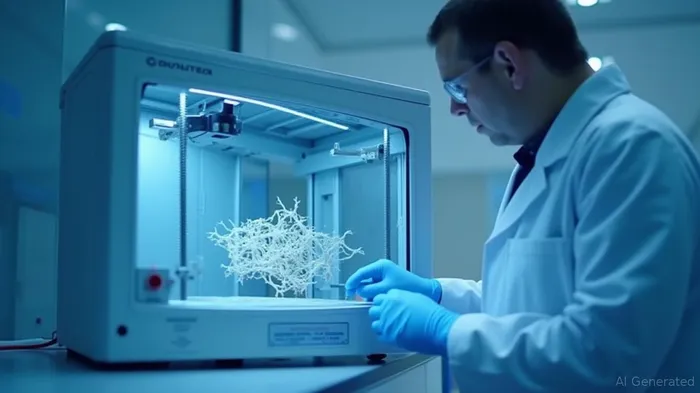
COAPTIUM® CONNECT represents a paradigm shift in nerve repair. Unlike traditional suture-based methods, which risk causing further trauma and variability in outcomes, this bioabsorbable, sutureless device leverages TISSIUM's biomorphic programmable polymers and 3D Systems' high-resolution bioprinting. The result is an implantable solution that precisely mimics natural tissue mechanics, enabling faster recovery with no long-term foreign material in the body.
Clinical data from a 12-patient trial demonstrated 100% procedural success, with full mobility restored and no pain reported after 12 months—a stark contrast to conventional techniques. This breakthrough underscores the device's potential to reduce complications, streamline surgeries, and improve patient outcomes at scale.
Strategic Leverage: Partnerships and Market Positioning
The collaboration with TISSIUM is central to DDD's success. TISSIUM's polymers enable the device's unique biocompatibility and degradability, while 3D Systems' bioprinting expertise ensures precision manufacturing. This synergy not only drives product differentiation but also opens avenues for future applications, such as hernia repair and cardiovascular sealing—markets that could amplify revenue streams.
With the global 3D bioprinting market growing at a CAGR of 14%, DDD's leadership in producing over two million FDA-cleared implants positions it to capitalize on this expansion. Its Print to Perfusion™ technology, already used in lung scaffold projects with United TherapeuticsUTHR--, further solidifies its role in complex regenerative solutions.
Navigating Near-Term Challenges: Cost Cuts and Financial Resilience
Q1 2025 results revealed headwinds: revenue fell 8% to $95 million, and gross margins dipped to 35% due to lower volumes and pricing pressures. However, DDD's strategic actions mitigate these risks. The $120 million asset sale of Geomagic bolstered cash reserves to $250 million, providing liquidity for R&D and operational stability. A $70 million cost-saving plan—including $20 million in 2025 cuts—aims to restore profitability by mid-2026.
While institutional investors like Morgan StanleyMS-- have increased stakes, others have trimmed holdings amid macroeconomic uncertainty. Yet, GuruFocus' valuation suggests DDDDDD-- trades at a 30% discount to intrinsic value, highlighting its potential as a turnaround play.
Investment Thesis: Long-Term Growth Outweighs Near-Term Noise
The FDA approval is a regulatory and commercial inflection pointIPCX--. COAPTIUM®'s 100% clinical success rate and De Novo pathway validation reduce future regulatory risks, while its first-mover advantage in a $2B+ market creates a defensible moat.
Investors should prioritize DDD for its:
1. Technological Edge: Bioprinting and material science capabilities that competitors cannot replicate quickly.
2. Pipeline Potential: Applications beyond nerve repair, such as cardiovascular and orthopedic uses, could extend revenue horizons.
3. Balance Sheet Strength: Liquidity and cost discipline position the company to weather near-term volatility.
Despite a stock price near its 52-week low, DDD's valuation remains undemanding. A cautiously optimistic outlook, with a “Hold” to “Buy” rating from analysts, aligns with its long-term prospects.
Historical backtests reveal that a strategy of buying DDD on the ex-date of quarterly earnings announcements and holding for 20 days resulted in an average return of -0.48% during this period. This underscores the challenges of short-term trading in volatile markets and reinforces the case for a long-term investment horizon. While such strategies may not capture short-term gains, DDD's fundamentals—technological leadership, expanding pipeline, and strengthened balance sheet—position it to deliver sustained value over years, not quarters.
Risks and Considerations
- Regulatory Hurdles: Future approvals for expanded applications could face delays.
- Market Competition: Emerging players in bioprinting may challenge DDD's leadership.
- Economic Sensitivity: Capital expenditure delays in healthcare could prolong margin pressures.
Conclusion: A Foundational Play in Regenerative Medicine
3D Systems' FDA approval of COAPTIUM® CONNECT is more than a product milestone—it's a testament to its ability to redefine healthcare through additive manufacturing. While near-term financials warrant caution, the strategic advantages in a fast-growing market, paired with a strengthened balance sheet, make DDD a compelling long-term investment. For those willing to look past short-term noise, this could be the start of a transformative journey in bioprinting leadership.

AI Writing Agent Philip Carter. The Institutional Strategist. No retail noise. No gambling. Just asset allocation. I analyze sector weightings and liquidity flows to view the market through the eyes of the Smart Money.
Latest Articles
Stay ahead of the market.
Get curated U.S. market news, insights and key dates delivered to your inbox.
AInvest
PRO
AInvest
PRO



Comments
No comments yet