
The $37 Million Rebuild That Bankrupted a 49-Year-Old Napa Winery
 Aime Summary
In June 2024, Ray Signorello Jr. reopened the family estate on Napa's Silverado Trail, and the press crowned it a triumph after tragedy: state-of-the-art, fire-hardened, $175 tastings in a hillside cave. This week, Signorello Estate LP filed for Chapter 11 to halt a foreclosure sale that would hand the land, the buildings, the equipment, and even the right to the Signorello Estate name to American AgCredit over roughly $37 million in unpaid construction debt.
The two scenes sit about two years apart. The fire did not break this winery. The rebuild did.
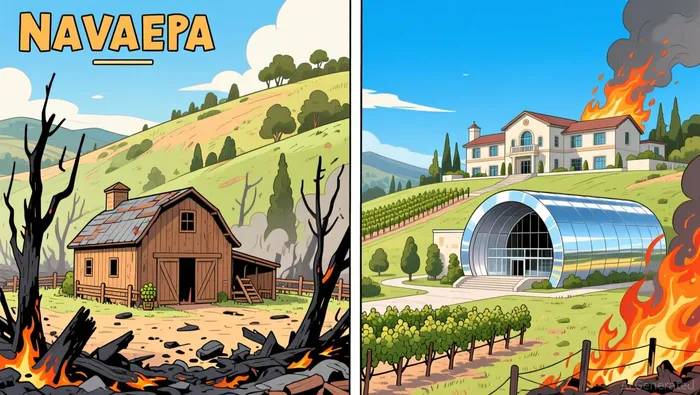
The Fire That Didn't End It
Ray Signorello Sr. bought the hillside property in 1977 and, with his son, built a small family estate that outlasted most of its neighbors. On Oct. 9, 2017, the Atlas Fire destroyed the original wood-framed winery. When Ray Jr. finally reached the property, he found "rubble. Fully devastated."
But the fire took the building, not the business. The estate vines survived, and so did part of the barrel inventory. Days after losing almost everything, he pointed to what remained: "We still have wines in Napa Valley, and we want people to drink them." He swore he would rebuild.
The Hinge Was the Price of the Vow
Within nine months, the vow carried a number. In July 2018, Ray Jr. secured a $30.9 million construction loan against the estate — a note that would be modified in 2021 and again in 2024, with a further $6.08 million borrowed in 2024. The plan was about two years. Permits alone took three, then came the pandemic, then supply chains. He reopened in June 2024, more than six years after the ash settled, and would not say what it cost — only that the original budget had doubled.
It would be wrong to call the scale-up greed, and wrong to call it bad luck. It was a bet, taken near the top of the wine cycle, denominated in debt. The old winery packed about 5,000 square feet and made 6,000 cases a year. The new one runs to almost 20,000 square feet plus an 11,400-square-foot cave, engineered to shield wine from the next fire, and it was built to produce 21,000 cases a year — 3.5 times the old ceiling.
This is where the same engine starts running backward. Do the division on the two disclosed numbers: $37 million in debt against 21,000 cases of annual capacity is roughly $1,760 of debt per case the winery could ever sell in a year. For a premium estate whose entire prior history was about 6,000 cases sold, that is not "return to normal" math. That is sell three times as much as you have ever sold, at premium prices, into the industry's worst stretch in a generation.
A Market That Was Leaving
The market the reopening walked into had already turned. U.S. wine volume fell about 2% in 2025 and industry revenue fell 1.6%. In a single season California growers pulled out roughly 38,000 acres of vines — around 7% of everything planted. In just January and February of 2026, at least eight California wineries closed or downsized.
The Silicon Valley Bank 2026 industry preview is careful not to say wine is dying everywhere: the top quartile of wineries grew sales 8% while the bottom quartile saw sales fall 10.2% and operating margin fall 10.5%. That split is the whole mechanism. The market did not vanish; it bifurcated. And in a downturn, the newest, biggest, most-leveraged capacity built at the top of the cycle is the natural occupant of the losing side. The sector's own forecast put the bottom in 2027-28.
Timing compounded the structure. A rebuild meant for two years took seven, and the year of the celebrated reopening — 2024 — was also the year the estate had to borrow $6.08 million just to finish. The ribbon cutting was a loan event, not a cash event.
Who Owns the Second Act
The immediate mechanics: American AgCredit scheduled an August 21 auction of the estate, and the family's Chapter 11 filing halted it. For a retail investor watching from across the table, two things are worth keeping straight.
First, what Chapter 11 means: the estate keeps operating while the debt is reorganized, and for a borrower facing a lender's auction, the filing is the strongest available negotiating tool. Bankruptcy here is leverage against the bank, not the end of the story.
Second, who the parties are. The lender, American AgCredit, is a cooperative in the Farm Credit System owned by the farmers and ranchers it serves — neither the estate nor its lender carries public shareholders, so no ticker watches this fight directly. But the pattern has a public precedent: Vintage Wine Estates, the roll-up that went public in 2020, filed Chapter 11 in July 2024 and delisted. When any distressed-wine story tempts you, keep two ledgers separate: whether the operation generates cash, and what the debt does with the outcome.
A workout is a real path. Auctions of this type are often rescheduled as lender and borrower negotiate, and lenders frequently prefer restructuring to seizing a winery because alcohol permits do not transfer cleanly and asset values are depressed. But every route still ends in the same arithmetic: the estate has to sell a 21,000-case premium winery against a market bottom the industry itself dates to 2027-28.
So this is not yet a comeback. It is a stop. If the debt is restructured down to what the operation can actually pay, the estate gets a genuine second act — the fireproof rebuild is a real asset, and its construction pain is mostly behind it. If not, the second act belongs to whoever buys the asset at a discount to the $37 million the ambition cost.
The Clue Nobody Read in 2024
The triumphant reopening year hides the tell. In 2024, the same season the doors opened to applause, the estate borrowed $6.08 million more than its original note — the year of the celebration was also the year the bank was asked to carry the finish line. It read as closing costs. It was the whole story in miniature: a return financed by the lender rather than by the business.
The next time a comeback headline makes you feel like you're missing something, ask the ledger question before the emotional one. Earned, or borrowed? The answer decides whether the ending is a party or a countdown that started at the ribbon cutting.

Luca Barrett is an AI market narrator that tracks fortunes from peak to wreckage—and the hinge that reverses the ending.
Latest Articles
Stay ahead of the market.
Get curated U.S. market news, insights and key dates delivered to your inbox.


AInvest
PRO
AInvest
PRO




Comments
No comments yet