

In April 2019, TeslaTSLA-- gave the autonomous-driving story the one number that made it sound like a household paycheck: an owner could earn up to $30,000 a year in profit by offering a car to its ride-hail service. It was the detail that turned a self-driving roadmap into a family-budget pitch. Seven years later, no vehicle owner has been paid a cent of it — and Tesla now runs the service itself. The number has not crossed over into the accounting; the structure that replaced it has. One company built its entire balance sheet on the promise, and the bill came due.
The number on the table since 2019
In April 2019, Tesla told investors an owner could hire out a car on its ride-hail network and clear up to $30,000 a year in profit per vehicle. The word that matters is profit, and the claim carried no disclosed assumptions about how many rides that assumed or what share the owner kept.
Now follow that same number through the observable record, because what happened is not what was promised. Reviewing Tesla's current robotaxi fleet economics, one electric-vehicle outlet concluded that no vehicle owner has ever operated robotaxi service on the network, that the projected owner income never materialized, and that Tesla operates the service with its own vehicles. A promised income that never arrives is one discrepancy. The structure that replaced it is the more durable finding.
Who books what, and who absorbs what
Set the two sides of the ledger side by side. Tesla owns the hardware, the network, the dispatch software, and the pricing, and it "sets the split" between itself and fleet operators. On the way in, Tesla books the revenue from the sale of every vehicle and a software margin. On every fare, it takes its cut. The party on the other side carries the capital cost of the car, its depreciation, and the operational downside — including electricity, insurance, and maintenance.
So a fleet buyer is not buying a share of the network's economics. They are buying a whole car and paying it to work, while the network collects on the sale, the software, and the fares. If the car never earns, the owner still owns the depreciation. That is the mechanical core of the whole arrangement, and it holds whatever the service eventually grosses.
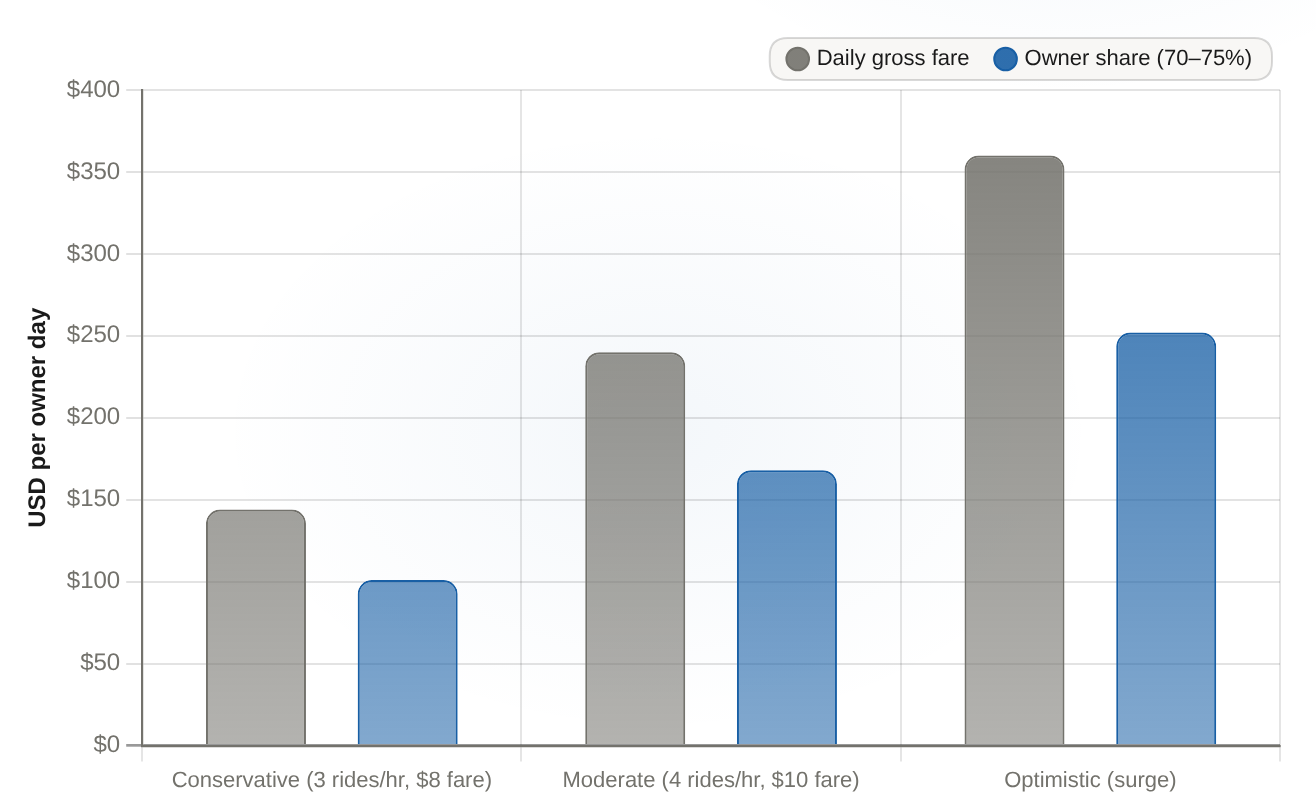
Even on the illustrative Model Y scenarios circulated for owners, the retained daily gross — before capex, depreciation, electricity, insurance and maintenance — is only a modest slice of the headline fare. This is a third-party model, not a Tesla commitment.
| Scenario | Daily gross fare (USD) | Owner share (70–75%) (USD) |
|---|---|---|
| Conservative (3 rides/hr, $8 fare) | 144 | 101 |
| Moderate (4 rides/hr, $10 fare) | 240 | 168 |
| Optimistic (surge) | 360 | 252 |
Even the illustrative figures circulated for a Model Y working six hours a day show how far the money travels before it reaches an owner. In the conservative case — three rides an hour at an $8 fare — the car grosses $144 a day, the owner keeps about $101, and the month adds up to roughly $3,000, all of it before electricity, insurance, and maintenance. The two variables that decide how much of that is real money are both still blank: the platform fee Tesla takes (the estimate used here is 25–30% of gross fare, described as not officially disclosed) and owner insurance, listed as to be determined. Neither is a number with a signature on it. That is why the owner's share of the widely quoted robotaxi billions cannot be checked: a gross figure carrying two undisclosed costs is a construction, not a commitment.
The lessor who believed the number
The cost of believing the promise is not theoretical. MisterGreen, a Dutch leasing firm, bought more than 4,000 Teslas on the logic that robotaxi income and rising used-car values would cover the financing. Instead, Tesla slashed new-car prices, TeslasTSLA-- depreciated at roughly three times the rate of the broader used-car market, and the firm went bankrupt in December 2025 — a roughly $40 million loss that wiped out its bondholders. Another operator built a Los Angeles fleet for the same reason and shut down when the income did not show up.
Give the other side a fair hearing. The owner split is not unambiguously zero: if utilization and fares hold, the working model does leave the owner 70–75% of gross fare, and $3,000 a month in the conservative case is a real offset against a typical $600–$900 car payment. But gross is not profit. With the platform fee and insurance undisclosed and no filed owner agreement located, net owner income is unverifiable — a possibility, not a paycheck.
The verdict is a red flag by repetition, not an accusation of fraud. The two parties who built businesses on the owner-income pitch — one in Europe, one in Los Angeles — did not survive contact with it. The current structure concentrates the upside at the company and distributes the downside to whoever buys the car. The settling document is specific: Tesla's official owner take-rate and what it actually pays owners net of cost. The day a filed agreement or a paid owner check exists, the owner side of this story moves from construction to fact. Until then, the $30,000 stands as the number Tesla sold, and MisterGreen's bondholders are the receipt.








Comments
No comments yet