

Three names arrived in the same week wearing the same label: AppleAAPL-- (AAPL), MerckMRK-- (MRK) and Analog DevicesADI-- (ADI), each carrying fresh bullish attention from a desk that matters. Before anyone leans on any of them, one thing is worth stating plainly: "top pick" describes Street sentiment, not a single verified endorsement issued for all three at once. It is a mood reading, and my job is to check that mood against the factor stack.
The question most investors ask is which one has the best story. The question the data answers is which call is anchored well enough to survive its next earnings report. Run the same lenses across all three — valuation against sector peers, growth, quality, cash flow, income, momentum — and the verdict is stable: Merck first, Analog Devices second, Apple third. The order has less to do with the logos than with how each bull case is built: Merck's on cash flow and a live revision cycle, ADI's on a great quarter that was already paid for, Apple's on narrative optionality priced at 40 times forward earnings.
The Valuation Spread Kills the "Comparable Picks" Premise
The first cut is valuation, and it immediately shows these are not interchangeable candidates. Ainvest data puts Merck at roughly half Apple's multiple on forward earnings — 19.8x against 40.1x — the cheapest forward P/E of the three, paired with a 2.21% dividend yield, while Apple pays 0.34%. Analog Devices is gauged on sales, not earnings: its reported forward P/E of 91.6x contradicts the adjusted-EPS run-rate implied by its own guidance and is a data artifact, so the market prices it on 13.5x trailing EV/Sales — enterprise value relative to revenue — the richest multiple of the trio. Merck cheapest on earnings, Apple richest, ADIADI-- priced on the top line: that spread is the whole argument in miniature.
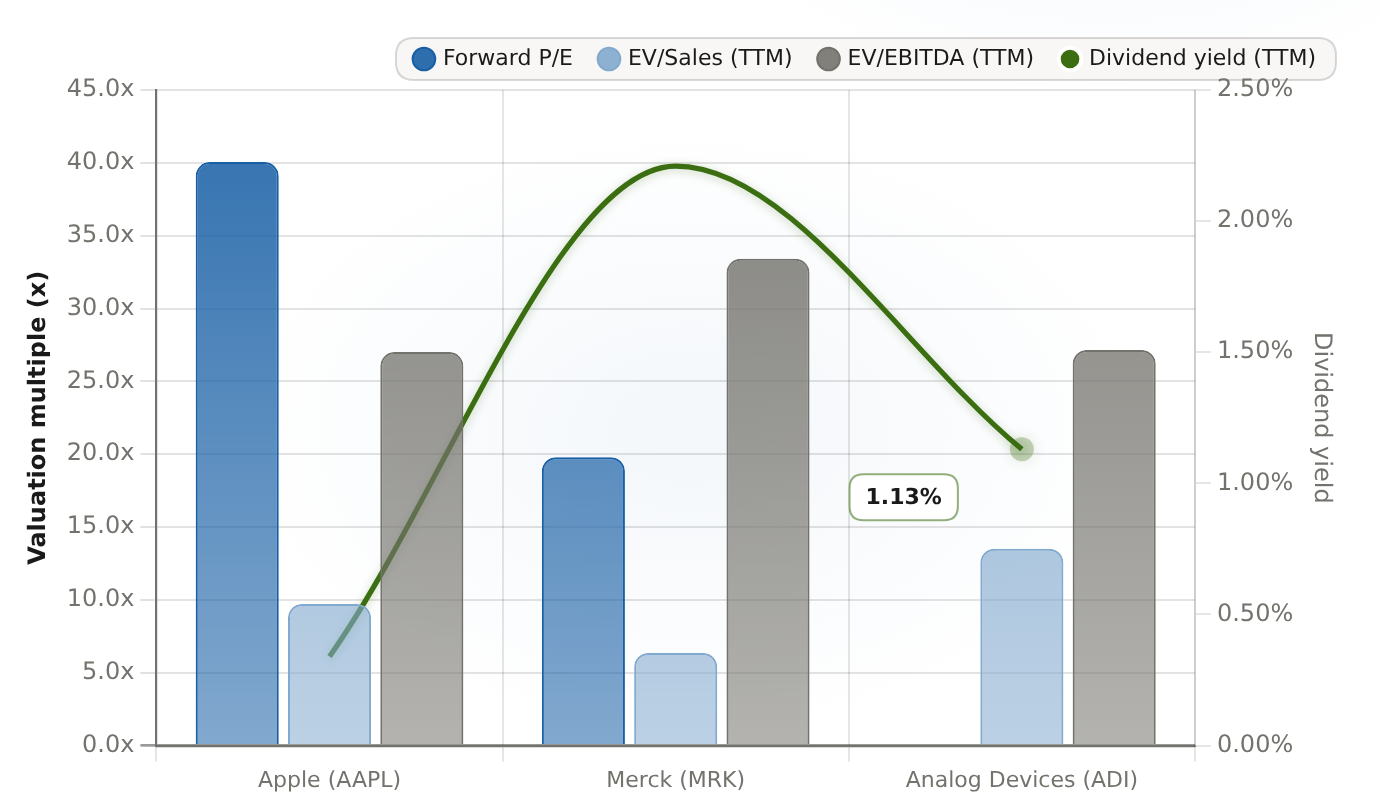
Merck ranks first in the quant case partly because it pairs the lowest forward earnings multiple of the trio (19.8x) with the highest dividend yield (2.21%), while Apple's 40.05x forward P/E leaves no valuation cushion and Analog Devices trades richest on sales (EV/Sales TTM 13.5x, the highest of the three).
| Company | Forward P/E (x) | EV/Sales (TTM) (x) | EV/EBITDA (TTM) (x) | Dividend yield (TTM) (%) |
|---|---|---|---|---|
| Apple (AAPL) | 40.05 | 9.72 | 27.01 | 0.34 |
| Merck (MRK) | 19.8 | 6.36 | 33.41 | 2.21 |
| Analog Devices (ADI) | N/A | 13.51 | 27.16 | 1.13 |
Why a Street Call Becomes Price
Bullish attention only reaches a portfolio through a mechanism, and the mechanism is predictable. Analysts revise their earnings estimates first; ratings and price targets follow; the stock's multiple re-rates last. The gate that decides whether the whole chain holds is the gap between reported GAAP earnings and the adjusted figures the Street actually anchors on. When that gap is small, a rating change is a tidy opinion. When it is a canyon — as it is in pharma this quarter — the durability of the call depends entirely on whether the adjusted numbers keep climbing.
Merck is the clearest example in this trio, which is part of why its call is the most defensible. Its trailing GAAP screens look broken — 118.6x trailing P/E, 3.5% trailing ROIC — meaningless on reported earnings that were negative for two straight quarters. That breakage is an accounting slug, not a broken business: R&D expense alone surged to roughly $9.7 billion in the June quarter, what one earnings review dubbed "aggressive pipeline shopping" that wiped out reported income. The forward 19.8x is only meaningful against the adjusted estimates the Street builds its targets on — which is exactly why the recent upgrade cycle matters, and exactly where this call would break if those estimates stopped rising.
Merck (MRK): The Call the Data Actually Supports
Merck's refresh is this week's clearest bullish action. Morgan Stanley lifted Merck to Overweight with a price target of $179 on Aug 20, a jump from its prior target of $116, and it was not the only desk hiking the name. The setup under that move is a beat-and-raise narrative built on a real beat: second-quarter sales of $16.6 billion came in ahead of the roughly $16.4 billion the market expected, with Keytruda and its subcutaneous extension, Keytruda QLEX, contributing $8.4 billion of the total and the newer Winrevair launch scaling. The Street's verdict is Moderate Buy — 15 buys against 8 holds and zero sells among 23 analysts.
Here is where Merck separates from the other two for me. Its value, income and revision screens point the same direction, which is the definition of a GARP setup — growth at a reasonable price. Cheapest forward earnings of the three, a 2.21% dividend yield, $16.1 billion in trailing free cash flow, and 24 consecutive years of dividend growth, all riding the strongest estimate revisions in the group. Apple can match the quality; ADI can match the growth; neither pairs a cheap forward price with live upward revision pressure and a real income stream. That combination is what makes the call durable rather than fashionable.

The discipline problem is entry, and I will not pretend otherwise. Merck's relative strength index — RSI, a momentum gauge — sits near 78 while the stock holds a 52-week high, roughly 19% above its 50-day average and up 44.9% year to date. Voting this the most compelling call is not the same as endorsing a chase: the verdict describes the strength of the case, not the perfection of today's entry. Treated as the income-and-revision leg of a barbell — a portfolio that pairs a defensive income sleeve with a growth sleeve instead of betting everything on one style — Merck earns a place; the disciplined entry comes on a pullback, not into an overbought ridge.
What breaks the call: a stumble in adjusted-EPS guidance, or a fresh acquisition charge. Either snaps the estimate-revision chain the 19.8x forward multiple depends on, and an RSI near 78 at a 52-week high means the market has front-run the good news. Watch the next quarterly print, and watch the direction of the adjusted-EPS estimate more than the price target — targets are static, revisions are live.
The Fundamental Scorecard Flips the Order of Merit
Flip the comparison from price to fundamentals and the internal ranking shifts even though the overall verdict does not. Per Ainvest data, Apple posts the strongest returns profile of the three — 71.17% trailing ROIC, 28.61% free-cash-flow margin, a 32.64% operating margin on 14.24% trailing revenue growth. Merck's trailing profitability is buried under this year's charge slug. And Analog Devices prints the group's best growth and cash conversion — 33.65% trailing revenue growth and a 35.83% free-cash-flow margin.
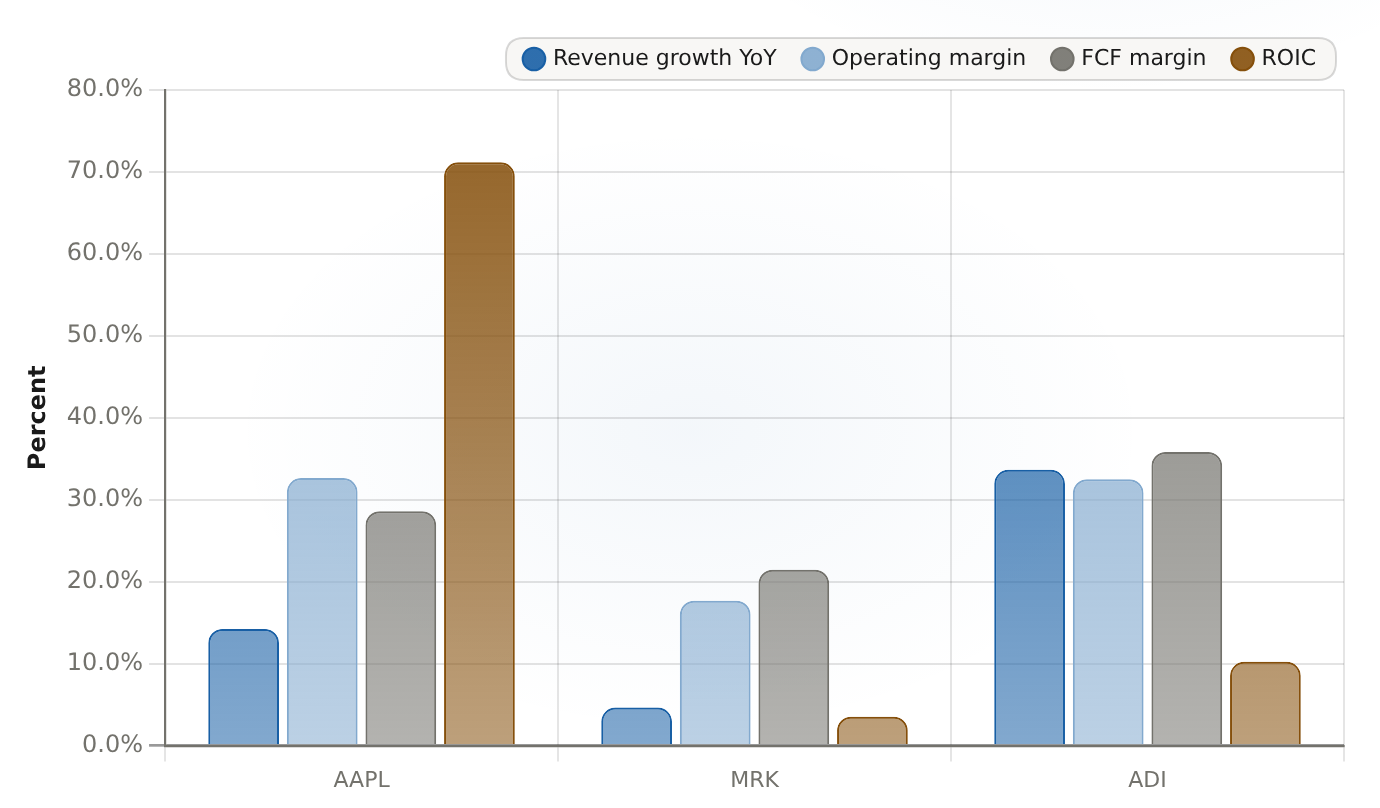
Analog Devices leads the three top picks on trailing growth, margins and FCF conversion, while Apple pairs strong margins with the highest return on capital; Merck trails on trailing metrics shadowed by charge-heavy GAAP quarters.
| Ticker | Revenue growth YoY (%) | Operating margin (%) | FCF margin (%) | ROIC (%) |
|---|---|---|---|---|
| AAPL | 14.24 | 32.64 | 28.61 | 71.17 |
| MRK | 4.64 | 17.68 | 21.46 | 3.51 |
| ADI | 33.65 | 32.5 | 35.83 | 10.22 |
That scorecard is exactly why Analog Devices is the second-most compelling call despite printing the best quarter. It is also exactly why the market's reaction to that quarter tells you the multiple is spent.
Analog Devices (ADI): The Best Quarter, Already Paid For
Analog Devices delivered the strongest report of the trio. Fiscal Q3 revenue of $4.02 billion marked its first $4 billion quarter, up about 40% year over year and roughly $103 million ahead of consensus, and adjusted EPS of $3.45 was up 68% on a $0.11 beat. The quality underneath is hard to argue with: a 72.5% non-GAAP gross margin, around 50% operating margin, and $4.9 billion in trailing free cash flow equal to 36% of revenue, with industrial up 53% and communications up 84% year over year and data-center power and optical growing triple digits.
The desks were not quiet. BMO Capital initiated at Outperform, raising its fair value estimate to $445 in an Aug 21 rating, and DA Davidson reiterated Buy with a price target of $498. This is where the sentiment reading and the data diverge in the most instructive way: the stock sold off after a great number. It is down 4.2% over five days and sits below its 50-day average with an RSI near 45 because the quarter it just reported was already in the price. At 13x trailing price-to-sales — against Texas Instruments at 12.4x, Micron at 12.1x, NXP at 4.3x — ADI carries the richest sales multiple in its own peer set. New good news cannot carry a stock priced for it; only an even higher multiple can. A fade below the 50-day line after a beat is the market saying the price had already adopted the fundamentals.
That makes ADI a growth-quality winner with an entry problem — the mirror image of Merck's position. It is the growth sleeve you want inside the same barbell, with AI power-density exposure compounding in earnest, but it is not a buy where the multiple sits today. Watch the next print against the guided revenue line of $4.3 billion and adjusted EPS guidance of $3.86: the bull case needs forward estimates climbing at a pace that validates, not merely tolerates, a 13x sales multiple. One post-earnings review summarized the dynamic by flagging the stock's fundamentals decoupling from its price — a strong quarter and a falling stock, the signature of expectations that ran ahead of the number.
Apple (AAPL): The Best Franchise, the Thinnest Margin for Error
Apple's presence in the same week's lineup shows how few things matter as much as the price you pay. The bullish minority is real: Rothschild Redburn upgraded Apple to Buy at a $400 target on Aug 17, and BofA held its Buy at $380 on Aug 20. But that camp is the exception on a cautious Street. The corrective batch of early August ran the other way — Jefferies down to Sell at $263.66, DZ Bank and China Renaissance stepping to Hold, Phillip Securities at Sell and $290 — and the Street's average 12-month target sits at about $319, essentially the market price. When the average desk targets the current quote, the Street is telling you the upside is paid for.
The valuation math makes the bull camp early rather than wrong. Apple trades at 40.1x forward earnings with a 0.34% dividend yield, and Ainvest's earnings timeline puts the June-quarter report of Jul 30 at about $109.4 billion of revenue and $2.02 EPS — below the data source's forecast of roughly $128 billion and $2.47. I will flag the size of that shortfall: the consensus baseline as it stood at report time was not independently verified, so treat the magnitude as approximate while the actuals and the direction of the miss stand. Against that, the franchise numbers remain elite — 71.17% ROIC, $136.7 billion in trailing free cash flow, a 28.61% free-cash-flow margin. Nobody should confuse "third here" with "bad company." The problem is cushion, not quality: at 40x, if the earnings growth that justifies the multiple does not arrive, there is no valuation floor under the bull case.
Momentum sides with the cautious desks, not the bulls: RSI near 47, price below the 50-day average, down 7.1% over 20 days. Apple is the quality core of a compounder portfolio — the name you own and accumulate on weakness, not the fresh top pick you initiate at 40x on services and AI optionality. Watch whether estimates turn up: at this multiple a flat revision trend is a slow leak, and only services-and-AI growth strong enough to lift the forward number refuels the case.
The Ranking, and the Cross-Check That Flatters the Also-Ran
The explicit adjudication: first, Merck — the only call where cheap valuation, rising estimates and real income point the same direction, built on a verified beat-and-raise quarter and anchored in $16.1 billion of cash flow rather than narrative. Second, Analog Devices — the best fundamentals and the worst entry, a great quarter the market had already paid for. Third, Apple — the best franchise and the thinnest margin for error, a 40x price on a June quarter that trailed the forecast, with the average Street target sitting at the market price.
Run the trio through AInvest's aggregate engine and the cross-check comes back bullish on all three: Buy on each name, with fundamentals scores of 7.52 on Apple, 6.25 on Merck and 4.87 on ADI. Read that for exactly what it is — an aggregate sentiment cross-check from an engine whose contributors and methodology are not disclosed, not a factor grade and not a named-analyst opinion. It corroborates the week's bullish tilt; it does not adjudicate whether the bullishness is priced. Its most useful quirk is that it scores Apple's fundamentals the highest — the same tension running through this whole exercise: the quality is real, and the price has already consumed it.
What to Do With the Verdict
If the question is which call the data supports this week, Merck's is the answer. The open question is how to act on it without pretending momentum timing is an entry signal, and the barbell is the honest container: Merck as the income-and-revision leg, accumulated on a pullback from an overbought high rather than chased; ADI as the growth-quality leg, re-entered once the post-beat fade stabilizes and the rich sales multiple finds a buyer; Apple as the quality core you keep and add to at levels that restore cushion.
The rankings will change when the inputs change — that is the point of a rating that re-runs daily rather than a target that re-prices slowly. Today's durability reads are specific. Merck breaks if adjusted-EPS guidance stumbles or another acquisition charge lands. ADI needs its $4.3 billion guide to hold and forward estimates to climb, not merely to arrive. Apple needs services-and-AI growth to translate into actual revision lift. Watch those, and let the calls prove themselves — the logos did the marketing, and the factor stack is doing the grading.








Comments
No comments yet