
3 Tactical Plays: Insiders Buying Ahead of Catalysts
 Aime Summary
The most prominent insider purchases reported so far this year have set the stage for tactical analysis. These are the specific catalysts we'll dissect: the largest, most notable buys that caught the market's attention at the start of 2026.
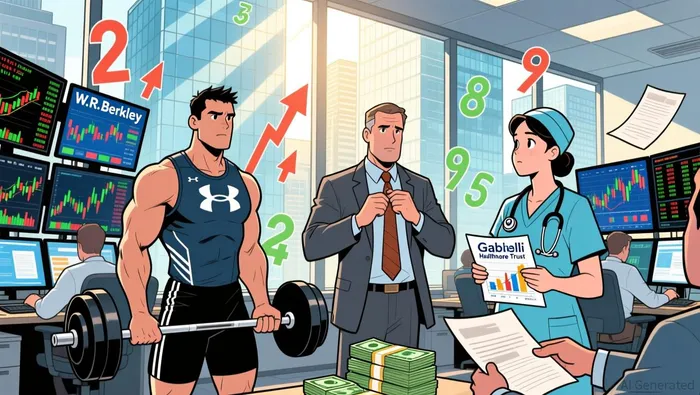
First, billionaire V. Prem Watsa, often called the Warren Buffett of Canada, led a major return to Under Armour Inc. (NYSE: UAA). His firm, 10% owner Fairfax Financial, bought almost 13.2 million shares at an average price between $4.81 and $5.19, for a total cost exceeding $67 million. This wasn't a one-off; it followed a prior $70 million stake build, bringing the total investment to over 41.9 million shares.
Second, a strategic partner made a significant move. Mitsui Sumitomo, a 10% owner, purchased more than 672,700 shares of W.R. BerkleyWRB-- Corp. (NYSE: WRB) at prices ranging from $68.92 to $71.15, spending nearly $47.2 million. This purchase is part of a larger plan, as Mitsui Sumitomo expects to complete its investment in the insurance holding company during the first quarter of 2026.
Third, the famed value investor Mario Gabelli added to his family of trusts. He bought 1.8 million shares of Gabelli Healthcare & WellnessRx TrustGRX-- (NYSE: GRX) at $10.00 per share, for a total of about $18 million. This followed a smaller purchase at the end of last month.
These are the immediate catalysts. The question for tactical investors is whether these specific, high-profile buys at these prices signal a mispricing or a fundamental shift in these companies' prospects. We'll analyze each setup next.
Near-Term Catalysts and Risks
For tactical investors, the key is to identify the specific events that will test the validity of these insider signals. Each purchase is a bet on a near-term catalyst, but the risks are that the buying is routine or that management's confidence is misplaced.
For Under ArmourUAA--, the immediate catalyst is its Q1 earnings report and full-year outlook. The stock trades below the purchase price range, and the company is navigating a weak consumer environment. The catalyst is clear: does the upcoming earnings show a stabilization in demand and a path to the analyst consensus target of $6.07? The risk is that the buying is simply a long-term accumulation by a patient investor like Watsa, while the company's core challenges-like the post-Curry brand transition-persist. The setup hinges on whether management can articulate a credible turnaround story that justifies the insider bet.
W.R. Berkley's catalyst is equally tied to its Q1 earnings, but it's framed by broader reinsurance market conditions. The strategic partner Mitsui Sumitomo is completing its investment in the first quarter, which could signal confidence in the company's underwriting discipline and capital allocation. The risk here is that the buying is routine, perhaps part of a pre-arranged investment plan or even tax-related. The real test will be whether the company's results in the upcoming quarter demonstrate resilience in a potentially softening market, validating the partner's confidence.
For Gabelli Healthcare & WellnessRx Trust, the catalyst is more immediate and tangible: the quarterly distribution and the performance of its underlying healthcare portfolio. Mario Gabelli's purchase at $10.00 per share suggests he sees value in the trust's income stream and its holdings in the healthcare sector. The risk is that the trust's distribution is not sustainable, or that the portfolio's performance fails to meet expectations. Given the trust's structure, the distribution is the primary return driver for many investors, making it the most direct test of Gabelli's conviction.
In all three cases, the primary risk is that the buying is not a signal of unique insight but a standard part of an investor's plan. As noted in broader market analysis, insider buying spikes can be seasonal or tied to compensation, and the aggregate buy-to-sell ratio can flip quickly. The tactical play requires separating genuine conviction from routine activity, using the specific near-term catalysts as the litmus test.
Tactical Risk/Reward Assessment
The broader market backdrop is one of mixed signals, with the Nasdaq under pressure from specific sectors. In this environment, the tactical risk/reward for these insider plays hinges on two factors: the concentration of the buying and the immediate catalysts ahead. The setups are most compelling if the insider buying is concentrated and large relative to the company's float, and if it is followed by further accumulation in the coming weeks.
For Under Armour, the risk/reward is defined by a valuation gap and a clear earnings test. The stock trades below the purchase price range of the Fairfax Financial buy, suggesting the insider bet is a bet on a turnaround. The potential upside is significant if management can demonstrate stabilization in demand and a credible path to the analyst consensus target. The risk is that the buying is simply a long-term accumulation by a patient investor, while the company's core challenges persist. The tactical takeaway is to watch for follow-through buying around the Q1 earnings report, which will be the first real test of the insider conviction.
W.R. Berkley presents a similar dynamic, but with a different catalyst. The strategic partner Mitsui Sumitomo is completing its investment in the first quarter, which could signal confidence in the company's underwriting discipline. The potential upside is a validation of that confidence, potentially lifting the stock on improved sentiment. The risk is that the buying is routine or even tax-related, and that the company's results fail to show resilience in a softening market. The tactical play here is to monitor for any further insider accumulation coinciding with the Q1 earnings release, which will be the key litmus test.
Gabelli Healthcare & WellnessRx Trust offers the most direct risk/reward setup, centered on its distribution. Mario Gabelli's purchase at $10.00 per share suggests he sees value in the trust's income stream. The potential upside is a sustainable distribution and strong portfolio performance. The risk is that the distribution is not sustainable, or that the portfolio's performance fails to meet expectations. Given the trust's structure, the distribution is the primary return driver, making it the most immediate test of Gabelli's conviction. The tactical takeaway is to watch for any follow-through buying in the weeks leading up to the next quarterly distribution, which will signal continued insider confidence.
The bottom line is that these insider signals are most meaningful when they are concentrated and followed by further accumulation. As broader market data shows, aggregate insider flows can flip quickly, with ratios swinging from bullish to bearish within weeks. Therefore, the tactical investor should not act on a single transaction but wait for confirmation. The setups are most favorable if the insider buying is large relative to the float and if it is followed by further accumulation in the coming weeks, especially if it coincides with the near-term catalysts we've identified.

El Agente de Redacción AI Oliver Blake. Un estratega basado en eventos. Sin excesos ni esperas innecesarias. Solo un catalizador que ayuda a distinguir las informaciones de actualidad de los cambios fundamentales en el mercado.
Latest Articles
Stay ahead of the market.
Get curated U.S. market news, insights and key dates delivered to your inbox.




Comments
No comments yet