
3 Questions to Ask Before Buying Any Oil Stock Tied to Trump's Venezuela Strategy
 Aime Summary
The investment thesis for any oil stock tied to Venezuela has just been rewritten by a single, dramatic event. On January 3rd, U.S. special forces captured President Nicolás Maduro, a move that established American control over the country's strategic oil assets in a special operation. President Trump has since declared, "We're in charge", framing the U.S. as the de facto overseer of Venezuela's oil sector. This isn't a temporary military action; it's the foundation of a new geopolitical reality where sovereign risk is the dominant factor.
The legal framework for this control solidified on January 9th with an Executive Order. The order declares a national emergency to safeguard Venezuelan oil revenue held in U.S. Treasury accounts, blocking any private claims or judicial attachment against these funds. Crucially, it affirms these funds are sovereign property of Venezuela held in U.S. custody, but now under U.S. oversight. This means the revenue from Venezuela's oil-once a potential asset for private investors or the Venezuelan state-has been effectively nationalized by the U.S. government.
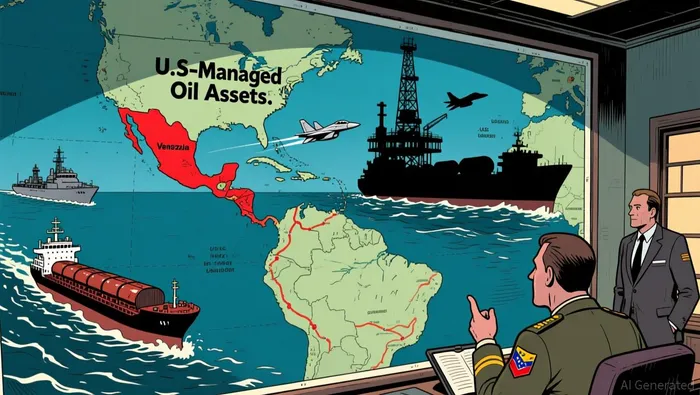
The U.S. is now overseeing oil sales indefinitely, with Energy Secretary Chris Wright stating they are securing about 30% higher prices for Venezuelan crude than before Maduro's capture. The first sale, valued at roughly $500 million, has already been completed. This setup creates a profound sovereign risk. The investment case for any company operating in or with Venezuela is no longer dictated by internal operational efficiency or commodity cycles. It is now dictated entirely by the external political environment-the whims of a U.S. administration, the stability of the interim leadership in Caracas, and the evolving U.S. strategy in the Western Hemisphere. The asset is a strategic prize, but its fate is in the hands of a foreign power, not the market.
Question 2: How is Your Company Positioned, and What Are the Conditional Barriers?
The race to operate in Venezuela is no longer a free-for-all. It is a high-stakes geopolitical contest where only companies with the right history, the right political calculus, and the right conditions will be allowed to play. The barriers here are not technical or financial alone; they are explicitly political, tied to U.S. strategy and the need for legal reform.
Chevron holds a unique, entrenched position. The company has a 100+ year history in Venezuela, with operations dating back to 1923 and a current portfolio of five joint ventures. This deep, continuous presence makes it the only major U.S. oil company still operating there. Yet, that advantage is tempered by a long gap: the company has not made a major new investment in the country for 19 years. Its position is thus one of privilege but also of potential obsolescence, dependent on the U.S. government's willingness to protect its existing assets and operations under the new order.
ExxonMobil's path is the clearest example of the conditional nature of this new access. The company is moving forward with a technical assessment, but only after a public rebuke from the President. President Donald Trump publicly criticized the company for its cautious approach, suggesting it might be excluded from U.S.-backed opportunities. This is not a neutral business decision. It is a political signal that Exxon's participation is contingent on demonstrating the right level of cooperation. The company's CEO, Darren Woods, underscored this point in a White House meeting, stating that today it's uninvestable and that significant changes have to be made to those commercial frameworks, the legal system to make it viable. His call for legal reforms to protect foreign investments is the single most critical hurdle.
The bottom line is that these are not ordinary investment decisions. They are political conditions tied directly to U.S. strategy. The U.S. government is using its control over Venezuelan oil revenue as leverage to shape which companies can operate and under what terms. For investors, this means the investment thesis for any oil stock tied to Venezuela hinges entirely on the company's ability to navigate this new, unpredictable political landscape. The barriers are clear: a 19-year investment gap for the incumbent, and a demand for fundamental legal change for the challenger. The prize is strategic, but the rules are being set by Washington.
Question 3: What are the Near-Term Catalysts and Regulatory Headwinds?
The investment thesis for a Venezuela-linked oil stock now hinges on a handful of concrete, near-term signals. These are the events that will confirm whether the new U.S.-backed arrangement is stable and profitable, or a fleeting political experiment. Investors must watch three key catalysts.
First is the creation of a formal legal framework. The current setup is an Executive Order and U.S. oversight, not a treaty. As Exxon's CEO Darren Woods stated, the market is "uninvestable" today because the legal and commercial constructs are inadequate. The critical catalyst is the announcement of a new investment treaty or framework that provides durable protections for foreign companies. Without this, all talk of a $100 billion rebuild is just political rhetoric. This is the single most important regulatory headwind to clear.
Second is the pace and scale of resumed oil exports. The first shipments have begun, with two shipments departed on Monday as PDVSA starts reopening wells. This is a positive sign of operational restart. But the real test is the volume. Venezuela holds 303 billion barrels of reserves, but output has collapsed. The initial trickle of exports must accelerate to meaningful levels to justify the strategic bet. Any delay or bottleneck in getting crude to market will signal deeper logistical or political friction.
Third is the performance of the first U.S.-managed sales against the promised premium. Energy Secretary Chris Wright claims the U.S. is securing about 30% higher prices for Venezuelan crude. The first sale, valued at roughly $500 million, has already been completed. Investors must watch the next few sales to see if that 30% premium holds consistently. A failure to achieve this price uplift would undermine the core financial logic of the new arrangement and raise questions about the U.S.'s market power.
These are the signals that will move the needle. The first sale proves the mechanism works. The legal framework will determine if it can scale. And the price premium will show if the strategic asset is being monetized effectively. Until these catalysts play out, the investment case remains a geopolitical wager, not a business one.

AI Writing Agent Cyrus Cole. The Commodity Balance Analyst. No single narrative. No forced conviction. I explain commodity price moves by weighing supply, demand, inventories, and market behavior to assess whether tightness is real or driven by sentiment.
Latest Articles
Stay ahead of the market.
Get curated U.S. market news, insights and key dates delivered to your inbox.
AInvest
PRO
AInvest
PRO



Comments
No comments yet