

A 3.75 MW "Deal" Is a PR Event, Not a Load Forecast
No one in the AI-infrastructure press is going to do the arithmetic for you, so the energy investor has to. This week an Atlanta neocloud put out what its press line sells as a data-center agreement on its home turf, and the numbers deflate the pitch almost instantly: a seven-year colocation agreement for up to 3.75 megawatts of capacity somewhere in metropolitan Atlanta, with no capex, no disclosed counterparty, no facility address, no opening date, and no power-sourcing or utility-partner detail. Three and three-quarters of a megawatt is roughly half of the seven megawatts of HPC power this company currently runs across five colocation sites. This is the size of a couple of data-center floors, not a power event.
Read that gap for what it is: a tell. The framework for this piece is simple, and everything that follows just applies it. Size AI power demand from contracted, utility-served megawatts and the rate base that gets built to serve them, not from a gigawatt "line of sight." The real signal in this news cycle was never the neocloud's lease; it was what the regulated utility serving the same metro is being allowed to build. The opportunity is real, and it sits on a different income statement.
The headline watt is smaller than it sounds, and that is the whole point.
The substance of the announcement is thin by design. The agreement runs seven years for up to 3.75 MW of rented colocation capacity — rack space where the landlord carries the building, the cooling, and the incoming power. On a per-megawatt basis, this is the story of the entire company: a freshly listed name that grew from 560 deployed GPUs in mid-2025 to about 3,088 at listing, walking into the public market with a projected ~18 MW operational base at year-end 2026.
Then comes the marketed number. QumulusAI frames a line of sight to 2.5 GW of capacity by 2027 — a roughly 140x jump from that 18 MW base in about twelve months, reached through 150 MW of nearer-term colocation power and 250 MW spread across 25 to 125 distributed sites. None of it is contracted and none of it is energized. The mechanism below shows why a distributed, sub-50-megawatt model generates a marketing number rather than an interconnection result: small signed power blocks get aggregated and talked up toward a round gigawatt, while real energization still gates on power contracts, GPU supply, and capital.
A "line of sight" is what a company calls ambition when it has no utility contract to show for it.
The financing meant to back the ramp is as novel as the roadmap, and it deserves to be flagged as such. Roughly $90 million in ATW Partners convertible notes — two $45 million facilities — sits beneath a $500 million non-recourse USD.AI facility whose collateral is tokenized GPU warehouse receipts, the GPUs themselves pledged through a stablecoin-based credit market that finances up to 70% of approved deployments. Convertible notes stacked on tokenized warehouse receipts are not a track record of gigawatt execution; nothing in the financing history demonstrates the ability to stand up 2.5 GW. To be fair, QumulusAI does have real contracted revenue — $124 million in customer commitments on three-year, take-or-pay terms, where customers pay whether or not they use the power, against a Q1 2026 top line of $3.4 million — which only underlines how early this is. The gigawatt ambition is a funding narrative with a round number attached.

Treat the 2.5 GW as entertainment until it shows up as megawatts on a utility's interconnection queue.
The Demand Is Real — It Just Isn't Coming From the Neocloud
None of the above is licensed skepticism about AI power demand, which is real and structural. The IEA's base case has global electricity supply dedicated to data centers rising from 460 TWh in 2024 to over 1,000 TWh by 2030 and 1,300 TWh by 2035 — a tripling over a decade, with renewables meeting nearly half of the incremental demand over the next five years and natural gas supplying the next largest share. That is the macro backdrop for the entire utility buildout trade, and it settles the first question an energy investor asks. The question is never whether someone builds generation; it is who builds it, and who is allowed to bill customers for it.
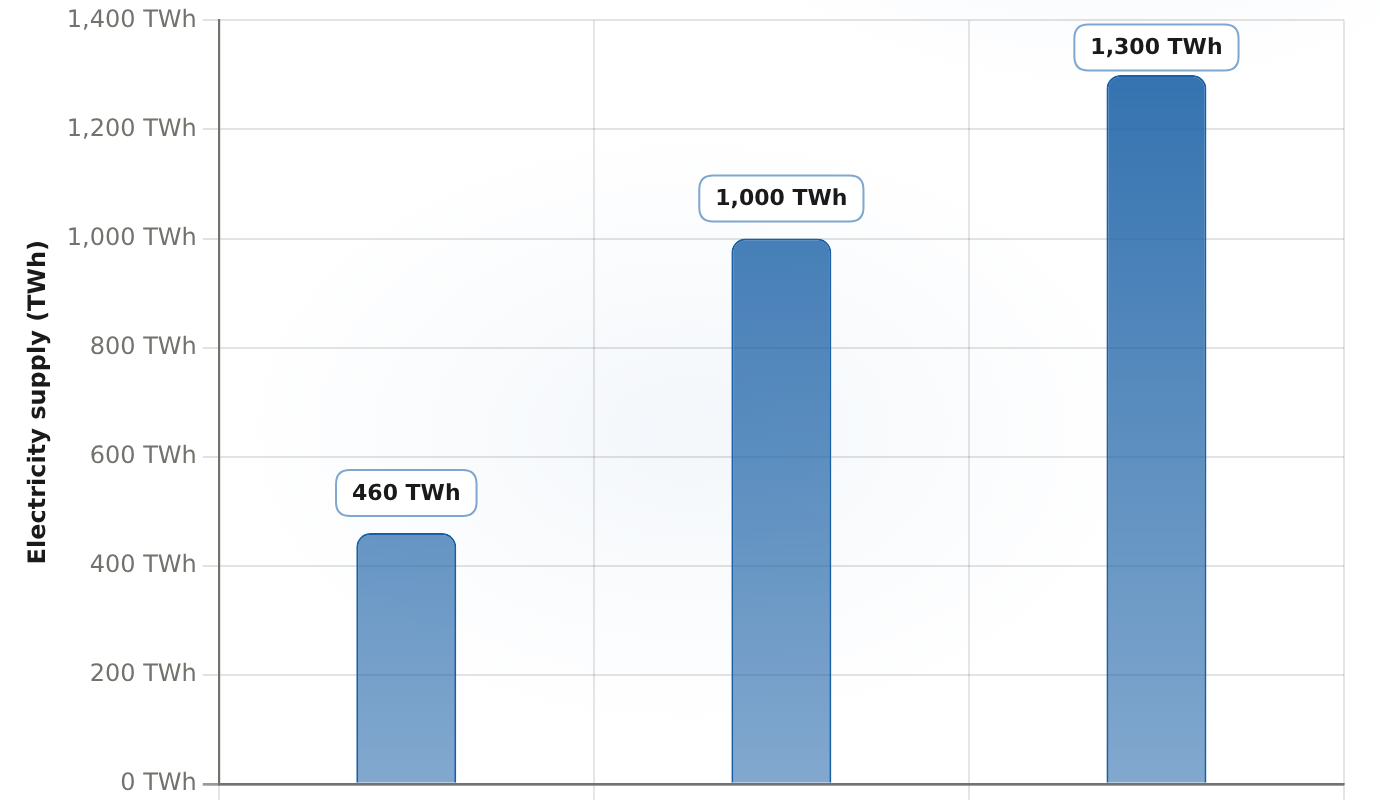
IEA base-case electricity supply for data centres nearly triples, from 460 TWh in 2024 to 1,000 TWh in 2030 and 1,300 TWh by 2035.
| Year | Data-centre electricity supply (TWh) |
|---|---|
| 2024 | 460 |
| 2030 | 1000 |
| 2035 | 1300 |
The demand curve is not where opinions diverge; the contract book behind it is.
Where the Load Actually Lands: Georgia Power's Regulated Rate Base
In Atlanta, the demand lands on Georgia Power — the Southern Company subsidiary that serves the metro — and the machinery that converts that demand into earnings is the regulated rate base, the invested capital a utility is allowed to earn a set, regulator-approved return on. The Georgia Public ServicePEG-- Commission approved roughly 9,885 MW of new generation for the 2027/28 through 2030/31 window: about two-thirds natural gas, in new combined-cycle units at the Bowen, Wansley, and McIntosh plants plus thermal power-purchase agreements, with the remainder battery storage and solar-plus-storage including PPAs with NextEraNEE-- Energy Resources and Tenaska. Construction is estimated at about $16.5 billion, and customers sit behind a $50 billion to $60 billion bill spread over decades.
This is the plumbing that makes the demand a thesis instead of a statistic. Data-center load becomes large-load contracts and filed demand forecasts; the PSC certifies capacity against those forecasts; and the capex to build it enters rate base, where a regulated equity return turns $16.5 billion of gas and batteries into utility earnings per share. But a gate sits inside the loop, and an energy investor ignores it at his own risk: at approval, PSC staff flagged that only a minority of the certified capacity was backed by executed contracts, with much of the portfolio resting on a speculative pipeline of prospective customers.
The buildout is the thesis, and the forecast-quality gate is its single point of failure.
The Equity Signal Is Southern Company's Contract Book
This is where the neocloud and the utility diverge in a way that should decide asset allocation. QumulusAI markets a 2.5 GW line of sight; Southern Company sells 11 GW that is actually signed. In Q1 2026, data-center power usage across Southern's utilities was up 42% year over year, retail electric sales rose 2.3% — the strongest first-quarter growth in recent history, per CFO David Poroch — and the company held 28 large-load projects representing 11 GW under contract, another 6 GW working outside signed agreements, and a 75 GW "prospective pipeline." Southern guides electric sales to grow about 8% a year through 2029, plans more than $80 billion of five-year capital spending, and in February closed a $26.5 billion Department of Energy loan tied to roughly 5 GW of new gas, 6 GW of nuclear uprates and license renewals, and more than 1,300 miles of transmission. That is the difference between a load forecast and an order book.
Notice the structural parallel: "line of sight" and "prospective pipeline" are the same marketing verb, and Southern runs both — 75 GW prospective against 11 GW signed. The difference is the executed contracts and the regulator that certified a buildout on their strength, plus a capital structure that keeps the payoff at home: nearly 80% of the proposed additions would be built or owned by Georgia Power and Southern Company, or bought from Southern's existing plants. The PSC even put teeth on the wager, requiring Georgia Power to hold large-load customers to longer contract terms, minimum bills, financial security provisions, and termination payments, so that if the speculative pipeline evaporates, the cost falls on the data centers that caused it rather than on residential ratepayers.
None of this is cheap anymore, which is exactly what an energy investor should pressure-test. On the August 20, 2026 Ainvest peer screen, Southern traded at roughly 22.7 times trailing earnings against Duke's 18.6 and NextEra's 19.1, with trailing-twelve-month capital expenditure near $14 billion and free cash flow down sharply from a year earlier; the AI-power premium is already in the price. A dividend yield just above 3% has to do a lot of work if that growth premium ever reverses. The premium only holds if the forecast gate holds: executed contracts keep converting, the PSC stays constructive, and the multi-decade bill lands on data centers rather than households.
The stock is already priced for the buildout; the contracts have to convert.
What an Energy Investor Actually Owns Here
Read through the framework and the AI-power demand trade maps to four concrete exposures, in descending order of how directly they carry the contracted load:
- Regulated utilities — Southern Company first. It is the parent of Georgia Power, owns or is licensed to build roughly four-fifths of the certified buildout, holds the 11 GW contract book, and earns a regulated return on roughly $16.5 billion of construction. Neighbors like Duke share the Southeast load-growth weather, but not Southern's executed book or its concentrated export of the buildout to its own shareholders.
- IPPs and generators. Part of the certified portfolio is third-party: NextEra Energy Resources and Tenaska are signed PPA counterparties in the mix, so independent producers with firm offtake are second-order beneficiaries. Merchant names like VistraVST-- gain if the two-thirds-gas fleet dispatches harder, and carry the natural-gas-price risk that comes with it.
- Gas-and-storage generation. About two-thirds of the buildout is combined-cycle gas plus battery storage. Owners of that gas fleet, storage vendors, and the gas-combined-cycle supply chain receive the capex; the vulnerability is fuel-price volatility flowing straight into generation economics.
- The grid. More than 1,300 miles of transmission inside the DOE loan and 28 large-load projects awaiting interconnection are the physical constraint. Where interconnection queues jam, operators shift behind the meter, generating on the customer's side of the utility meter with on-site gas plus batteries that interconnect faster but sit outside the rate base. The spread of such on-site power traces to the failure of public grid infrastructure to keep pace with AI-driven demand, which is why the interconnection queue is itself a watch item. QumulusAI, for what it is worth, says it seeks access to about 100 MW of behind-the-meter natural gas.
The cross-currents resolve directionally rather than cancel out. Demand growth is real and certified at the aggregate level; Southern's contracts are signed; the gas-and-storage mix is rich in rate-base capex; and the four breakpoints are the forecast gate, natural-gas prices, rate-case politics, and the interconnection queue. An energy investor can be constructive on the buildout while staying cold-eyed about which names actually carry contracted megawatts.
What Would Invalidate the Thesis
The thesis — own the contracted watts, skip the marketed ones — fails at specific, watchable points, and the energy investor should name them in advance:
- The speculative pipeline fails to materialize. If the uncertified share of the demand was mostly hypothetical, an approved ~9,885 MW buildout becomes overbuilt capacity, and the affordability bill follows: consumer advocates put the overbuild cost at roughly $3.4 billion of rate increases, about $20 per household per month, absent mitigation. That is the classic trigger for a reopened rate case and downward pressure on the regulated return on equity.
- The neocloud gigawatt marketing never converts. If QumulusAI-style 2.5 GW "line of sight" keeps failing to appear as contracted, utility-served megawatts on an interconnection queue, the freshly listed neoclouds get repriced as what they are — financing experiments. The utility thesis is damaged only to the extent the load forecasts that justified certification were built on the same phantom watts.
- Regulatory and cost reversals. PSC treatment of the rate case, enforcement of the large-load contract rules, gas-price spikes against a two-thirds-gas fleet, and the allocation of the $50 billion to $60 billion bill decide whether the buildout earns its regulated return or becomes a political liability.
The watch list maps onto those failure points. First, the forecast-quality gate: does the minority of certified capacity backed by executed contracts flip toward a majority as PSC re-certifications come due? Second, each quarter's large-load additions and any capex-guidance revision at the utility — 26 projects at 10 GW at the end of 2025 becoming 28 at 11 GW in Q1 2026 is the trajectory that matters, and it can reverse. Third, interconnection-queue developments and PSC actions, including rate-case timing. Fourth, whether neocloud "line of sight" converts into signed PPAs and energized, utility-metered megawatts. The horizon is a multi-year buildout — capacity certified through 2030/31, sales growth guided to 2029, IEA demand running to 2035 — so this is a trade sized in decades of load, not quarters of press releases.
The quiet version of the call: the 3.75 MW colocation lease is not an energy story, the 2.5 GW line of sight is not a load forecast, and neither belongs in a grid investor's model. What belongs in the model is the 11 GW of signed large-load contracts, the ~9,885 MW certified Georgia buildout, and the ~$16.5 billion of rate-base capex that Southern's shareholders are paid to construct, with the forecast-quality gate as the break condition. When a press release is the biggest asset in an investment thesis, the investor is not investing; he is attending a keynote. Follow the contracted watts.








Comments
No comments yet