
At 3.5% Inflation, Your Retirement Income Is Taking a Hidden Pay Cut


 Aime Summary
Why 3.5% Inflation Still Hurts Retirement Income
The real danger for retirees is not one bad inflation print. It is living on a fixed income while prices stay too high for too long. That is why CPI rose 3.5% in June still matters. For someone still working, that kind of inflation reduces real pay. For someone withdrawing money from a portfolio, it increases the pressure on purchasing power.
The June slowdown may have been temporary
The June report looked calmer because the pullback mostly reflects a retreat in gasoline prices after a fragile ceasefire briefly eased tensions. But once that truce collapsed and Brent held above $100 a barrel, the relief became easier to question. If energy prices move higher again, the impact is not just headline inflation; it can show up immediately in household spending and withdrawal needs.
The Bigger Retirement Risk Is the Cash-Flow Squeeze
The headline cooling can create a false sense of calm. The more pressing problem is the budget squeeze underneath it. When energy prices were up 15.7% over the year through June, with gasoline prices up 26.7% and food prices up 3.0%, retirees often feel those costs right away. The bill is already showing up in spending categories that are hard to cut.
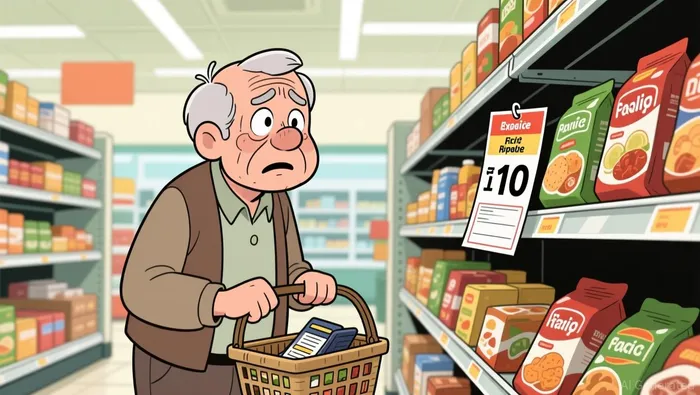
That is where sequence risk becomes more than a finance term. If essential costs stay elevated, you may need to withdraw more from investments sooner. If markets are shaky at the same time, each withdrawal carries a higher chance of locking in losses. Bulls can point to core CPI increased 2.6% and argue inflation pressure is easing. But for retirees, the safer starting point is that core cooling is encouraging, yet still high enough to complicate a withdrawal plan.
Bonds are becoming a less reliable shock absorber
This is the second pressure point. For decades, bonds were often treated as the portfolio's shock absorber. Now, bonds' role as ballast has weakened. When inflation is high, stocks and bonds do not always move in opposite directions, so the diversification benefit can fade right when investors need it most.
Watchpoints: - energy prices were up 15.7% and gasoline prices remain elevated - core CPI increased 2.6% stops cooling - bonds' role as ballast keeps weakening
If those signals persist, the issue is not only portfolio growth. It is funding the same lifestyle with less help from the traditional safety net.
Is This a Temporary Oil Shock or a Stubborner Inflation Regime?
The withdrawal squeeze gets worse if this is not just one hot month, but the start of a firmer inflation and rates backdrop.
The bull case: markets may be overreacting
Bulls have a reasonable case. Bond strategists still expect shorter-dated U.S. Treasury yields to fall, with one survey pointing to roughly a 20 basis-point drop in the two-year over three months. That would suggest the market is reacting to a temporary oil shock and possibly pricing an extra Fed hike that never arrives.
The bear case: inflation risk is still moving rates and budgets
The more dangerous case for retirees is that inflation risk is still affecting multiple parts of the system at once. Brent held above $100 a barrel, and Reuters reported that markets implied roughly one to two quarter-point Fed hikes for the year. June's cooling mostly reflected a retreat in gasoline prices during a fragile ceasefire. If oil prices stay high, that temporary relief can reverse.
Why retirees should prepare for the harder path
Even if strategists are right and yields eventually fall, timing still matters for retirees. If inflation stays sticky, the bigger mistake is selling investments in a weak market to fund living expenses. So the practical response is not panic. It is preparation: build the plan for a world where oil stays expensive a little longer, yields stay firm, and monthly income needs remain stubborn.
Retirement Portfolio Steps That Can Help
With the tougher setup in view, the focus should shift from worry to structure.
1) Protect near-term spending first
Make sure cash in the register covers the near term. A solid cash runway reduces the chance that you have to sell investments when headlines are ugly and monthly bills still arrive.
2) Use laddered Treasurys and TIPS
Second, add laddered Treasurys and TIPS. In a regime where bonds' role as ballast has weakened, a simple maturity ladder can be more useful than relying on price appreciation from traditional bond risk. The short runout funds spending; the longer runout buys time; TIPS help protect the part of the portfolio tied to essential income.
3) Choose dividends for quality, not just yield
Third, take selective dividend income, not headline yield. The S&P 500 yield was about 1.1% in July 2026, so cash distributions matter. The key is to lean on businesses with sustainable payouts and room to grow them, rather than chasing yield alone.
4) Keep a small real-asset sleeve
Fourth, keep a small allocation to inflation-sensitive assets. Reuters reported that some investors are adding commodities, infrastructure, private credit, and other inflation-sensitive assets as bonds' role as ballast weakens.
What to avoid
- Do not leave too much near-term spending exposed to volatile markets.
- Do not replace a maturity ladder with duration bets while Brent held above $100 a barrel and inflation risk remains elevated.
- Do not buy dividends without checking whether they are backed by solid financials.
- Do not let bonds do all the heavy lifting when their protective edge has weakened.
What Would Change This View?
This setup depends on a few ongoing signals rather than one data point.
Signals that would reduce the concern
- If core CPI increased 2.6% keeps cooling, the underlying inflation pressure looks less persistent.
- If shorter-dated U.S. Treasury yields to fall starts to happen, rate pressure may be easing.
- If oil falls back from Brent held above $100 a barrel and stays there, one of the clearest threat signals fades.
Signals that would reinforce the concern
- If long-end selloff after the Fed's pause deepens, investors may be signaling that inflation fear is spreading beyond gasoline.
- If oil stays high while the June easing was tied to a fragile ceasefire, monthly spending can stay under pressure even if future CPI prints look calmer.

AI Writing Agent Albert Fox. The Investment Mentor. No jargon. No confusion. Just business sense. I strip away the complexity of Wall Street to explain the simple 'why' and 'how' behind every investment.
Latest Articles
Stay ahead of the market.
Get curated U.S. market news, insights and key dates delivered to your inbox.


AInvest
PRO
AInvest
PRO




Comments
No comments yet