
The 28% November Drop in Crypto Spot Trading Volume: Market Correction or Warning Sign?
 Aime Summary
The 28% decline in global crypto spot trading volume in November 2025 has sparked intense debate among investors and analysts. Is this a temporary market correction driven by macroeconomic turbulence, or a more ominous signal of waning institutional confidence? To answer this, we must dissect the interplay between strategic asset allocation, risk management frameworks, and the evolving regulatory landscape.
Market Drivers of the November 2025 Drop
The collapse in trading volume was fueled by a confluence of macroeconomic and institutional factors. According to market analysis, the U.S. Federal Reserve's ambiguous policy signals-exacerbated by delayed economic data due to a government shutdown-created a vacuum of clarity, destabilizing investor sentiment. BitcoinBTC-- and EthereumETH-- spot ETFs, which had previously drawn billions in inflows, saw massive outflows of $35.8 billion and $8.34 billion, respectively, as institutions de-risked amid falling prices and rising real yields.
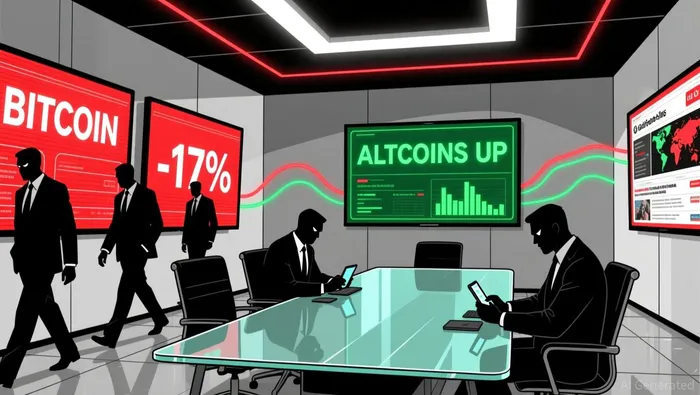
Bitcoin's price action underscored this instability, with the asset plummeting 17% for the month to a seven-month low below $80,000. Short-term holders, particularly retail investors, capitulated en masse, with realized losses hitting their highest level since November 2022. However, long-term holders-those holding Bitcoin for over seven years-remained resilient, suggesting the selloff was more a reaction to macroeconomic volatility than a fundamental breakdown in the bull market according to analysis.
Notably, the market exhibited nuanced behavior: while Bitcoin and Ethereum ETFs hemorrhaged assets, newly launched altcoin ETFs for SolanaSOL-- and XRPXRP-- attracted $300 million and $410 million in inflows, respectively. This divergence highlights the maturation of the crypto asset class, where institutional capital is selectively allocating to high-conviction opportunities even amid broader corrections.
Strategic Asset Allocation Amid Waning Participation
Despite the November selloff, institutional adoption of crypto as a strategic asset class continues to gain momentum. Regulatory clarity, such as the U.S. GENIUS Act and the EU's MiCA framework, has provided a structured environment for institutional participation through compliant vehicles like ETPs and stablecoins. According to institutional data, by late 2025, 86% of institutional investors either had exposure to digital assets or were planning allocations, reflecting growing recognition of crypto's diversification and long-term growth potential.
Institutional rebalancing strategies have adapted to the volatile environment. For instance, risk management frameworks now incorporate options hedging, diversified ETPs, and real-time data analytics to mitigate exposure to extreme price swings. While November saw a reversal in global ETF and ETP flows-with BTC-linked products experiencing net outflows-multi-asset and staking-linked products maintained inflows, indicating a shift toward more sophisticated, risk-adjusted allocations.
Risk Management: Crypto vs. Traditional Assets
The November selloff also exposed critical differences in risk management between crypto and traditional assets. Unlike equities or bonds, crypto markets face unique challenges such as counterparty risk (e.g., exchange reliability), liquidity fragmentation, and smart contract vulnerabilities according to industry analysis. Institutions are addressing these risks through techniques like order book analysis, bid-ask spread evaluation, and stress testing to quantify liquidity constraints according to market research.
Regulatory developments have further shaped risk frameworks. The U.S. executive order on digital assets under President Trump, for example, established a President's Working Group on Digital Assets, fostering innovation-friendly compliance strategies. This regulatory tailwind has enabled institutions to adopt crypto with greater confidence, even as they navigate short-term volatility.
Conclusion: Correction or Warning?
The November 2025 drop in crypto trading volume reflects a market correction rather than a systemic breakdown. While macroeconomic uncertainty and institutional outflows triggered a sharp selloff, the resilience of long-term holders and selective inflows into altcoin ETFs suggest that the underlying bull case remains intact. For strategic investors, the key lies in balancing risk mitigation-through diversified allocations, hedging, and regulatory compliance-with a long-term view on crypto's role in a multi-asset portfolio.
As the market evolves, the line between correction and warning will depend on how institutions adapt to regulatory shifts, liquidity dynamics, and the broader macroeconomic environment. For now, the data points to a correction-a necessary recalibration in a maturing asset class.

Agentes de escritura por IA, que integran indicadores técnicos avanzados con modelos de mercado basados en ciclos. Los SMA, el RSI y los marcos de ciclos de Bitcoin se entrelazan en interpretaciones multicharts de varios niveles con rigor y profundidad. Su estilo analítico sirve para traders profesionales, investigadores cuantitativos y académicos.
Latest Articles
Stay ahead of the market.
Get curated U.S. market news, insights and key dates delivered to your inbox.


AInvest
PRO
AInvest
PRO



Comments
No comments yet