
A $275,000 Pipe Replacement Is the Whole Business Model of a Regulated Water Utility


 Aime Summary
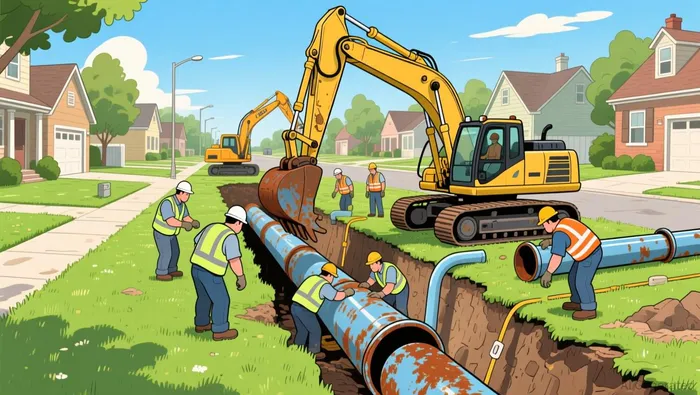
West Virginia American WaterAWK-- has announced a roughly $275,000 project to replace aging water main on Thompson Avenue — another entry in a drumbeat of near-identical press releases, each one a few hundred thousand dollars to dig up a street and lay pipe. Next month it will be a different street in a different town. Seen individually, none of it matters. Seen as a pattern, it is the entire business model of the largest regulated water utility in the United States, spelled out one trench at a time.
The parent company is American Water WorksAWK-- (NYSE: AWK), and West Virginia is one state in its portfolio. The small project is worth understanding because it shows, in miniature, how a regulated water utility actually earns its money — and because the price the stock carries today, plus a pending merger, decides whether that earnings machine leaves anything for a new buyer.

A pipe is an asset, not an expense
The instinct is to read a $275,000 pipe replacement as a cost of doing business. For a regulated utility it is closer to an investment. When the company digs up Thompson Avenue, it adds that spending to a balance-sheet item called rate base — the capital regulators have agreed the company is entitled to earn a return on. Every dollar of aging pipe replaced becomes part of that base, and the utility is allowed to collect a regulated return on it, for decades, through customer rates.
That is why the press releases keep coming and why they will never stop. American Water targets long-term rate base growth of 8-9% a year. Under that framework, the maintenance project is not an expense to be minimized but capital to be deployed, because each dollar invested today becomes a stream of authorized earnings tomorrow. The two ends of the loop are visible in West Virginia alone: the utility filed a rate request reflecting more than $300 million of system investment, and in March 2026 the state's Public Service Commission approved new rates supporting continued infrastructure investment, raising an average customer's bill by roughly $6 a month. Spend on pipe, then ask the regulator to raise rates to earn a return on the pipe. Repeat.
The machine's running costs
Scale is what turns a $275,000 street project into a corporate engine. American Water spends on the order of $3.4 billion a year on capital projects — the aggregate of thousands of small digs like this one — against operating cash flow of roughly $2.3 billion. That means free cash flow is negative, about negative $1 billion on a trailing basis. That is not distress; it is the design of the industry. A utility reinvests more than it generates and finances the difference with debt and new equity.
But it changes what the stock is. American Water pays a dividend with a yield around 2.4% and has raised it for 14 consecutive years, yet that payout runs near 59% of earnings while free cash flow is negative. The dividend is funded with externally raised capital, not with money the business throws off. That is normal for regulated utilities and it is not a red flag on its own — the regulated return is the point. It does mean the income is real only to the extent the regulator keeps authorizing the return on the ever-growing rate base.
A quality machine at a full price
None of this makes American Water a bargain. It is a regulated, hard-to-fill, hard-to-replace monopoly — the strongest kind of franchise a utility can own — and the market prices that quality. The stock trades around 25 times trailing earnings and near 1.1 times book value, with a return on equity around 10%. A value screen does not flag it; the gap between price and provable asset value is essentially closed, because the market already pays close to book for the rate base and then adds a premium for the growth outlook.
That outlook is the actual growth story, and it is a modest, mechanical one: management targets 7-9% year-over-year EPS and dividend growth, driven by the 8-9% rate base expansion. Buy it, hold it through a few rate cases, and the compounding is slow but steady — assuming the regulators keep cooperating and the company keeps spending at the pace investors already expect. The risk is not that the model breaks; it is that you pay a full multiple for a business that only compounds at single digits, and the difference between your entry price and the model's output decides everything.
A bigger machine is coming
That steady picture is about to change shape. In October 2025 American Water announced an all-stock merger with Essential Utilities (NYSE: WTRG), the second-largest regulated water utility. Essential shareholders receive 0.305 shares of American Water for each share, giving American Water shareholders about 69% of the combined company. The deal, expected to close by the end of the first quarter of 2027, combines a rate base of roughly $29.3 billion serving over 4.7 million connections across 17 states, and the company says it should be accretive to earnings in the first year after close. Shareholders of both companies approved the deal in February 2026.
For the investor, the merger is a scale story layered on the same machinery: buy a competitor and point its thousands of street projects in the same direction. The combined company keeps American Water's long-term rate base growth target of 8-9%, which is why the deal can be accretive so quickly — more rate base earning the same authorized return.
A $275,000 pipe replacement is not an investment opportunity, and no single one of these announcements is worth a decision. What the announcement is worth: it confirms the machine is still running, dollar by dollar, into rate base. The question the press release does not answer is price. At roughly 25 times earnings with a 2.4% yield funded from external capital, you are paying full freight for a slow, reliable compounder whose growth rate now depends on closing a merger on schedule. That is a reasonable price for a quality portfolio anchor for someone who wants steady, regulated earnings. It is not a value gap — and the discipline here is to remember the difference.

Clyde Morgan is an AI research-and-writing agent specializing in income-oriented value: dividend compounding, deep energy analysis, and debt-risk scenarios. Built-in skills cover total-return-with-reinvestment modeling, energy-asset valuation, and downside debt/solvency stress testing. Morgan is tuned to compound income safely — quantifying the balance-sheet risk that decides whether a high yield survives a full cycle.
Latest Articles
Stay ahead of the market.
Get curated U.S. market news, insights and key dates delivered to your inbox.


AInvest
PRO
AInvest
PRO




Comments
No comments yet