
B-21 Raider: The Stealth Bomber Driving Aerospace Growth and Why Northrop Grumman Is the Key Play
The U.S. military's push to modernize its strategic bomber fleet is not just a defense priority—it's a goldmine for investors in aerospace and defense. At the heart of this transformation is the B-21 Raider program, a stealth bomber designed to counter 21st-century threats, particularly from China. For investors, the B-21 represents a multi-decade revenue stream, with Northrop Grumman (NOC) positioned as the sole prime contractor and a prime beneficiary of geopolitical tensions in the Indo-Pacific. Here's why this program—and this stock—deserve attention.
The B-21: A Program Anchored in Geopolitics
The B-21's development isn't just about replacing aging B-52s and B-2s. It's a direct response to China's military modernization, which has raised concerns about its ability to challenge U.S. power in the Western Pacific. The Pentagon's National Defense Strategy explicitly names countering China as its top priority, and the B-21's stealth and long-range strike capabilities are central to this mission.
Congress has backed this vision with cash. The FY2025 National Defense Authorization Act allocated $5.34 billion for the B-21 program, and FY2026 projections suggest a further $4.7 billion, with $2.35 billion from reconciliation funds to accelerate production. This funding isn't just about building planes—it's about sustaining a modern nuclear triad and deterring adversaries.
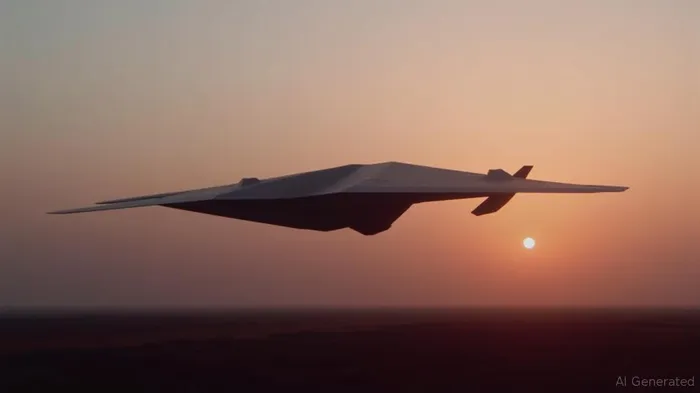
Northrop Grumman's Role: Short-Term Pain, Long-Term Gain
Northrop Grumman is the sole contractor for the B-21, a position that grants it a monopoly on a program expected to produce at least 100 aircraft, with some estimates pushing toward 250 units over its lifespan. But the path to profitability isn't smooth. In Q1 2025, the company reported a $477 million pre-tax charge tied to the first five production lots of the B-21. These losses stem from process reengineering to boost production rates and unexpected material cost surges. CEO Kathy Warden framed these as “one-time” adjustments to achieve 20 aircraft/year production by the late 2020s—a pace requiring a potential second manufacturing plant.
The trade-off? These upfront costs are designed to unlock $2 billion+ in annual revenue once production scales. Northrop's valuation metrics already reflect this bet. As of December 2024, its EV/EBITDA of 12.58 and P/E ratio of 17.26 (TTM) suggest the market isn't yet pricing in the program's full potential.
Catalysts to Watch: Production Milestones and Budget Politics
Investors should monitor two key catalysts:
1. Production Acceleration: The Air Force aims to begin full-rate production by 2027. If Northrop meets targets—like hitting 20/yr production by 2028—it could validate its cost-reduction strategy. A second manufacturing site, possibly in the Midwest, could be announced as early as 2026.
2. FY2026 Budget Outcomes: The Pentagon's $4.7 billion request for the B-21 is likely to pass, but reconciliation funds hinge on political gridlock. If Congress approves the reconciliation package, it could unlock an extra $4.5 billion to boost production beyond 100 aircraft.
Risks: Cost Overruns and Sentinal's Shadow
Northrop isn't without risks. Its Sentinel ICBM program (another major Pentagon contract) faces an $141 billion price tag, 81% over initial estimates, straining resources. While the company claims it's reworking Sentinel's design to reduce costs, delays or further overruns could divert cash from B-21 production. Additionally, geopolitical shifts—like a de-escalation in Indo-Pacific tensions—could weaken the urgency for bomber modernization.
Investment Thesis: Buy the Dip, Play the Long Game
Northrop Grumman's stock has stumbled in 2025, pressured by B-21 losses and Sentinel's woes. But for long-term investors, this is a buying opportunity. The B-21's $692 million per-unit cost (inflation-adjusted) and 25-year service life ensure steady cash flows. With a 10-year production timeline, the program's peak revenue years (2030–2040) are still ahead.
Valuation Takeaway: At an EV/EBITDA of 12.58, Northrop trades at a discount to peers like Lockheed Martin (LMT) and Raytheon (RTX), which hover around 15–20. If production milestones are met, this multiple could expand to 15–18x, lifting the stock by 20–40%.
Actionable Advice: Accumulate positions on dips below $350/share, with a $450–$500 target by 2028 if production targets are hit. Pair this with a 3–5 year holding period, and use near-term volatility (from quarterly B-21 updates) as buying opportunities.
Final Thought
The B-21 program isn't just a plane—it's the backbone of U.S. power projection for decades. Northrop's role here is irreplaceable, and while near-term losses are a speed bump, the runway ahead is long. For investors willing to look past quarterly noise, this is a rare chance to back a strategic, high-margin monopoly in a sector where geopolitical tailwinds are guaranteed.

Delivering real-time insights and analysis on emerging financial trends and market movements.
Latest Articles
Stay ahead of the market.
Get curated U.S. market news, insights and key dates delivered to your inbox.


AInvest
PRO
AInvest
PRO



Comments
No comments yet