
The 2028 Democratic Nomination: Why a 16% Market Price Isn’t Just a Number, It’s a Warning
 Aime Summary
Lead
The market for the 2028 Democratic presidential nomination is pricing a specific, left-wing candidate at just 16.2 cents on the dollar. This price appears to reflect a straightforward consensus on low viability, but it also embeds a complex web of recent primary shocks, ambiguous resolution rules, and structural liquidity dynamics. This article dissects the gap between the market’s implied probability and the path to a definitive settlement, arguing that the current price is as much a function of rule-based risk and low-information inertia as it is a genuine electoral forecast.
Event Definition
This market is a binary bet on whether a specific, named individual will win and formally accept the 2028 Democratic Party nomination for U.S. president. The core disagreement is not about a candidate’s ideological appeal, but about the viability of a populist-left figure breaking through the party’s institutional machinery. The market’s low price signals a strong consensus that this path is blocked, but the settlement hinges on a precise, time-bound event: an official acceptance by the 2028-11-07T00:00:00Z deadline.
Latest News & Information Increments
The most significant information shock came from the Michigan Senate primary, where progressive Abdul El-Sayed defeated moderate Haley Stevens, a candidate backed by $60 million in outside spending. This victory is widely interpreted as a seismic, leftward shift in the party’s base, forcing a reckoning with the viability of candidates campaigning on universal healthcare and halting military aid to Israel. Analysts explicitly link this outcome to the 2028 presidential landscape, identifying economic populism as a prerequisite for viability and naming Alexandria Ocasio-Cortez as a leading potential contender.
However, the news flow also contains a powerful counter-narrative. Despite El-Sayed’s win, betting markets reacted negatively, with the odds of Democrats retaining the Senate seat dipping by approximately ten points, as the candidate underperformed polls. This aligns with a Washington Post/Ipsos poll showing 55% of Americans would not consider a democratic socialist for president, suggesting limited general-election appeal. The effective information is therefore deeply mixed: a primary victory validates the left’s energy, while general election data and market reactions underscore its perceived ceiling. In this environment, the 16% price for a left-wing nominee reflects a market digesting a high-upside, low-probability event, not a simple dismissal.
Market Resolution Rules Analysis
The contract settles based on a “consensus of official Democratic Party sources” that a named individual has won and accepted the 2028 nomination. The primary source of truth is the party’s official channels, and the event must occur before a hard deadline. This framework moves beyond a simple vote count; it requires an affirmative, public acknowledgment of the win by the candidate and a unified, official confirmation from the party apparatus. The settlement is not triggered by media projections or candidate claims, but by a formal, institutional declaration.
Rule Risk Points & Disputed Scenarios
Two critical rule risks could cause a divergence between real-world events and market settlement. First, the term “consensus of official Democratic Party sources” is ambiguous. In a contested convention or a scenario with disputed credentials, multiple “official” sources could issue conflicting statements, leaving the platform’s resolution mechanism to adjudicate an inherently political fracture. Second, the requirement that a candidate “wins and accepts” introduces a gray area around the nature of acceptance. A private acceptance communicated to party leaders might not satisfy a market that requires a public, convention-stage declaration, creating a potential trap for traders who assume a victory is sufficient. These risks are not theoretical tail events; they are structural features of the contract that could suppress the price of any candidate whose path to the nomination is likely to be contentious.
Market Overview
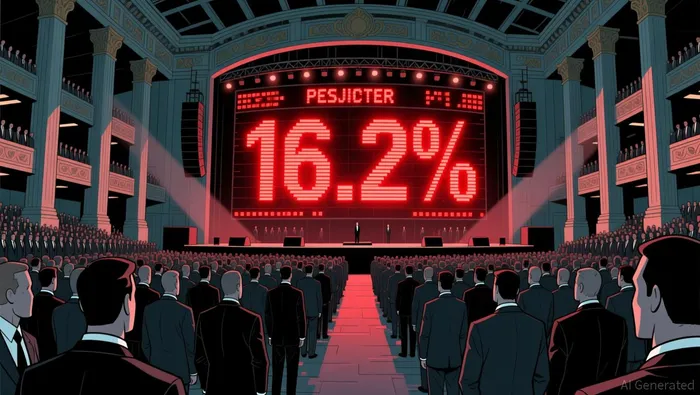
The current price of 16.2% for the “Yes” outcome implies a market firmly anchored in a low-probability assessment. The tight bid-ask spread of 0.001 suggests efficient price discovery for this specific instrument, but the broader context is one of heavy asymmetry. This price does not merely reflect a polling average; it embeds a significant discount for the rule risks and the structural hurdles a left-wing candidate would face in securing a unified, official party consensus. The market is not saying the candidate has a 16% chance of winning a primary vote; it is saying there is a 16% chance of a clean, undisputed, and officially ratified nomination by the deadline.
Market Dynamics (Volatility & Volume)
The market’s price behavior tells a story of slow, low-intensity repricing rather than speculative bursts. Over the past week, the “Yes” price increased by 0.022, a steady upward drift that aligns with the narrative of the Michigan primary’s impact. Yet, the 24-hour change was a negligible decline of 0.002, indicating that the initial shock has been absorbed and the market is now in a holding pattern. This price action is underpinned by genuine, massive global interest, with total trading volume exceeding $1.25 billion. Critically, the 24-hour volume of over $600,000 confirms that the recent price stability is not an artifact of a dead market; it is a high-volume equilibrium where substantial capital is actively maintaining the current price. The absence of extreme short-term volatility, despite the high volume, suggests that both buyers and sellers are confident in their positions, creating a dense liquidity zone that is difficult to dislodge without a major new catalyst.
Trading Judgment & Follow-up Observation Points
The 16% price is a well-funded consensus, but its foundation is fragile. The most important variable to track is not the next primary poll, but the emergence of any official Democratic Party communication that clarifies the nomination process for 2028. A change in delegate selection rules, a statement from party leadership on candidate eligibility, or a public dispute over the nomination’s legitimacy would directly impact the resolution rule’s “consensus” mechanism. The convergence of high volume and low volatility suggests the current price is a robust, but potentially brittle, equilibrium. The moment a credible “official source” narrative shifts, this price is likely to reprice violently, not incrementally, as the market’s rule-based risks are suddenly re-evaluated.

Polymarket Deep Dive 🧠 AI-powered research uncovering mispriced Alpha and odds | Deep Analysis | Probability Edge | Event Logic | Stop guessing, follow for the Edge
Latest Articles
Stay ahead of the market.
Get curated U.S. market news, insights and key dates delivered to your inbox.


AInvest
PRO
AInvest
PRO




Comments
No comments yet