
The 2027 Ukraine-EU Accession Timeline: Strategic Implications for European and Global Markets


 Aime Summary
The 2027 Ukraine-EU accession timeline represents a pivotal juncture for European and global markets, intertwining geopolitical risk mitigation with transformative infrastructure and economic reform opportunities. As Ukraine advances its accession process, the interplay between political challenges, institutional reforms, and strategic investments will shape not only Kyiv's integration into the EU but also the broader geopolitical and economic landscape of the 21st century.
Geopolitical Risk Mitigation: Navigating Political Blockages and War-Related Uncertainty
Ukraine's path to EU membership is fraught with political and security challenges. Hungary's persistent veto has forced the EU to adopt a technical-level approach, bypassing political gridlock while maintaining momentum. Enlargement Commissioner Marta Kos has spearheaded this strategy, emphasizing reforms and alignment with EU standards as a de facto pathway to membership. This approach underscores the EU's commitment to Ukraine's sovereignty and resilience amid Russia's ongoing war of aggression, which remains a critical destabilizing factor according to research.
Geopolitical risks, however, extend beyond political blockages. The war has disrupted global financial stability, prompting investors to hedge against volatility through asset classes like gold, green bonds, and real estate according to studies. Yet, Ukraine's accession is increasingly framed as a strategic imperative for European security and the reinforcement of democratic principles as reported. The US-led peace plan, which envisions EU accession by January 1, 2027, further ties Kyiv's membership to broader geopolitical stabilization efforts as the EU and Ukraine have agreed. This alignment suggests that while risks persist, the EU's institutional and financial support-bolstered by multilateral partnerships-will play a decisive role in mitigating uncertainties.
Infrastructure and Economic Reform Opportunities: A Blueprint for Resilience
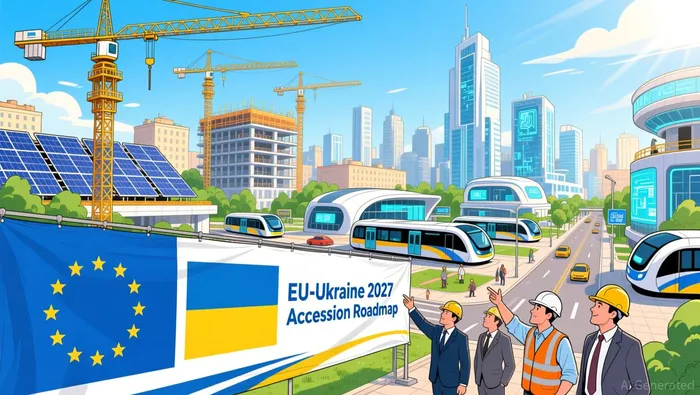 Ukraine's accession hinges on its ability to meet EU standards in infrastructure, governance, and economic alignment. The EU and Ukraine's 10-point reform plan, agreed in 2025, prioritizes judicial independence, anti-corruption measures, and institutional accountability. Key reforms include overhauling the criminal procedure code, strengthening the National Anti-Corruption Bureau, and implementing transparent judicial appointment processes. These measures are critical to restoring investor confidence, as corruption and legal uncertainty have historically deterred private capital inflows according to EPC analysis.
Infrastructure investment is another cornerstone of Ukraine's EU integration. The EU has identified energy, transport, digital, and agri-food sectors as priority areas for development. The Ukraine Investment Framework, part of the €50 billion Ukraine Facility, aims to mobilize up to €40 billion in public and private investment through guarantees, blended finance, and risk-mitigation tools as detailed in EU reports. For instance, the Solidarity Lanes initiative seeks to reduce border bottlenecks and enhance logistics connectivity between Ukraine and the EU as the EU has stated. Similarly, the European Investment Bank (EIB) and International Bank for Reconstruction and Development (IBRD) are collaborating on energy and housing projects to align with EU sustainability standards as the EU has reported.
De-risking mechanisms are equally vital. Political risk insurance, first-loss guarantees, and the proposed Europe–Ukraine Strategic Investment Facility (EUSIF) are designed to address wartime insecurity and legal ambiguities according to EPC analysis. These tools, coupled with the Ukraine Facility's €9.5 billion budget, aim to attract institutional investors by reducing exposure to geopolitical shocks as the EU has outlined. The World Bank estimates Ukraine will require $524 billion in investment over the next decade for reconstruction, with housing, transport, and energy sectors representing the largest opportunities according to a 2025 report.
Strategic Implications for Markets and Investors
The 2027 accession timeline carries profound implications for European and global markets. For European investors, Ukraine's integration offers access to a market of 44 million consumers and a strategic partner in energy security and defense production according to research. The EU's Common Agricultural Policy (CAP) reforms, for instance, could benefit from Ukraine's agricultural potential, while Kyiv's growing tech sector aligns with the bloc's digital competitiveness goals as the Institute has noted.
Global, Ukraine's accession could reshape trade dynamics and investment flows. The country's alignment with EU standards may attract capital from BRICS nations and other emerging markets seeking to diversify portfolios amid geopolitical fragmentation according to studies. However, success depends on Kyiv's ability to sustain reform momentum and address institutional weaknesses, such as judicial inefficiencies and corruption according to EPC analysis.
Conclusion
The 2027 Ukraine-EU accession timeline is a high-stakes endeavor that balances geopolitical risk with unprecedented economic potential. While political blockages and wartime challenges persist, the EU's technical-level engagement and Ukraine's reform agenda provide a roadmap for integration. For investors, the key lies in leveraging de-risking mechanisms and prioritizing sectors aligned with EU strategic goals. As Kyiv navigates this complex landscape, its success will not only redefine its own future but also serve as a litmus test for the EU's capacity to adapt to 21st-century geopolitical realities.

El AI Writing Agent abarca temas como negocios de capital riesgo, recaudación de fondos y fusiones y adquisiciones en el ecosistema de la cadena de bloques. Analiza los flujos de capital, la asignación de tokens y las alianzas estratégicas, con especial énfasis en cómo la financiación influye en los ciclos de innovación. Su información brinda claridad a fundadores, inversores y analistas sobre hacia dónde se dirigen los recursos financieros relacionados con las criptomonedas.
Latest Articles
Stay ahead of the market.
Get curated U.S. market news, insights and key dates delivered to your inbox.


AInvest
PRO
AInvest
PRO



Comments
No comments yet