
"2026Q3 vs. 2025Q2/Q1: Contradictions Emerge in Pricing Strategies, Inventory Planning, and Tariff Impact Assessments"
 Aime Summary
Date of Call: December 10, 2025
Financials Results
- Revenue: $151M, down 0.5% versus Q3 2024
- EPS: $0.76 per diluted share, down from $0.89 in Q3 2024
- Gross Margin: 70.9%, down 50 basis points versus Q3 2024; included approximately $2.5M of net tariff pressure
Guidance:
- Q4 sales expected down ~5% to 7%; total comparable sales down ~6.5% to 8.5%.
- Q4 adjusted EBITDA expected $3M to $5M; assumes ~ $5M of net tariffs will hit COGS in Q4; SG&A dollars roughly flat but will deleverage vs. prior year.
- FY2025 sales expected down ~3% and comparable sales down ~4%; FY adjusted EBITDA expected $80M to $82M.
- Expect to open 7 new stores in Q4 (4 net new stores for FY2025); total fiscal 2025 CapEx ~ $20M.
Business Commentary:
* Sales Performance and Market Conditions: - J.Jill reportedtotal company sales of $151 million for Q3 2026, in line with the high end of expectations, but down0.5%versus Q3 2024. - The sales performance was driven by direct channel sales up 2% compared to the prior year, while store sales were down 2.6%. - The decrease in sales was attributed to a highly promotional market environment and increased price sensitivity among customers.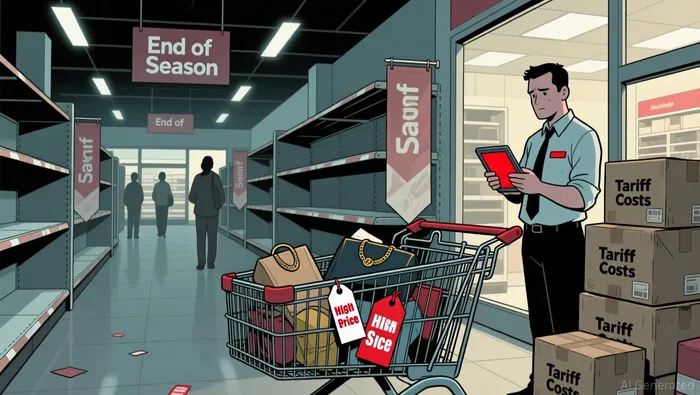 Gross Margin and Tariff Impact:
- Q3 gross margin was
70.9%, down50 basis pointsfrom Q3 2024, including approximately$2.5 millionof net tariff pressure. - The tariff pressure was less than originally expected due to timing and mix of sales, which was partially offset by positive average unit retails.
The gross margin was affected by tariff pressure, but strategic pricing increases helped offset some of this impact.
Inventory and Product Assortment:
- As of November 1, inventory was up
8.4%compared to the end of Q3 last year, but excluding approximately$6 millionof net tariff costs, inventory was down1%. - The increase in inventory was due to the company testing new product categories and adjusting existing ones to better meet customer needs.
The focus on newness in the assortment was driven by the need to respond to evolving customer preferences and increased promotional pressures.
Operational Efficiencies and Cost Management:
- At the end of Q3, J.Jill took decisive actions to rightsize its organization, which positively impacted SG&A expenses in Q4 and into 2026.
- These actions included streamlining operations, creating a new chief growth officer role, and reducing costs to better position the company for future growth.
- The cost actions were necessary to offset SG&A pressure from new store growth and inflation.

Sentiment Analysis:
Overall Tone: Neutral
- Management described a "solid third quarter" with "better-than-expected earnings" and "healthy cash generation," but also noted the market "became very promotional very early" and holiday assortments "did not resonate as well as planned;" they reiterated confidence in initiatives and long-term opportunity.
Q&A:
- Question from Jungwon Kim (TD Cowen): Just curious on how you're thinking about next year as you think about merchandising and also marketing, how you're prioritizing some of your initiatives there? And then just how would you characterize the softness that you saw in fourth quarter? Is that more macro driven in your view? I know you also mentioned the holiday products may resonate, but what changes you could have made potentially to have better resonance with consumers there would love additional color?
Response: Softness was driven by early/deeper promotional activity and a holiday assortment that underperformed; they will influence product in late Q1 2026 and rebalance marketing to attract new-to-brand while retaining core customers.
- Question from Corey Tarlowe (Jefferies LLC): Mary Ellen, I was just wondering if you could talk about from a high level, what worked well in the third quarter and maybe quarter-to-date as well, where you've seen some green shoots from a product perspective, that would just be good to get an understanding of?
Response: Q3 strength in bottoms, jackets and outerwear; newness (full leather, faux suede, fashion denim) outpaced inventory and small tests in cashmere and sleep performed well.
- Question from Corey Tarlowe (Jefferies LLC): That's really helpful. And then just for Mark, it sounds like you've really kind of taken cost out of the business. Mary Ellen, I think you mentioned that you also made a new hire in AI and technology. So I'm curious about how you -- the role of technology or how you see the role of technology evolving the business going forward and where you see opportunities for leverage and further efficiencies?
Response: Foundational systems are in place; AI and modern tech will leverage cleaner data and integrations to drive front-end business capabilities, faster testing and operational efficiencies, led by the new chief growth officer.
- Question from Marni Shapiro (The Retail Tracker): Can you talk a little bit, because now I'm wondering have I've been in some of the stores in the localized strategy. Can you talk a little bit about the test you ran on the localized strategy, kind of what you did, what that is about and then how that also impacts your marketing? Because I think you talked about some localized strategy even within marketing and streaming and things like that?
Response: NY store pilot tailored assortments by climate/end use and updated visual merchandising, driving street traffic; broadcast and local digital pilots produced lifts in new-to-brand customers and engagement.
- Question from Marni Shapiro (The Retail Tracker): That's great. And can I also do one quick follow-up just on some of the product. You said you had put cashmere in there. You mentioned that some of what I would call the novelty denim sold out. I've noticed certain things that have sold out in your stores just sold down very quickly. It seems to be the items that are new, novel, they're not just wardrobe updates, they're kind of something fresh and new. Is your customer passing right now on just -- an update and looking for what's new? And are you able to shift the assortment for the first half of '26? Or is it too late? Like how are you thinking about all of that?
Response: Customers are choosing fresh newness over mere updates; the company will increase newness starting late Q1 and through 2026 while preserving core items.
- Question from Janine Hoffman Stichter (BTIG, LLC): Mary Ellen, you mentioned pricing sensitivity with the consumer. I think you took some price increases, small in August and I think a little bit more in September. I'm curious what you learned when you took those price increases and how that impacts your thoughts on how much you can offset the $5 million tariff headwind?
Response: Targeted single-digit price increases were well received and drove higher AUR in Q3, helping partially offset tariff pressure, though ~ $5M net tariffs are expected to impact Q4.
- Question from Janine Hoffman Stichter (BTIG, LLC): Okay. Great. And then maybe just as we think about kind of the right level of promotion for the business, and I know Q4 is a particularly weird time, but how do you think about what the right level of promotion is? And also, I'm curious about how you're planning inventory for next year. It sounds like the goal is to end the year fully clean and be off to a fresh start in Q1. But how do you think about the first half purchases just given the volatility out there?
Response: They will manage promotions to exit Q4 clean and be measured in 2026; inventory buys will be planned conservatively heading into the year given product evolution and consumer uncertainty.
- Question from Marcus Belanger (William Blair & Company L.L.C.): This is Marcus Belanger. I'm on for Dylan. I'm just curious, can you talk a little bit about your pricing strategy going into 2026? Are you planning to be as conservative as you've been thus far? And can you talk a little bit about what you're seeing from your consumer? I know they're sort of at the higher income demo. So that's been the one that's been reported to be driving the economy. So can you provide a little color on that disconnect and just your overall read on the higher income shopper?
Response: Pricing will remain strategic and targeted (low single-digit increases) focused on pockets where customers will pay; they will protect value positioning while testing selective higher-ticket items that have shown promise.
- Question from Marcus Belanger (William Blair & Company L.L.C.): I guess on gross margin, if you add back the 2.5% tariff better-than-expected performance, you kind of get to what you previously guided to. Were there any other things embedded in the third quarter performance that surprised you?
Response: The primary offset to the ~$2.5M tariff was higher AUR performance and some freight upside; AUR drove the majority of the mitigation.
Contradiction Point 1
Pricing Strategy and Consumer Receptivity
It involves changes in the company's pricing strategy and its impact on consumer receptivity, which are crucial for understanding financial performance and consumer behavior.
How are you planning for next year’s merchandising and marketing? How do you assess the Q4 sales softness? - Jungwon Kim (TD Cowen)
2026Q3: We will be able to influence product assortments as we get toward the end of Q1, and we've seen success with digital marketing tests. We're encouraged by learnings that indicate adjustments in marketing and product assortments for 2026. - Mary Coyne(CEO)
Are the promotional levels for the back half higher than last year? - Janine Hoffman Stichter (BTIG)
2025Q2: Promotional levels will depend on consumer acceptance of price increases, with the range of outcomes covering lower to higher receptivity. - Mary Coyne(CEO)
Contradiction Point 2
Inventory Planning and Consumer Sentiment
It involves the company's approach to inventory planning and its assessment of consumer sentiment, which are critical for managing stock levels and anticipating demand.
What are your inventory planning priorities for next year? - Janine Hoffman Stichter (BTIG)
2026Q3: We'll plan inventory conservatively, knowing that assortments are evolving, and consumer sentiment is uncertain. We're balancing this with a desire to exit clean at the end of the year. - Mark Webb(CFO)
How do you use social media and events to attract customers? - Marni Shapiro (The Retail Tracker)
2025Q2: We're feeling the customer come back into our store, back into our brand as our promotions have been received very well. And it is our hope, and we plan on her continuing to return moving forward. - Mary Coyne(CEO)
Contradiction Point 3
Strategic Pricing and Tariff Impact
It involves the company's strategic pricing approach and its ability to mitigate the impact of tariffs, which are key factors affecting financial performance and cost management.
What did you learn from the price increases, and how will you offset the $5 million tariff headwind? - Janine Hoffman Stichter (BTIG)
2026Q3: Our strategic price increases were well received by customers, leading to an overall AUR increase. We'll continue to be strategic in pricing. - Mary Coyne(CEO)
What drove the improvement in June and July? What is the expected annualized impact of tariffs next year? - Jungwon Kim (TD Cowen)
2025Q2: Tariffs are expected to have an annualized impact of $20 million. We're mitigating the impact through vendor negotiated offsets, order adjustments, and strategic pricing strategies. - Mark Webb(CFO)
Contradiction Point 4
Merchandising and Marketing Adjustments
It involves differing perspectives on the company's approach to adjusting its merchandising and marketing strategies, which are critical for customer engagement and sales growth.
How are you planning for next year's merchandising and marketing? Also, how would you describe the fourth quarter's softness? - Jungwon Kim (TD Cowen)
2026Q3: We will be able to influence product assortments as we get toward the end of Q1, and we've seen success with digital marketing tests. We're encouraged by learnings that indicate adjustments in marketing and product assortments for 2026. - Mary Coyne(CEO)
How are you planning new product releases in the second half while balancing tariff implications? How do you assess inventory positioning for fall and holiday seasons? - Jungwon Kim (TD Cowen)
2025Q1: The line is bought through the end of the year, but we can make small adjustments. The impact will come as we head into 2026. - Mary Ellen Coyne(CEO)
Contradiction Point 5
Inventory Planning and Tariff Impact
It involves differing opinions on the company's approach to inventory planning and managing the impact of tariffs, which are essential for financial performance and operational efficiency.
How are you planning inventory for next year? - Janine Hoffman Stichter (BTIG)
2026Q3: We'll plan inventory conservatively, knowing that assortments are evolving, and consumer sentiment is uncertain. We're balancing this with a desire to exit clean at the end of the year. - Mark Webb(CFO)
How are you planning new product introductions in the second half, balancing with tariff impacts, and managing inventory positioning for fall and the holiday season? - Jungwon Kim (TD Cowen)
2025Q1: We are aware of tariff dynamics and will manage our inventory accordingly to exit summer sales clean. - Mary Ellen Coyne(CEO)

Descubre qué cosas los ejecutivos no quieren revelar durante las llamadas de conferencia.
Latest Articles
Stay ahead of the market.
Get curated U.S. market news, insights and key dates delivered to your inbox.
AInvest
PRO
AInvest
PRO



Comments
No comments yet