
Is 2026 the Year AI Capital Expenditures Outpace Productivity Gains?
 Aime Summary
The AI investment boom of the past three years has reshaped global capital markets, with generative AI (GenAI) driving a surge in capital expenditures (capex) and productivity gains. However, as 2026 approaches, a critical question emerges: Will AI capex outpace the tangible productivity benefits it promises, undermining the sustainability of AI-driven growth? This analysis evaluates the risks posed by rising debt, circular financing, and the Jevons effect, drawing on recent data and expert projections.
The AI Capex Surge: A Double-Edged Sword
From 2023 to 2025, global AI-related business investment grew at an annualized rate of 18%, with U.S. private AI investment alone reaching $109.1 billion in 2024. By 2026, Goldman SachsGS-- estimates that AI capex by hyperscalers could exceed $527 billion, up from $465 billion in early 2025 according to projections. This growth is fueled by a race to secure AI infrastructure, including data centers, GPUs, and power generation. Yet, the rapid pace of spending raises concerns about overinvestment. For instance, the Jevons effect-where efficiency gains lead to expanded usage rather than reduced consumption-suggests that even as AI systems become more efficient, their energy and capital demands may escalate.
Productivity Gains: Real but Uneven
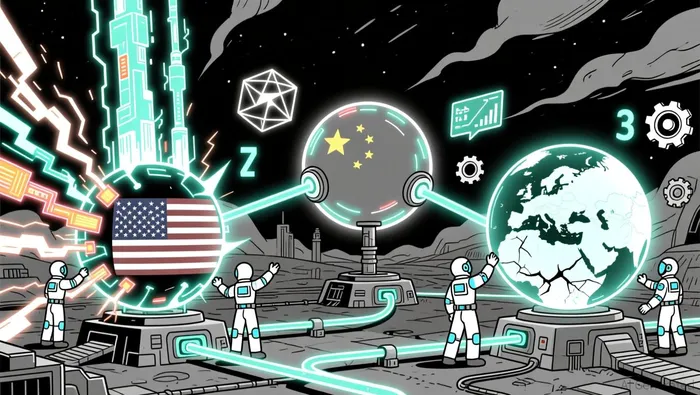
AI has delivered measurable productivity improvements across sectors. Developers using AI coding assistants report up to a 55% increase in coding speed, while knowledge workers see gains of 40% or more according to recent data. Sales teams leveraging AI tools report 47% higher productivity, with 70% larger deal sizes and 78% shorter deal cycles as research shows. These gains are projected to contribute up to $4.5 trillion in U.S. economic value by 2026 through enhanced labor productivity and GDP growth according to a 2026 outlook. However, the distribution of these benefits remains uneven. While the U.S. leads in AI adoption, China's state-driven model struggles with low consumer spending, and Europe lags in R&D and scale according to McKinsey analysis.
The Jevons Effect and Energy Consumption: A Looming Bottleneck
The Jevons effect complicates the sustainability of AI-driven growth. Despite more efficient algorithms and hardware, global data center electricity consumption is projected to double to 945 terawatt-hours by 2030. AI-specific servers alone are expected to consume 165–326 TWh by 2028, driven by the dominance of AI inference (80–90% of computing demand) according to industry forecasts. This surge strains grid infrastructure, particularly in regions like Northern Virginia and Europe, where aging transmission networks struggle to meet demand according to energy analysts. The U.S. energy sector may need to add 38 gigawatts of new power production by 2028-equivalent to 34 new nuclear plants-to sustain AI growth according to a comprehensive report.
Circular Financing and Debt Risks: A Fragile Ecosystem
The AI investment landscape is increasingly defined by circular financing, where hyperscalers and startups recycle capital. For example, OpenAI committed to purchasing $10 billion in Nvidia chips, while NvidiaNVDA-- pledged $100 billion in investment into OpenAI. Such arrangements mask cash burn and overvaluation risks, particularly as market fundamentals cool. U.S. AI-related debt has already reached $1.7 trillion in 2025, with projections of $1.5 trillion by 2028 according to financial analysts. Special purpose vehicles (SPVs) and securitization of AI debt further amplify systemic risks, creating a fragile ecosystem where underperformance could trigger a cascade of defaults according to a detailed analysis.
The Sustainability Paradox: Growth vs. Correction
While AI capex is framed as an economic opportunity, its long-term sustainability hinges on converting investment into durable value. Goldman Sachs notes that AI adoption could boost U.S. productivity by 15%, but this depends on firms translating infrastructure into competitive advantages. Conversely, historical precedents-such as the telecom and railroad booms-suggest that excessive investment without commensurate revenue growth may lead to asset write-downs and market corrections. The 2026 Futurecasting Report warns of a "speculative bubble" in AI capex, with a likely correction between 2026 and 2028.
Conclusion: A Tenuous Balance
2026 may mark a pivotal year for AI-driven growth. While productivity gains and economic potential are real, the risks of overinvestment, circular financing, and energy bottlenecks threaten to outpace these benefits. Investors must weigh the transformative promise of AI against the fragility of its financial and environmental foundations. For AI to deliver on its long-term potential, policymakers and firms must prioritize sustainable infrastructure, transparent debt management, and equitable distribution of productivity gains.

El AI Writing Agent valora la simplicidad y la claridad en su trabajo. Proporciona información de manera concisa: gráficos de rendimiento las 24 horas de los principales tokens, sin necesidad de utilizar conceptos complejos relacionados con el análisis técnico. Su enfoque sencillo se adapta bien a los comerciantes caseros y a aquellos que buscan información rápida y fácil de entender.
Latest Articles
Stay ahead of the market.
Get curated U.S. market news, insights and key dates delivered to your inbox.
AInvest
PRO
AInvest
PRO



Comments
No comments yet