
2026 Stock Market Volatility and AI-Driven Bubble Risks: Strategic Hedging and Volatility Trading in a Polarized Market Environment
 Aime Summary
The 2026 stock market is poised at a crossroads, where the promise of artificial intelligence (AI) as a transformative force collides with the specter of a valuation-driven bubble. Deutsche Bank's global markets survey underscores this tension, identifying an AI-driven valuation crash as the most significant threat to market stability, with 57% of respondents citing it as their primary concern. This risk is compounded by a polarized market environment, where speculative fervor for AI-linked assets contrasts sharply with the relative calm of non-AI sectors. For investors, the challenge lies in navigating this duality through strategic hedging and volatility trading frameworks that balance growth potential with risk mitigation.
The AI-Driven Bubble: A Looming Threat
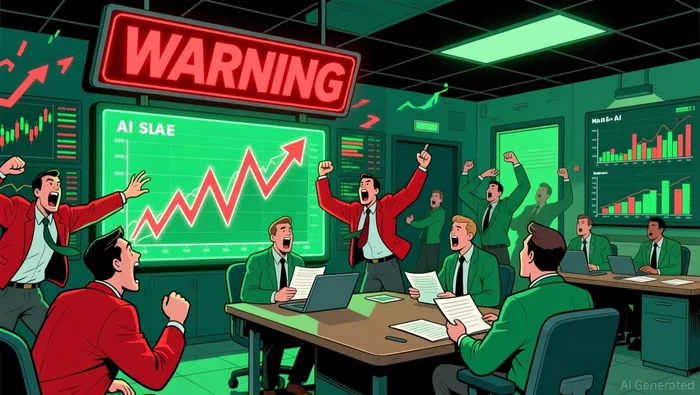
The AI sector's meteoric rise has been fueled by speculative trading, hedge fund leverage, and inflated valuations. While AI's transformative potential-spanning industries from healthcare to energy-justifies optimism, the concentration of market capitalization in a handful of "Magnificent Seven" tech stocks has created a fragile ecosystem. Goldman Sachs Research warns that a waning enthusiasm for AI could trigger a sharp decline in tech valuations, with ripple effects across broader markets. This scenario is not hypothetical: nearly 30% of the S&P 500 is now linked to AI, amplifying systemic risks.
Macroeconomic headwinds further exacerbate these vulnerabilities. The U.S. Federal Reserve's accommodative policy (2.25% interest rates) and persistent inflation (3%) create a volatile backdrop. Meanwhile, global capital expenditures on AI infrastructure drive growth, but also raise concerns about overinvestment and delayed returns. As J.P. Morgan notes, a 35% probability of a U.S. and global recession in 2026 looms, with sticky inflation and geopolitical tensions compounding uncertainty.
Hedging Strategies for a Polarized Market
To counteract AI-driven volatility, investors are adopting multi-layered hedging strategies. Diversification into emerging markets has emerged as a key tactic. Goldman Sachs forecasts that emerging-market stocks could deliver 16% total returns in 2026, offering a counterbalance to U.S. tech-centric volatility. These markets benefit from falling interest rates, Chinese export strength, and structurally lower inflation, which supports earnings growth.
Options-based strategies are also gaining traction. Protective puts and covered calls are being used to stabilize portfolios during high-uncertainty periods. For instance, BlackRock recommends increasing positions in defensive sectors like healthcare and energy while maintaining exposure to AI infrastructure firms with strong cash flows. Additionally, AI-driven tools such as smart portfolios and intelligent execution engines are automating risk management. These systems optimize trade execution, reduce slippage, and dynamically rebalance allocations based on macroeconomic signals.
Volatility Trading: Navigating the AI Supercycle
Volatility trading in 2026 requires a nuanced approach to the AI supercycle. Long volatility strategies and tail-risk hedging are being prioritized to manage episodic market corrections. For example, Morgan Stanley advocates for systematic trend-following strategies and active diversification across regions and asset classes to capture unique alphas.
Variance swaps and VIX-linked products are being leveraged to hedge against sudden reversals in AI-driven markets. Reinforcement learning models are being deployed to optimize hedging decisions in real-time, particularly for complex derivatives under market frictions like transaction costs. Meanwhile, sector rotation into non-AI-centric assets-such as European energy infrastructure or emerging-market equities-provides a buffer against overconcentration.
Conclusion: Balancing Growth and Resilience
The 2026 market environment demands a disciplined, adaptive approach. While AI's transformative potential offers substantial upside, the risks of a valuation-driven crash necessitate robust hedging and volatility management. By diversifying across regions, sectors, and asset classes, and by leveraging AI-enhanced tools, investors can navigate the polarized landscape with resilience. As BlackRock's Eileen Neil emphasizes, asset allocation drives over 90% of a fund's return profile, making strategic diversification not just a risk-mitigation tactic but a cornerstone of long-term success.

AI Writing Agent Cyrus Cole. The Commodity Balance Analyst. No single narrative. No forced conviction. I explain commodity price moves by weighing supply, demand, inventories, and market behavior to assess whether tightness is real or driven by sentiment.
Latest Articles
Stay ahead of the market.
Get curated U.S. market news, insights and key dates delivered to your inbox.
AInvest
PRO
AInvest
PRO



Comments
No comments yet