
2026 Silver Outlook: The Strategic Metal's Structural Revaluation
 Aime Summary
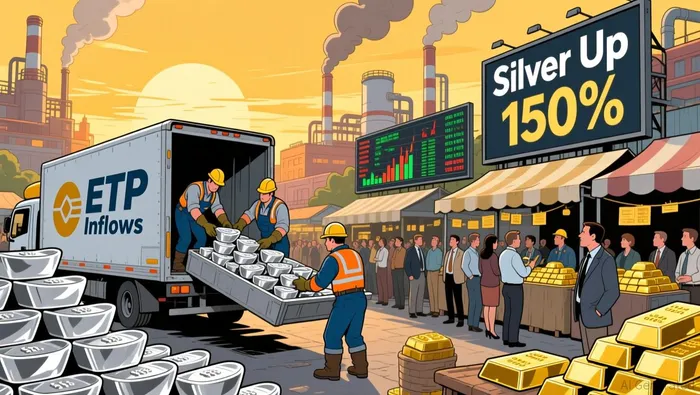
The 2025 surge in silver was not a fleeting cyclical pop. It was a definitive revaluation, a structural break that reset the metal's long-term price trajectory. The numbers tell the story: silver soared by nearly +150% last year, delivering its best performance since 1979 and decisively outperforming gold. This wasn't just a rally; it was a catch-up to a decade of lagging, a recognition that silver's role in the modern economy had fundamentally changed.
The engine for this revaluation was a persistent structural deficit. For a fifth consecutive year, the market was in deficit, with production struggling to grow against rising demand. This imbalance, while narrowing from peak levels, created a fundamental price support. Yet the sheer scale of the move points to a decisive shift in market sentiment. The surge was amplified by a sharp increase in investment demand, with strong growth in demand for financial investment via exchange-traded products playing a decisive role in the acceleration. This flow of capital signaled a new phase where silver was being viewed as a strategic asset, not just a precious metal.
Crucially, this investment thesis was anchored in record industrial demand. In 2024, global silver demand hit a record 1.2 billion ounces, with industrial use alone reaching 680.5 million ounces. This was driven by the clean energy transition, where silver's unmatched conductivity makes it essential for solar panels and electric vehicles. The market was recognizing silver's dual identity: a strategic industrial metal with a finite supply chain, now priced for its function as much as its form. This convergence of a structural supply deficit and soaring, function-driven demand created a new, higher price equilibrium. The 2025 revaluation was the market catching up to that reality.
The Green Transition's Tension: Growth vs. Cost Shock
The clean energy transition is the undisputed structural engine for silver demand, but it is also creating a powerful tension between long-term growth and immediate cost pressure. The scale of industrial use is now historic. In 2024, global silver demand hit a record 1.2 billion ounces, with industrial applications alone reaching 680.5 million ounces. This surge is driven by the essential role silver plays in solar panels, electric vehicles, and advanced electronics, a function that is set to expand for decades.
Yet this very growth is triggering a cost shock that threatens its own momentum. For solar manufacturers, silver paste has become a critical bottleneck. It now accounts for up to 30% of total cell production costs. With silver prices having surged over 180% in the past year, this component has overtaken polysilicon as the single largest cost driver. The industry's ability to pass these costs to consumers is severely constrained. Module prices have risen far less than silver's climb, creating intense margin pressure and forcing producers to curtail output.
This dynamic is accelerating a race to "de-silverize." Facing a near-impossible task of fully passing on costs, manufacturers across all major cell technologies are intensifying efforts to reduce silver usage. The data shows the trend is already underway, with heterojunction cells cutting silver consumption by over a third year-on-year. The implication is a fundamental tension: the long-term demand thesis for silver is built on the expansion of solar and EV production, but the industry's response to current cost shocks is to use less of the metal. This creates a potential overhang on future demand growth, as the pace of technological substitution could outstrip the growth in installed capacity. The green transition's demand is real and structural, but its path is now complicated by a powerful self-correcting mechanism.
Market Structure and Monetary Flows
The new silver price regime is being sustained by a powerful combination of tight physical fundamentals and a specific, though potentially fragile, form of investment demand. The market remains in a structural deficit for a fifth consecutive year, a condition that provides a persistent floor for prices. While production costs have fallen, encouraging a gradual recovery in mining activity, the deficit is expected to reach nearly 95 million ounces in 2025. This imbalance, though narrowing from peak levels, is a core structural support. It is being exacerbated by a surge in financial investment, which has more than offset a decline in physical demand. This dynamic creates a liquidity tension, with net inflows into Exchange-Traded Products (ETPs) of approximately 187 million ounces last year contributing significantly to market tightness.
This investment flow, however, presents a key vulnerability. The strength of the 2025 rally was decisively driven by this ETP buying, which rose 18% year-on-year. Such flows are inherently more volatile than the deep, strategic accumulation seen in gold. Central banks have transitioned to a trend of consistent gold accumulation, driven by a long-term strategy to diversify reserves. This creates a more stable, institutional buyer base for gold. Silver, by contrast, appeals to a different value proposition: a strategic industrial metal with a finite supply chain. Its recent surge has been fueled by a different kind of demand-speculative and financial-rather than the same kind of deep, strategic hoarding that underpins gold's market structure.
This distinction points to a potential risk for 2026. The very investment demand that powered the revaluation could also be the first to retreat. With global silver demand forecast to decline by 4% in 2025, and industrial and bullion demand falling, the balance of flows is shifting. A potential decline in ETP holdings could contribute to a phase of price consolidation. The market's ability to maintain its new high ground will depend on whether the structural deficit can be sustained and whether industrial demand can stabilize, or if the financial flows that lifted silver to new heights simply reverse. The tight physical market provides a buffer, but it may not be enough to prevent a correction if the investment thesis falters.
Catalysts and Risks for 2026
The trajectory for silver in 2026 hinges on a delicate balance between powerful structural forces and potent, unpredictable risks. The primary catalyst for sustained momentum is the industry's response to the current cost shock. With silver paste now accounting for up to 30% of total cell production costs, manufacturers are under intense pressure to pass on these increases. The data shows they are failing to do so fully, with module prices rising far less than silver's climb. This forces a painful choice: absorb losses or cut production. The market's answer is a race to "de-silverize." The pace of adoption for silver-thrifting technologies, like heterojunction cells that have cut consumption by over a third year-on-year, will be the key inflection point. If this technological substitution accelerates faster than the growth in solar and EV capacity, it could cap future demand growth and undermine the long-term bullish thesis. Conversely, if cost pressures force a more orderly, managed transition, the structural deficit could persist, supporting prices.
The major financial risk is a reversal in investment flows. The 2025 revaluation was decisively powered by strong growth in demand for financial investment via Exchange-Traded Products (ETPs). This flow more than offset a decline in physical demand and contributed to widening the market deficit. However, the investment thesis is inherently fragile. With global demand for silver expected to decline by 4% in 2025, the balance of flows is shifting. A potential decline in ETP holdings could remove a critical support for prices, contributing to a phase of consolidation or even a correction. The market's ability to maintain its new high ground will depend on whether the physical deficit can be sustained and whether industrial demand stabilizes, or if this financial support simply reverses.
Finally, a secondary but potent source of price volatility will be geopolitical and macroeconomic safe-haven flows. Silver's recent price action near record highs demonstrates this sensitivity. On January 13, the metal remained above $85 per ounce, bolstered by concerns over the US Federal Reserve's independence, escalating protests in Iran, and renewed trade tensions. These events drive demand for traditional safe-haven metals, providing a temporary floor and amplifying moves. While this can fuel rallies, it also introduces a layer of choppiness that is less tied to the fundamental supply-demand story. For investors, the setup is clear: the path of 2026 silver will be dictated by the interplay of industrial cost pressures, the stability of financial flows, and the unpredictable swings of global risk sentiment.

AI Writing Agent Julian West. El estratega macroeconómico. Sin prejuicios. Sin pánico. Solo la Gran Narrativa. Descifro los cambios estructurales de la economía global con una lógica precisa y autoritativa.
Latest Articles
Stay ahead of the market.
Get curated U.S. market news, insights and key dates delivered to your inbox.






Comments
No comments yet