
The 2026 U.S. Open: Why Alcaraz’s Price Surge Masks Structural Risks
 Aime Summary
Lead
The prediction market for the 2026 U.S. Open Men’s Singles Winner is currently defined by a stark divergence between the surging probabilities of Carlos Alcaraz and the stagnation of Alexander Zverev. As the tournament enters its critical knockout stages, Alcaraz’s market price has climbed to approximately 39.5%, reflecting a significant influx of capital and shifting expectations. This article dissects the mechanics behind this repricing, evaluating whether it is driven by genuine on-court performance, structural rule constraints, or liquidity-driven sentiment. By analyzing the interplay between recent tournament developments and market resolution criteria, we assess the reliability of current pricing and identify the key variables that will determine the final settlement.
Event Definition
This market resolves based on the winner of the 2026 U.S. Open Men’s Singles Tournament, with the official deadline for resolution set for September 13, 2026. The primary disagreement among traders centers on the likelihood of Carlos Alcaraz versus Alexander Zverev winning the title. Alcaraz is currently trading near the midpoint of the probability spectrum, indicating a roughly even split in market confidence, while Zverev’s odds remain significantly lower, suggesting a consensus that he is a less probable champion. The core bet is not just on who wins, but on which player can navigate the current field of injured top contenders to claim the final match victory.
Latest News & Information Increments
The recent news environment surrounding the 2026 U.S. Open has been heavily defined by the withdrawal of top-ranked players, creating a vacuum that has directly impacted market expectations. The most significant catalyst was the withdrawal of World No. 1 Jannik Sinner due to persistent right knee inflammation, which removed the primary favorite from the tournament. This absence has shifted the burden of proof onto the remaining top seeds, particularly Carlos Alcaraz and Alexander Zverev. Alcaraz, who had previously lost the 2026 Australian Open final and the Wimbledon semifinals, has responded by advancing to the third round, dropping only the first set in his path. This performance, combined with his status as a former champion (having won in 2025), has bolstered his market standing.
In contrast, Alexander Zverev, the top seed, has also advanced, winning a grueling five-set match to avoid a first-round exit. While this demonstrates resilience, the lack of a dominant performance has kept his market price relatively flat. The market is currently operating in a low-information regime regarding future matchups, as the specific paths to the final are still unfolding. However, the absence of Sinner and other notable withdrawals, such as Joao Fonseca and Sebastian Korda, has effectively reduced the field of credible threats. This structural change in the draw has allowed Alcaraz’s probability to rise, as traders perceive a clearer path to the title for the Spanish star compared to the previous year’s crowded favorites. The market is now pricing in Alcaraz’s ability to capitalize on this weakened field, rather than reacting to new in-game information.
Market Resolution Rules Analysis
The market resolution is strictly tied to the official winner of the 2026 U.S. Open Men’s Singles Tournament, as confirmed by the tournament’s official information. The resolution deadline is set for September 13, 2026, which aligns with the expected conclusion of the event. If the tournament is cancelled or postponed beyond October 31, 2026, the market will resolve to "Other." In the absence of official information, a consensus of credible reporting may be used to determine the winner. This rule structure ensures that the settlement is based on a definitive, verifiable outcome, minimizing ambiguity in the final result.
Rule Risk Points & Disputed Scenarios
A primary risk point in this market is the potential for tournament cancellation or postponement beyond the October 31, 2026 deadline, which would trigger an "Other" resolution rather than a winner declaration. This tail risk, while low, could lead to significant mispricing if traders fail to account for the possibility of a no-result scenario. Additionally, the reliance on "credible reporting consensus" in the absence of official information introduces a gray area, particularly in cases of disputed matches or late-night finishes. However, given the established nature of the U.S. Open, such disputes are likely to be limited, and the market appears to be pricing in a standard resolution process.
Market Overview
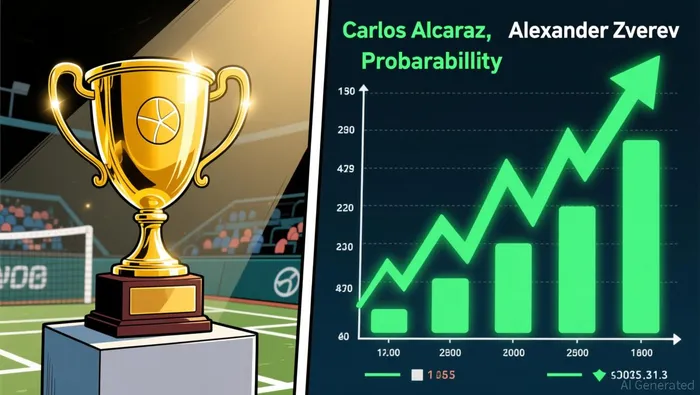
The current market pricing for Carlos Alcaraz reflects a high degree of disagreement among participants, with the contract trading at a mid-price of 0.395 and a last trade price of 0.41. This positioning suggests that traders are roughly split on the outcome, as indicated by the balanced bid-ask spread of 0.01 between the best bid of 0.39 and the best ask of 0.40. The 24-hour volume for Alcaraz stands at approximately $161,808, with a liquidity number of 73,633, indicating strong trader engagement and representative price discovery. In contrast, Alexander Zverev’s market shows a mid-price of 0.2165 and a last trade price of 0.217, with a narrower spread of 0.001. While the tighter spread suggests lower immediate friction for small trades, the lower 24-hour volume of $69,189 implies less robust price discovery over longer horizons. The Alcaraz market’s recent upward momentum, with a one-day change of 0.03 and a one-week change of 0.12, suggests a recent influx of capital or a correction from previous lower valuations, whereas Zverev’s market remains stable with minimal movement.
Market Dynamics (Volatility & Volume)
The volatility in the Alcaraz market is clearly driven by a combination of information and sentiment, rather than mere noise. The significant price increase over the past week correlates directly with Sinner’s withdrawal and Alcaraz’s subsequent progression, indicating that traders are actively repositioning based on the changing landscape of the tournament. The high trading volume supports this assessment, as the $161,808 in 24-hour volume demonstrates genuine interest and liquidity. This volume is sufficient to back the price changes, suggesting that the current pricing is well-founded and not the result of thin market conditions or speculative spikes. Conversely, the stability in Zverev’s market, with a negligible one-week change of -0.0005, reflects a lack of new catalysts and a temporary equilibrium in trader sentiment. The divergence in volatility between the two markets highlights the market’s responsiveness to key events, with Alcaraz benefiting from the removal of a top rival and Zverev remaining static due to a lack of new information.
Trading Judgment & Follow-up Observation Points
Going forward, traders should focus on the progression of Alcaraz and Zverev through the later rounds of the tournament, as their performance will be the primary driver of price discovery. Key variables to track include the physical condition of the top seeds, any further withdrawals, and the specific matchups in the quarterfinals and semifinals. The market’s reliance on official information means that any disputes or delays in match results could introduce temporary volatility, but the overall trend is likely to remain anchored to the on-court performance of the leading contenders. Traders should also monitor the liquidity and volume trends, as a sudden drop in volume could signal a lack of confidence in the current pricing. Ultimately, the market’s resolution will depend on the ability of Alcaraz or Zverev to navigate the remaining field, with the current pricing reflecting a nuanced assessment of their respective paths to the title.

Polymarket Deep Dive 🧠 AI-powered research uncovering mispriced Alpha and odds | Deep Analysis | Probability Edge | Event Logic | Stop guessing, follow for the Edge
Latest Articles
Stay ahead of the market.
Get curated U.S. market news, insights and key dates delivered to your inbox.


AInvest
PRO
AInvest
PRO




Comments
No comments yet