
2026 Nvidia GTC Showdown
 Aime Summary
As the Q1 2026 earnings season draws to a close, Wall Street's gaze is fixed squarely on next week's (March 16, 2026) NvidiaNVDA-- GPU Technology Conference (GTC). In the world of AI investing, GTC has long transcended a mere corporate product launch; it's hailed as the "Super Bowl of AI." For retail investors, it's not just a tech spectacle—it's the compass that will dictate capital flows in the tech sector for the next 12 to 24 months.
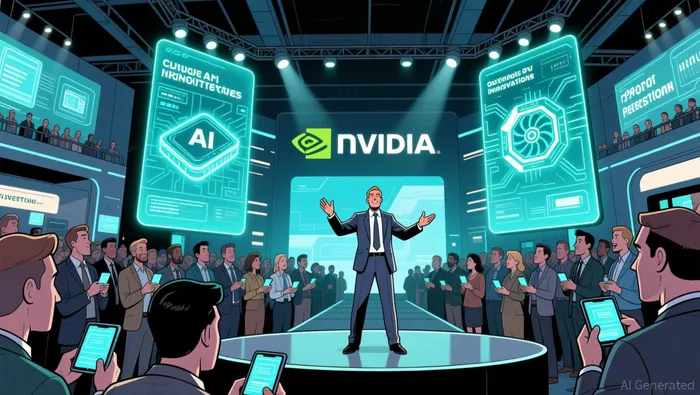
But this year's GTC is fundamentally different from the last two. In the prior frenzy, the market's singular focus was on compute power itself—who had more GPUs, whose single card was fastest. Yet, as AI model complexity grows exponentially, a new bottleneck and investment thesis is emerging: Optical Interconnects.
From the perspective of a US retail investor, this article will dissect the core themes of the 2026 GTC, unearth the industrial logic hidden beneath the tech announcements, and formulate practical trading and allocation strategies.
The Current Macro Backdrop: K-Shaped Divergence vs. AI Capex
Before diving into specific stocks, we must understand the macro environment. Early 2026 presents a complex "K-shaped" market. Sentiment swings violently between "sticky inflation" fears and faith in "sustained AI capital expenditure."
Macro data shows a resilient US economy. Inflation is sticky around 3%, but thanks to fading tariff impacts and massive investment in AI infrastructure, 2026 GDP growth expectations have been revised up to 2.2%. This provides fundamental support.
However, major indices tell a different story. While the Dow and Russell 2000 have held relatively steady, the tech-heavy Nasdaq Composite retracted over 2.9% earlier this year. The core reason? The market is starting to question the massive AI CapEx from hyperscalers (Microsoft, Amazon, Google, Meta). Wall Street is asking: When will these hundreds of billions in compute investment translate into proportional software profits?
This anxiety is causing rapid sector rotation. Defensive consumer staples have outperformed, while richly-valued software stocks—whose business models aren't yet fully AI-transformed—have been sold off ruthlessly. Within the still-strong semiconductor sector, leadership is narrowing dramatically. Money is concentrating on infrastructure players with solid "picks and shovels" logic.
It's in this "separating wheat from chaff" environment that the 2026 GTC is critical. Nvidia must not only show next-gen chip performance but prove to Wall Street that the AI infrastructure investment thesis remains intact. "Optical Interconnection" is the most convincing chapter in that proof.
Deep Dive: Why "Optical Interconnects"?
To grasp GTC's significance, we must look beyond "GPU compute" to the entire data center system architecture. As Bank of America analyst Vivek Arya notes, the optical interconnect market could quadruple to $73B by 2030 as AI workloads demand performance beyond traditional copper.
1. Breaking Copper's Physical Limits Data centers have long relied on copper. But with the explosion of trillion-parameter AI models, bandwidth needs between GPU clusters are growing geometrically. As network speeds move from 400G/800G to the 1.6T (Terabit) architecture slated for late 2026 deployment, copper's limits are fully exposed.
At high frequencies, copper suffers severe signal degradation, electromagnetic interference, and, most critically, heat dissipation issues. Leaked specs suggest Nvidia's next-gen Vera Rubin architecture (expected at GTC) will have a single GPU TDP of 2.3 kilowatts—a 500W jump. Rubin will use HBM4 memory with 22.2 TB/s bandwidth, enabling clusters of 576 GPUs. With such extreme power and density, using copper for long-distance or cross-rack data transfer is impossible—the parasitic heat alone would overwhelm cooling systems.
2. The Co-Packaged Optics (CPO) Revolution Optical interconnects (using photons, not electrons) are the only solution. Light offers immense bandwidth, low latency, and minimal heat. Nvidia is widely expected to lead this shift, potentially becoming the first major player to adopt Co-Packaged Optics (CPO) at scale, replacing traditional copper-based server backplanes.
In traditional setups, pluggable optical transceivers sit on switch faceplates, requiring electrical signals to travel across long PCB traces to the chip, causing significant power loss. CPO is a structural revolution: it packages the optical engine directly with the switch ASIC on the same substrate. By integrating silicon photonics, Nvidia's CPO solution dramatically shortens electrical paths, enabling 5x better energy efficiency and 10x greater network elasticity. For hyperscalers building "million-GPU AI factories," this efficiency isn't just cost-saving—it's existential for breaching total power capacity ceilings.
Notably, the Optical Fiber Communication Conference (OFC) coincides with GTC next week. This dual-event overlap will provide a concentrated barrage of information on optical laser supply/demand and CPO adoption progress.
Beneath the Surface: The Overlooked Business Logic
For retail investors, understanding the tech trend isn't enough. The real market game is in the details. We can discern three critical, yet often missed, underlying logics from recent moves.
Logic 1: From "Compute Supremacy" to "Supply Chain Blockade" In early March, Nvidia stunned the industry with a strategic move: $2B investments each in optical tech leaders Lumentum (LITE) and Coherent (COHR), totaling $4B in committed procurement and R&D funding. This isn't a simple supplier contract; it's a blatant "supply chain blockade."
The core components of high-end optical modules and CPO engines (especially 800G/1.6T) are Indium Phosphide (InP) lasers and photodetectors. Despite Lumentum quadrupling its InP output over 18 months and building a fifth fab, capacity still lags far behind exploding demand. By providing billions in prepayments and capital infusion, Nvidia has effectively cornered the future advanced laser component capacity of these two optical giants.
The implication? When AMDAMD--, Google (TPU), or any other Nvidia challenger tries to scale their AI clusters, they may face a crippling shortage of optical components. By locking down optical interconnect supply, Nvidia has extended its GPU moat into the entire data center's physical network. This is a dimensional shift in competition and a core reason for Nvidia's valuation premium.
Logic 2: The "Pure-Play" Optics Beneficiaries and the "Underestimated" Leader In this optical revolution, giants like Nvidia and Broadcom are leaders, but their diverse businesses can dilute the optics growth story for investors. BofA's Vivek Arya highlights more "pure-play" beneficiaries.
Marvell Technology (MRVL) is a core pick because it sits at the intersection of two hot themes: custom AI chips (ASIC) and optical interconnects. Its recent Q4 FY2026 earnings were stunning: record annual revenue of $8.19B (up 42% YoY), with Data Center Q4 revenue hitting $1.65B. Crucially, Marvell's 1.6T optical interconnect products entered mass production in H2 FY2026, and visibility for its custom processor (XPU) projects for Microsoft and Amazon improved significantly. Citing these catalysts, BofA raised its target on MRVL from $90 to $110. Its ~23x forward P/E looks attractive in today's frothy tech market.
MACOM Technology Solutions (MTSI) is a frequently overlooked "hidden champion." While Lumentum and Coherent focus on large optical modules, MACOM specializes in foundational components like photodetectors and lasers. Arya believes the market severely "underestimates" MACOM's positioning. As an upstream player, its profitability and gross margins could be superior to downstream module assemblers.
Logic 3: "Optical In" Doesn't Mean "Copper Out" – Niche Differentiation Tech investing hates binary "either/or" thinking. The rise of optics doesn't mean the death of copper. In this ecosystem, "traditional" connection suppliers like Credo Technology Group (CRDO) are facing multi-billion dollar new opportunities.
Inside a data center, while cross-rack and long-distance links must use fiber, for short-distance intra-rack connections (within ~7 meters, like GPU-to-switch), optics bring unnecessary cost and high failure rates. Traditional passive copper cables can't handle 800G+ over this distance. Enter Credo's innovative solution: Active Electrical Cables (AECs).
AECs integrate high-performance retimers and DSP chips at both ends of the copper cable. They not only restore attenuated signals but consume half the power of equivalent optical modules and are 1,000x more reliable. In an era where an AI cluster outage costs millions per hour, this reliability and efficiency are irresistibly attractive to hyperscalers. Credo dominates the high-speed AEC market. Its recent quarterly revenue guidance of $404M-$408M smashed expectations, and analyst consensus targets suggest significant upside. Light and copper aren't at war; they have distinct, complementary roles in next-gen AI infrastructure.
Historical Playbook: Lessons from Similar Events
History doesn't repeat, but it often rhymes. Before formulating GTC trading strategies, let's learn from past patterns.
Case 1: GTC's "Buy the Rumor, Sell the News" Pattern For a mega-cap star like Nvidia, its annual conference creates a predictable volatility pattern. Reviewing the 2024 and 2025 GTC events shows a clear trend: in the month before the event, fueled by hype for new architectures (Blackwell, Blackwell Ultra), Nvidia and its key supply chain stocks often see strong valuation expansion.
However, after the CEO's keynote reveals all the impressive specs, the stock frequently experiences sharp volatility or a pullback within a week to a month. For example, in early 2024, Nvidia's stock rallied to a peak around GTC before succumbing to profit-taking. This "sell the news" dynamic is common in semis. Analyst Vivek Arya warns that due to Nvidia's roadmap's profound industry impact, related stocks could see heightened volatility. Indeed, in early March 2026 (just before GTC), Lumentum, Coherent, and MACOM saw pullbacks of 11.3%, 6.2%, and 13.6%, respectively—likely due to pre-event position adjustments and profit-taking.
The Takeaway for Traders: Don't FOMO (Fear Of Missing Out) and chase prices during the keynote frenzy. GTC confirms long-term trends; it doesn't provide short-term buy points. Short-term volatility is inevitable. As long as the core logic—"compute expansion is gated by optical interconnect expansion"—remains intact, any post-event irrational sell-off could be a window to accumulate quality names.
Case 2: The S&P 500 Inclusion Effect As mentioned, Lumentum (LITE) and Coherent (COHR) are scheduled for inclusion in the S&P 500 on March 23, 2026—the week after GTC. This is a major, deterministic capital flow event.
Recall the classic 2024 case of Super Micro Computer (SMCI). After its inclusion announcement, its stock soared in a one-way rally up to the effective date, fueled by expectations of forced buying from passive index funds (like those tracking SPY, VOO).
Fast forward to 2026. Lumentum and Coherent, currently in the S&P MidCap 400, have market caps (~$42.6B and ~$46.2B) that far exceed mid-cap bounds, making them "overweight" in their current index. On the first full trading day after the March announcement (March 9), LITE stock gapped up, surging 10.4% intraday.
The Takeaway for Traders: The passive buying pressure from index inclusion is real but finite. History shows the strongest gains typically occur between the "announcement date" and the "effective date." Once inclusion happens on March 23 and passive funds finish buying, stocks revert to being driven by fundamentals. Both LITE and COHR are up 68.6% and 31.4% YTD, respectively, and valuations are at historical highs (a key reason for BofA's Neutral ratings). If you missed the initial pop, avoid chasing them right before the effective date. Consider waiting for the post-inclusion mean reversion for a better long-term entry.
The Core Players: A Data-Driven Snapshot
For a clear, at-a-glance view of the key companies, their drivers, and the data, see the table below.
Mindset & Strategy for the Retail Investor
Faced with monumental tech shifts and wild volatility, how should the individual investor proceed? Against Wall Street's information and capital advantages, retail must rely on discipline and a clear strategy.
1. Ditch the "All-In" Mentality. Understand and Use Volatility. As Arya warns, short-term swings can be brutal. Any tweak to Nvidia's roadmap can cause a 20%+ move in an optical supplier. The classic retail mistake is getting swept up in the GTC keynote hype and buying at the peak.
The right approach is scaling in or dollar-cost averaging. Treat GTC/OFC as an "information confirmation point," not a "buy trigger." Use the pre-event uncertainty (like the ~10% pullbacks we saw) or the post-event "sell the news" panic to build a position gradually.
2. Build a Core-Satellite Portfolio. In the AI infrastructure race, don't bet on a single winner. Engineering uncertainties abound (e.g., CPO adoption rate, copper's extended lifespan). Mitigate risk with a Core-Satellite strategy: * Core Holdings: Allocate the bulk of your capital to giants with wide moats, multiple growth engines, and reasonable valuations. Examples: Nvidia (the sovereign, highest certainty) and Marvell (MRVL) (dual ASIC/optical engines, 23x P/E offers margin of safety). This ensures you capture the AI super-cycle. * Satellite Holdings: Allocate a smaller, risk-capital portion to "pure-play" or niche suppliers. Examples: the severely underestimated, high-margin MACOM (MTSI), or the high-upside play on "copper's second life," Credo (CRDO). As for Lumentum and Coherent, while promising, the S&P 500 inclusion has created a valuation bubble. They are best watched closely for now, awaiting a valuation digestion before considering an entry.
3. Trust the Safety of the "Picks and Shovels" Logic. In the current macro climate, there's deep skepticism about software companies' ability to monetize AI profitably, hence the software slump. But infrastructure investment is highly certain. Whether OpenAI, Google, or an unknown startup wins the AI application war, they must buy Nvidia GPUs, use Marvell's DSP chips, lay Credo's AEC cables, and install Lumentum's lasers in their data centers.
This is the classic "sell shovels in a gold rush" logic. As retail investors, we don't need to predict which AI app will win. We just need the conviction that the demand for data transfer bandwidth is insatiable on the path to AGI. By holding these infrastructure "picks and shovels" players, we can participate in this era's wealth creation with relative certainty.
Final Thoughts
The 2026 Nvidia GTC is poised to be the historic pivot where AI compute architecture evolves from "compute is king" to "interconnect is king." The Vera Rubin architecture's staggering 2.3kW power draw and massive cluster scale sound the death knell for pure copper in data center long-haul transport. In this great migration to light speed, CPO technology, the battle for upstream InP materials, and AECs' stubborn hold on short-reach links weave a magnificent tech investment tapestry.
For the individual investor, a cool head is paramount. Facing this multi-billion-dollar opportunity: * Don't chase short-term hype. * Understand the underlying industrial logic. * Avoid the short-term valuation bubbles created by index inclusion. * Focus on fundamentally strong "picks and shovels" players with clear moats.
This is how you navigate the turbulent AI wealth wave. Volatility around the event is guaranteed. But as industry experts agree: all these underlying connectivity suppliers are positioned for strong, broad-based growth for years to come. That is the investment thesis to embrace as we move through 2026.

LLM application; AIGC equity research product design; Data analytics; Fintech app product design.
Latest Articles
Stay ahead of the market.
Get curated U.S. market news, insights and key dates delivered to your inbox.
AInvest
PRO
AInvest
PRO



Comments
No comments yet