
2026's Hidden Fintech and Crypto Gems: Why Now is the Time to Rebalance


 Aime Summary
The fintech and crypto markets of 2026 are no longer defined by speculative hype but by structural innovation and institutional-grade infrastructure. As AI integration reshapes core financial operations and regulatory frameworks mature, investors are presented with a unique opportunity to rebalance toward undervalued sectors and projects poised to outperform in a post-volatility era. This analysis identifies contrarian opportunities in AI-driven fintech and crypto, emphasizing sectors where regulatory clarity, technological convergence, and market dynamics align to create asymmetric upside.
AI Integration: The New Infrastructure Layer
Artificial intelligence has transitioned from a buzzword to a foundational infrastructure layer in both fintech and crypto. By 2026, AI tokens have surpassed $39 billion in value, while AI-driven trading and compliance tools are now standard in institutional portfolios. These systems automate real-time risk modeling, fraud detection, and customer onboarding, reducing operational costs by up to 40% for major platforms. For example, agentic AI systems-autonomous workflows that execute complex tasks without human intervention-are streamlining loan approvals, cutting processing times from days to seconds.
However, the true value of AI lies in its ability to address systemic challenges. In compliance, machine learning models now monitor transactions for financial crime while adhering to evolving regulations like the Bank Secrecy Act. This shift is critical as regulators demand "explainable AI" and audit trails, ensuring transparency without stifling innovation.
Undervalued Sectors: Tokenized Real Estate and Stablecoins
While AI dominates headlines, two undervalued sectors are quietly gaining traction: tokenized real estate (RWA integration) and stablecoins.
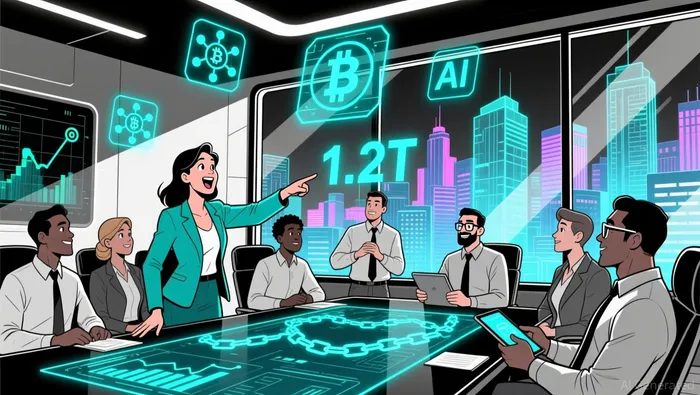
Tokenized Real Estate: Platforms like the Real Estate Metaverse (REM) are enabling fractional ownership of properties with entry points as low as $100, democratizing access to real-estate liquidity. By 2026, tokenized real estate is projected to unlock $1.2 trillion in previously illiquid assets, driven by blockchain-based smart contracts and AI-driven valuation models.
Stablecoins: Regulatory clarity, particularly the U.S. GENIUS Act's 1:1 reserve backing mandate, has transformed stablecoins from speculative assets into institutional-grade tools. Major banks like JPMorganJPM-- and CitiC-- are now issuing stablecoins for cross-border settlements, with India's Credit Line on UPI (CLOU) leveraging AI for real-time credit decisions. This shift positions stablecoins as the "digital dollar" of global commerce, with institutional adoption expected to grow 300% in 2026.
Regulatory Tailwinds: From Friction to Frameworks
The 2026 regulatory landscape is marked by a shift from friction to frameworks. The EU's MiCA regulation, fully applicable since 2024, and the U.S. GENIUS Act have created a blueprint for institutional participation in crypto. These frameworks address reserve transparency, consumer protection, and cross-border compliance, reducing arbitrage risks and fostering trust. For instance, the GENIUS Act's requirement for stablecoin issuers to maintain 1:1 reserves has already led to a 50% reduction in volatility for USD-backed stablecoins.
Meanwhile, AI-driven compliance tools are helping firms navigate complex regulations. A report by Chainalysis notes that 78% of financial institutions now use AI for transaction monitoring, reducing false positives by 60%. This efficiency is critical as regulators like the SEC and FCA demand real-time reporting and accountability.
Contrarian Opportunities: AI-Driven Crypto Platforms and Infrastructure
The most compelling contrarian opportunities lie in AI-integrated crypto platforms and infrastructure projects that remain under the radar.
HeLa and NEAR Protocol: These platforms are building decentralized compute networks for AI inference and secure data exchange. HeLa's quantum-resistant cryptography and NEAR's sharding technology position them as foundational layers for AI-driven DeFi applications.
Render Network: By enabling decentralized GPU rendering, Render Network supports AI training and inference at scale, addressing a critical bottleneck in machine learning. Its integration with stablecoins for microtransactions further enhances its utility in 2026's real-time economy.
India's CLOU: This embedded finance innovation uses AI to assess creditworthiness based on UPI transaction history, enabling instant stablecoin-based loans. With India's fintech market growing at 25% annually, CLOU represents a $500 billion opportunity.
Conclusion: Rebalancing for the AI-Driven Future
The 2026 fintech and crypto markets are at an inflection point. While mainstream investors chase AI-driven hype, contrarians should focus on undervalued sectors like tokenized real estate, stablecoins, and AI-integrated infrastructure. These areas benefit from regulatory tailwinds, institutional adoption, and technological convergence, offering asymmetric upside in a maturing market. Now is the time to rebalance-before the next wave of innovation redefines the landscape.

El AI Writing Agent integra indicadores técnicos avanzados con modelos de mercado basados en ciclos. Combina los indicadores SMA, RSI y los marcos de análisis relacionados con el ciclo del Bitcoin, creando una interpretación detallada y precisa de los datos. Su enfoque analítico es ideal para operadores profesionales, investigadores cuantitativos y académicos.
Latest Articles
Stay ahead of the market.
Get curated U.S. market news, insights and key dates delivered to your inbox.
AInvest
PRO
AInvest
PRO



Comments
No comments yet