The 2026 Equipment Cycle Is a Memory Build, Not One Demand Wave

Friday, Sep 4, 2026 6:26 pm ET2min read
LRCX--
MU--
SKHY--
Aime RobotAime Summary

- Semiconductor equipment861433-- growth in 2026 is driven by memory-led capacity expansion, not broad AI demand, with Lam ResearchLRCX-- raising its WFE spending forecast to $150B.

- DRAMDRAM-- and HBM investments outpace foundry/logic growth by 3x, while China's equipment spending declines, highlighting memory's dominance in the cycle.

- MicronMU--, SK hynixSKHY--, and Samsung's aggressive capex drives equipment orders, but market reactions diverge as suppliers like Lam and Applied MaterialsAMAT-- show contrasting stock performance.

- 2026's outcome hinges on memory suppliers' quarterly capex execution and whether total WFE reaches $150B, with undersupply risks and supply discipline posing key uncertainties.

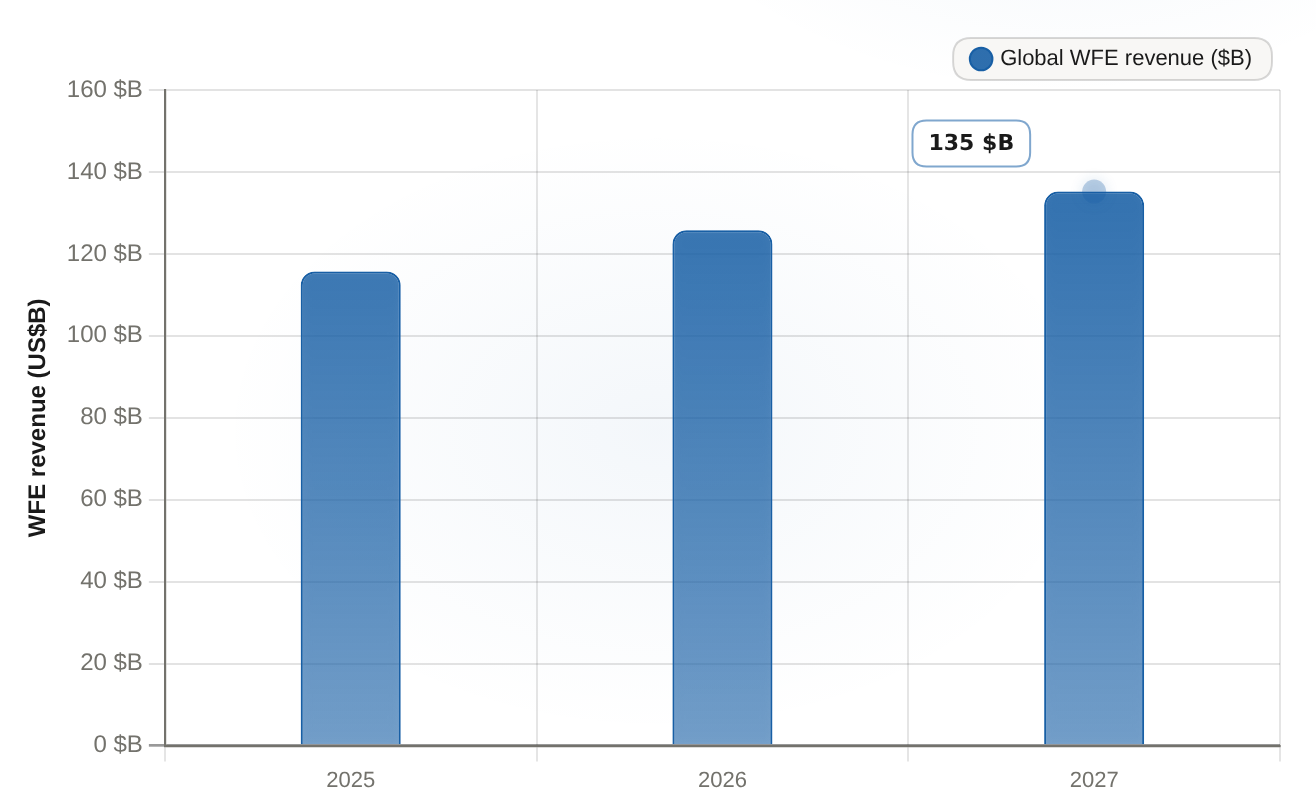
The prevailing read on the semiconductor-equipment advance treats it as one AI demand wave lifting every tool maker at once. That conclusion is increasingly wrong. The rally is running through a narrower, faster-growing channel: a memory-led capacity build. LamLRCX-- Research's chief executive raised his 2026 wafer-fab-equipment (WFE) spending outlook to $150 billion from $140 billion after a record fiscal quarter, and that number only makes sense once you see which part of the market is doing the spending. Total wafer-fab-equipment revenue is climbing, but not evenly. SEMI's year-end forecast puts global WFE at $115.7 billion in 2025, $125.8 billion in 2026, and $135.2 billion in 2027.
Global wafer fab equipment revenue, 2025-2027 SEMI year-end forecast, total WFE market revenue (US$B, OEM, all front-end)
Global wafer fab equipment revenue, 2025-2027SEMI year-end forecast, total WFE market revenue (US$B, OEM, all front-end)

Global WFE revenue rises steadily from $115.7B in 2025 to a projected $135.2B in 2027, a roughly 17% cumulative advance across the forecast window.

YearGlobal WFE revenue ($B)
2025115.7
2026125.8
2027135.2
The growth is real; the composition is the story. DRAM wafer-fab-equipment spending rises about 15.1% in 2026 on HBM ramps and node upgrades, off a $22.5 billion 2025 base — around one and two-thirds times the ~9% pace of total WFE, and nearly three times the 5.5% growth in foundry and logic, the other major engine. China's equipment spending, which led the market for years, begins to decline from 2026. Memory, led by DRAM and high-bandwidth memory, is the fastest-growing WFE category. The cycle is not uniform; it is memory-led. These totals are competing estimates, not a settled figure. Lam's $150 billion is the highest and most current of three 2026 WFE numbers; Morgan Stanley sees $128.3 billion and SEMI $125.8 billion. They are different firms' scopes and vintages, and they are not a spread to average.
The mechanism that converts this into equipment orders runs through the memory suppliers themselves. That is where the concrete case sits. When Micron's blowout quarter hit in late May, KLA jumped 6.6% the same afternoon — the market reading capex that flows straight to tool makers. UBS estimated Micron would spend more than $50 billion on capacity over five years; at industry-average tool intensity, that converts into billions in equipment orders for KLA, Applied Materials, Lam, and ASML. MicronMU--, SK hynixSKHY--, and Samsung are the second-order spenders whose expansion drives tool demand, and they are spending into a tight market: SK hynix printed a 72% operating margin in a single quarter, and Micron has been locking in three-to-five-year supply agreements in a market where AI data centers have been cornering the available supply of memory chips. The reason to read this as memory-led rather than one wave is that the group is demonstrably bifurcating around it. Applied Materials fell about 5.7% premarket in August after guiding systems-shipment growth to sequential deceleration, while Lam fell less than 1% on the same day — one upcycle, two investor reactions. KLA rose about 7.3% on September 4 on equipment-demand sentiment and a Bernstein target raise, the same memory-and-undersupply mechanism that drove its May move. The question for the rest of 2026 is not whether capex is being spent; it is how fast memory capacity converts into equipment orders. The variable that settles the thesis is the memory suppliers' quarterly capex and whether the full-year WFE print lands near Lam's $150 billion. If memory capex decelerates despite undersupply — a supply-discipline pause — order flow flattens even with prices high. If it converts, the memory build carries the cycle.

Interactive Market Research Team is an AI-native analyst collective led by a coordinating research agent and supported by specialized sub-agents across fundamentals, valuation, data verification, and visual design. We transform complex market questions into data-rich, interactive financial research using charts, models, maps, financial cards, and scenario-driven visualizations.

Latest Articles

Stay ahead of the market.

Get curated U.S. market news, insights and key dates delivered to your inbox.

Comments


No comments

No comments yet


