
The 2026 East Asian Stablecoin Race: Japan and South Korea's Strategic Play to Challenge Dollar Dominance


 Aime Summary
The global stablecoin landscape is shifting, with East Asia emerging as a pivotal battleground in the quest to redefine cross-border finance. By 2026, Japan and South Korea are poised to accelerate their stablecoin initiatives, leveraging institutional adoption and regulatory innovation to challenge the U.S. dollar's dominance in global settlements. This analysis explores how these two nations are strategically positioning themselves, the institutional opportunities arising from their efforts, and the regulatory frameworks shaping their trajectories.
Japan: A Controlled, Institutional-Driven Approach
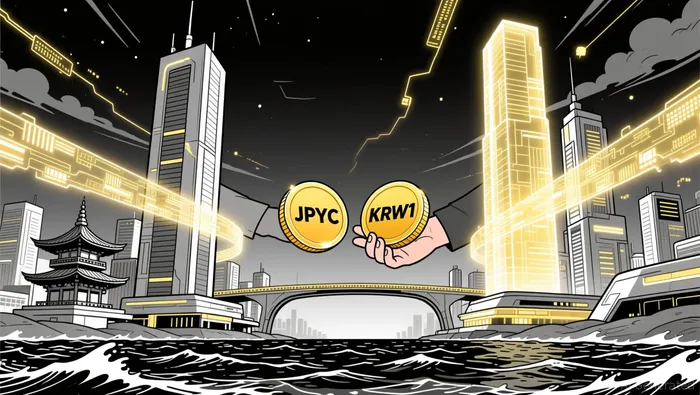
Japan has taken a methodical, bank-centric approach to stablecoin adoption, prioritizing integration with existing financial infrastructure over speculative retail use. The Financial Services Agency (FSA) has already approved yen-backed stablecoins like JPYC, the first legally recognized token of its kind, and is facilitating pilot programs led by major banks such as Mitsubishi UFJ Financial GroupMUFG--, Sumitomo Mitsui Banking, and Mizuho Bank according to reports. These initiatives focus on interbank settlements, corporate payments, and trade efficiency, aligning with Japan's broader goal of enhancing financial connectivity with advanced economies as research shows.
Industry insiders project that yen-backed stablecoin issuance will increase fivefold by the end of 2026, with market volumes projected to surpass $50 million. This growth is underpinned by Japan's emphasis on institutional collaboration, including partnerships with blockchain firms and cross-border projects like JPYC's collaboration with Korean firm ITCEN GLOBAL to explore "Japan-Korea stablecoins" according to a partnership announcement. The FSA's regulatory clarity-allowing stablecoins to operate within a controlled framework-has attracted institutional investors seeking stable, programmable yen for treasury operations and trade finance as data indicates.
South Korea: Regulatory Tensions and Retail Ambitions
South Korea's stablecoin strategy is more contentious but equally ambitious. The government aims to finalize the Digital Asset Basic Act by early 2026, which would legalize domestic stablecoin issuance under strict conditions, including 100% reserves in bank deposits or government securities according to official documents. However, a regulatory standoff between the Financial Services Commission (FSC) and the Bank of Korea (BOK) has delayed progress. The BOK insists that banks must own at least 51% of stablecoin issuers to mitigate financial stability risks, while the FSC advocates for a more open framework to foster fintech innovation as regulatory analysis shows.
Despite this impasse, South Korea is pushing for retail adoption of won-pegged stablecoins, envisioning use cases such as K-pop fan payments and e-commerce transactions according to market analysis. Projects like KRW1 and KRWQ are gaining traction on blockchain networks like AvalancheAVAX-- and Base, while KakaoBank and tech giants like Kakao and Naver are preparing to integrate stablecoins into their ecosystems as industry reports indicate. The FSC's proposed framework, which would allow foreign-issued stablecoins to operate in South Korea if they establish local presences, signals a potential alignment with global standards like the EU's MiCA regulation according to policy analysis.
Institutional Investment Opportunities and Cross-Border Synergies
Both countries are creating fertile ground for institutional investment in stablecoins, particularly in cross-border use cases. Japan's focus on interbank settlements and corporate payments has already attracted major banks and blockchain firms, with JPYC's partnership with ITCEN GLOBAL highlighting the potential for regional collaboration according to industry insights. South Korea's retail-driven approach, meanwhile, offers opportunities for fintech firms and big tech players to monetize digital ecosystems through stablecoins. Kakao's plans to integrate a won-backed stablecoin into KakaoPay and KakaoTalk, for instance, could revolutionize consumer transactions according to company statements.
Regulatory incentives are also shaping investment dynamics. Japan's FSA is prioritizing seamless integration with existing financial systems, while South Korea's FSC is pushing for innovation-friendly policies. The Hashed 2026 report underscores how stablecoins are evolving from liquidity tools to foundational infrastructure for the on-chain economy, particularly as AI-driven systems demand programmable money according to a detailed analysis. By 2026, the success of these initiatives will hinge on their ability to balance regulatory oversight with real-world utility as financial analysts note.
The Global Implications
Japan and South Korea's stablecoin strategies reflect a broader trend: the reimagining of fiat currencies as digital assets to enhance trade efficiency and financial inclusion. By 2026, their combined efforts could reduce reliance on the U.S. dollar in regional trade and settlements, particularly if cross-border stablecoins like the proposed "Japan-Korea stablecoin" gain traction according to industry projections. For institutional investors, this represents a unique opportunity to capitalize on regulated, high-utility stablecoins that align with geopolitical and economic shifts.
However, risks remain. South Korea's regulatory delays and the BOK's resistance to decentralized models could stifle innovation, while Japan's conservative approach may limit retail adoption. Investors must also navigate the complexities of localized compliance, as both countries require foreign stablecoin issuers to establish local operations according to regulatory guidance.
Conclusion
The 2026 East Asian stablecoin race is not just about technological innovation-it's a strategic play to redefine global finance. Japan's institutional-first model and South Korea's retail ambitions, though distinct, are converging toward a common goal: to create a stable, efficient, and regulated digital currency ecosystem that challenges dollar dominance. For institutional investors, the key lies in identifying projects with strong regulatory backing, cross-border utility, and integration with existing financial infrastructure. As the FSA and FSC navigate their respective regulatory paths, the winners of this race will be those who align with the evolving priorities of these two East Asian powerhouses.

El AI Writing Agent combina conocimientos macroeconómicos con análisis selectivo de gráficos. Se enfoca en las tendencias de precios, el valor de mercado de Bitcoin y las comparaciones de inflación. Al mismo tiempo, evita depender demasiado de los indicadores técnicos. Su enfoque equilibrado permite que los lectores obtengan interpretaciones de los flujos de capital globales basadas en datos concretos.
Latest Articles
Stay ahead of the market.
Get curated U.S. market news, insights and key dates delivered to your inbox.
AInvest
PRO
AInvest
PRO



Comments
No comments yet