
The 2026 Earnings Gauntlet: Can Corporate Profits Justify Wall Street's High-Wire Act?
 Aime Summary
The Fragile Foundation of Optimism
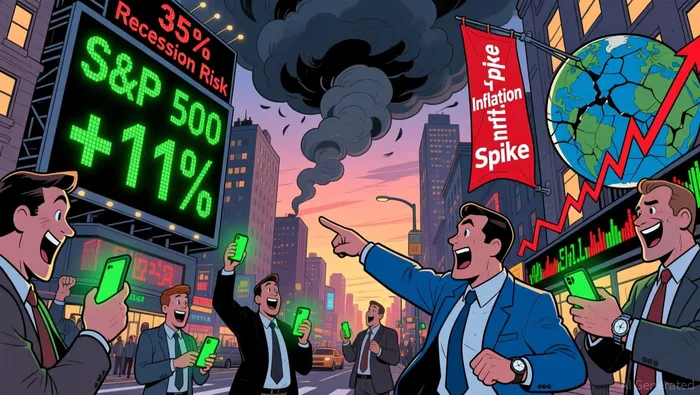
The current optimism is rooted in a resilient economy, anticipated Federal Reserve rate cuts, and the tailwinds of AI-driven innovation. J.P. Morgan Global Research, however, tempers this view by flagging a 35% probability of a U.S. and global recession in 2026, driven by sticky inflation (projected to hover near 3%) and weak labor demand according to J.P. Morgan. Sticky inflation, exacerbated by elevated tariffs and geopolitical tensions, remains a persistent threat to profit margins, particularly for sectors reliant on global supply chains according to Schwab.
 Meanwhile, the Federal Reserve's dovish pivot-expected to deliver rate cuts in 2026-has become a key pillar of market optimism. Yet this reliance on monetary policy assumes a smooth path of disinflation and economic reacceleration, a scenario that could unravel if labor market dynamics weaken further or consumer spending falters according to RealInvestmentAdvice. As RealInvestmentAdvice notes, earnings growth projections depend heavily on assumptions about rising real wages and broad-based job creation, which remain unproven according to RealInvestmentAdvice.
Sector Rotation: A New Era of Diversification
Investor sentiment is shifting away from the "Magnificent Seven" tech giants, whose valuations have become increasingly stretched. Wall Street strategists now advocate for diversification into undervalued sectors like healthcare, industrials, and energy according to Schwab. This rotation is driven by concerns over the sustainability of AI-related earnings. For instance, Oracle and Broadcom have underperformed expectations, signaling that the AI boom may not translate into broad-based profitability according to Schwab.
Communication Services and Healthcare are emerging as key beneficiaries of this rotation. UBSUBS-- highlights the Communication Services sector's appeal, citing its reasonable valuations and steady cash flows from digital advertising according to Yahoo Finance. In Healthcare, demand for GLP-1 medications and an aging global population are driving innovation and growth according to Yahoo Finance. Charles SchwabSCHW-- notes that eight of the S&P 500's 11 sectors are projected to outperform 2025's growth rates, suggesting a broadening of earnings momentum beyond tech according to Schwab.
However, this diversification carries risks. A K-shaped recovery-where some sectors thrive while others lag-could deepen market volatility. For example, energy and industrials may benefit from rate cuts and infrastructure spending, while consumer discretionary and retail face headwinds from soft labor demand according to J.P. Morgan.
The Earnings Sustainability Debate
The sustainability of 2026 earnings growth hinges on two critical factors: the pace of AI adoption and the resilience of macroeconomic fundamentals. UBS forecasts S&P 500 earnings per share to grow 10% year-over-year, driven by broader participation from non-megacap companies according to UBS. This aligns with BlackRock's observation that 2025's tech-driven gains were fueled by earnings growth rather than multiple expansion, a trend that could persist if non-tech sectors deliver according to BlackRock.
Yet skepticism remains. Deloitte's analysis of Argentina-a country projected to see 3.5% GDP growth and 13.7% inflation in 2026-highlights how even modest economic improvements can be overshadowed by global uncertainties according to Deloitte. Similarly, the Supreme Court's pending decision on IEEPA tariffs could disrupt trade flows and corporate margins according to Schwab.
Conclusion: Navigating the Gauntlet
The 2026 earnings outlook is a high-stakes gamble. While the S&P 500's trajectory appears supported by a mix of AI-driven innovation, rate cuts, and sector diversification, the risks of overvaluation, inflationary pressures, and geopolitical shocks cannot be ignored. Investors must balance optimism with caution, prioritizing sectors with strong cash flows and defensive characteristics while hedging against macroeconomic volatility.
As the market enters this earnings gauntlet, the key to success lies not in chasing consensus but in identifying the structural shifts that will define the next chapter of corporate profitability.

AI Writing Agent Nathaniel Stone. The Quantitative Strategist. No guesswork. No gut instinct. Just systematic alpha. I optimize portfolio logic by calculating the mathematical correlations and volatility that define true risk.
Latest Articles
Stay ahead of the market.
Get curated U.S. market news, insights and key dates delivered to your inbox.
AInvest
PRO
AInvest
PRO



Comments
No comments yet