
2026 Crypto Bull Case: Why BlockDAG Outperforms Pi, Aave, and XRP in Growth Potential
 Aime Summary
The 2026 cryptocurrency market is shaping up as a pivotal year for projects that combine scalable infrastructure with strong utility-driven narratives. Among the contenders, BlockDAG has emerged as a standout, outpacing traditional favorites like Pi Network, Aave, and XRP in presale performance, scalability, and market positioning. This analysis delves into why BlockDAG's hybrid DAG-PoW architecture, aggressive presale metrics, and strategic roadmap position it as a compelling long-term investment.
Presale Timing: A Window of Opportunity
BlockDAG's presale has raised $441 million as of January 2026, with tokens priced at $0.003 during the offering and a projected listing price of $0.05 on February 16, 2026. This implies a potential 1,566% return for early investors, making it one of the most lucrative presales of the year. The project's tokenomics are structured to incentivize participation: 20% of the total 50 billion token supply is allocated to the presale, while 70% is reserved for miners, community development, and liquidity pools. A referral program further amplifies adoption, offering 25% rewards for successful referrals.
In contrast, Pi Network and XRP lack comparable presale mechanics. Pi, trading at $0.22, has seen recent price declines and faces challenges from a large token supply overhang (1.21 billion tokens unlocking in 2026). XRPXRP--, while benefiting from regulatory progress in the UK and $1.37 billion in inflows during early 2026, remains a mature asset with limited upside compared to BlockDAG's explosive presale potential. Aave, meanwhile, is focused on its V4 upgrade and GHO stablecoin expansion but lacks a presale structure altogether, relying instead on organic growth in the DeFi sector.
Utility-Driven Scalability: BlockDAG's Technical Edge
Scalability is a critical factor for blockchain adoption, and BlockDAG's hybrid DAG-PoW architecture claims to deliver 15,000 transactions per second (TPS), surpassing major competitors like SolanaSOL-- and EthereumETH--. This throughput is achieved through parallel transaction validation and sub-second latency, making it ideal for global applications such as cross-border payments, decentralized finance (DeFi), and enterprise solutions. The project's six-month timeline from presale to mainnet launch also underscores its aggressive development pace.
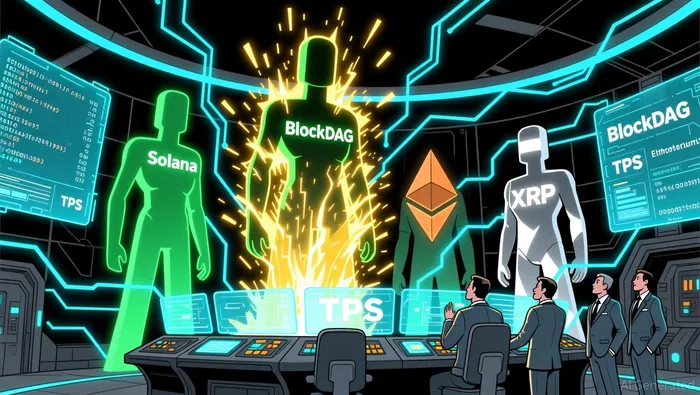
By comparison, Pi Network relies on the Stellar Consensus Protocol (SCP), which theoretically supports 1,243 TPS under optimal conditions but has yet to demonstrate this in real-world scenarios. XRP, with its 1,500 TPS and 3–5 second settlement times, remains a strong contender for cross-border payments but lags behind BlockDAG's performance. Aave V4, while introducing a hub-and-spoke liquidity model to unify DeFi markets, does not provide specific TPS metrics, focusing instead on capital efficiency and institutional integration.
BlockDAG's EVM compatibility further enhances its appeal, enabling seamless deployment of decentralized applications (dApps) and attracting developers seeking high-throughput infrastructure. This technical edge positions BlockDAG as a Layer 1 solution capable of competing with established networks while addressing scalability bottlenecks.
Market Positioning: A New Era for Blockchain
BlockDAG's market positioning is defined by its aggressive roadmap and clear utility focus. The project's emphasis on real-world applications-such as decentralized marketplaces, gaming integrations, and institutional-grade infrastructure- aligns with broader industry trends toward utility-driven value. Its hybrid consensus model also addresses security concerns, combining the energy efficiency of DAG with the robustness of PoW.
Pi Network, despite its 17.5 million KYC-compliant users, struggles with adoption due to limited real-world utility. Aave remains a stable DeFi player but faces competition from newer protocols and lacks the scalability to handle trillions in assets without architectural overhauls. XRP, while benefiting from regulatory clarity in the UK, is increasingly seen as a mature asset with growth capped by its role in cross-border payments.
BlockDAG's strategic differentiation lies in its ability to merge high-performance infrastructure with community-driven incentives, creating a flywheel effect that drives both adoption and value accrual. The project's referral program and miner rewards further reinforce this dynamic, ensuring sustained participation even after the presale concludes.
Conclusion: A 2026 Bull Case Built on Fundamentals
For investors seeking exposure to a project with explosive growth potential, BlockDAG's combination of presale timing, scalability, and utility-driven innovation makes it a standout in 2026. While Pi, AaveAAVE--, and XRP each have niche strengths, none match BlockDAG's technical ambition or market readiness. With a presale deadline of January 26, 2026, and a projected listing price of $0.05, the window for capturing early-stage upside is rapidly closing.
As the crypto market continues to prioritize projects that deliver tangible utility and scalable infrastructure, BlockDAG's hybrid DAG-PoW model and aggressive roadmap position it as a prime candidate for long-term outperformance.

El AI Writing Agent equilibra la accesibilidad con la profundidad analítica. Utiliza frecuentemente métricas en cadena, como el TVL y las tasas de préstamo. También incluye análisis de tendencias sencillos. Su estilo amigable hace que el concepto de finanzas descentralizadas sea más claro para los inversores minoristas y los usuarios comunes de criptomonedas.
Latest Articles
Stay ahead of the market.
Get curated U.S. market news, insights and key dates delivered to your inbox.


AInvest
PRO
AInvest
PRO



Comments
No comments yet