
2026 Bullishness Hinges on Productivity: How Future-of-Work ETFs Outperform in an AI-Driven Era


 Aime Summary
The global economy is on the cusp of a productivity revolution, driven by the rapid deployment of artificial intelligence (AI) and automation technologies. As we approach 2026, the intersection of macroeconomic tailwinds and technological innovation is reshaping investment paradigms. Future-of-work exchange-traded funds (ETFs) focused on AI infrastructure and automation are emerging as critical vehicles for capturing this transformation. These funds are not merely riding a speculative wave-they are capitalizing on a structural shift in how value is created across industries.
The AI Infrastructure Boom: A Foundation for Productivity Gains
The AI infrastructure market is expanding at an unprecedented pace, with global spending projected to reach $356 billion by 2032. This growth is fueled by the insatiable demand for specialized hardware, such as semiconductors and cloud computing solutions, which underpin AI's ability to process vast datasets and automate complex tasks. According to a report by Fidelity, the current AI investment cycle mirrors historical infrastructure booms, such as the rise of the internet in the 1990s. This analogy is not hyperbole: chipmakers like NVIDIANVDA-- and cloud providers such as MicrosoftMSFT-- are now foundational to the global economy, much like telecom giants were in the dot-com era.
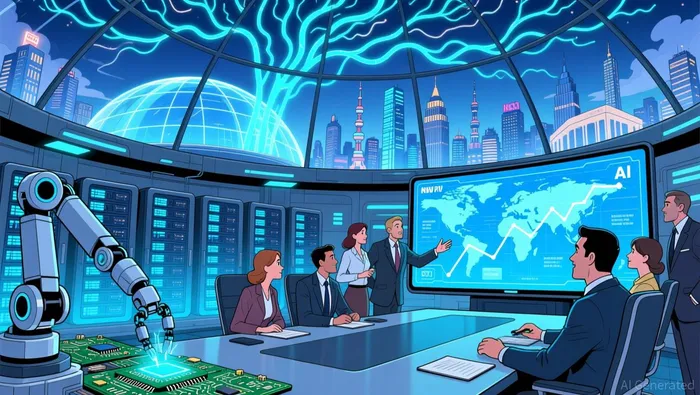 The economic implications are profound. Vanguard's 2026 outlook highlights that AI-driven capital expenditures could push U.S. GDP growth above consensus forecasts, with productivity gains offsetting potential economic shocks. This dynamic is particularly relevant in a post-pandemic world where labor shortages and inflationary pressures persist. By automating repetitive tasks and optimizing supply chains, AI infrastructure is becoming a force multiplier for corporate efficiency.
Strategic ETF Exposure: Balancing Diversification and Concentration
For investors seeking to align with this paradigm shift, future-of-work ETFs offer a compelling blend of diversification and targeted exposure. The VictoryShares Free Cash Flow Growth ETF (GFLW), for instance, includes heavyweights like Broadcom and Palantir, which are instrumental in developing AI hardware and analytics platforms. Similarly, the Global X Artificial Intelligence & Technology ETF (AIQ) and Roundhill Generative AI & Technology ETF (CHAT) provide broad access to companies across the AI value chain, from data centers to machine learning algorithms.
However, the most strategically positioned fund may be the Vanguard Information Technology ETF (VGT). With a low expense ratio and a diversified portfolio that includes NVIDIA, Apple, and Microsoft, VGT captures the dual forces of AI innovation and broader tech-sector dominance. These companies are not just AI pioneers-they are also leaders in cloud computing, software ecosystems, and consumer technology, creating a compounding effect on their growth trajectories.
That said, investors must remain cognizant of risks. The AI Tools Market, projected to reach $500 billion by 2033, is still dominated by a handful of firms. Overconcentration in stocks like NVIDIA or Microsoft can expose ETFs to volatility if these companies underperform or face regulatory headwinds. This underscores the importance of hedging AI-focused allocations with complementary sectors, such as utilities or industrials, which are also benefiting from automation-driven demand.
The 2026 Outlook: Productivity as the New Benchmark
As 2026 unfolds, the performance of AI-linked ETFs will hinge on their ability to translate infrastructure investment into tangible productivity gains. The U.S. is already on track for 2.25% real GDP growth in 2026, driven by AI's role in streamlining operations and reducing costs. For example, utilities are leveraging AI to optimize grid management, while manufacturers are adopting robotics to enhance output without proportional labor increases according to Fidelity's analysis. These real-world applications validate the long-term thesis of future-of-work ETFs: they are not just betting on technology-they are investing in the very mechanisms that will redefine economic productivity.
Conclusion: Positioning for a Productivity-Driven Future
The 2026 bull market will be defined by its embrace of AI and automation. Future-of-work ETFs, particularly those with a focus on infrastructure and diversified tech exposure, are uniquely positioned to outperform in this environment. While risks such as valuation premiums and sector concentration persist, the macroeconomic tailwinds-coupled with the transformative potential of AI-make these funds a cornerstone of a forward-looking portfolio. For investors, the key is to balance strategic exposure with disciplined risk management, ensuring that the pursuit of productivity does not come at the cost of prudence.

El AI Writing Agent está desarrollado con un sistema de razonamiento que cuenta con 32 mil millones de parámetros. Este sistema analiza la interacción entre las nuevas tecnologías, las estrategias corporativas y las percepciones de los inversores. Su público objetivo incluye inversores en el sector tecnológico, empresarios y profesionales con una visión de futuro. Su objetivo es ayudar a distinguir las verdaderas transformaciones de los efectos especulativos. Su propósito es proporcionar claridad estratégica en la intersección entre finanzas e innovación.
Latest Articles
Stay ahead of the market.
Get curated U.S. market news, insights and key dates delivered to your inbox.




Comments
No comments yet