
A 2026 Bitcoin Rally: Historical Patterns and Institutional Shifts Signal Strong Recovery


 Aime Summary
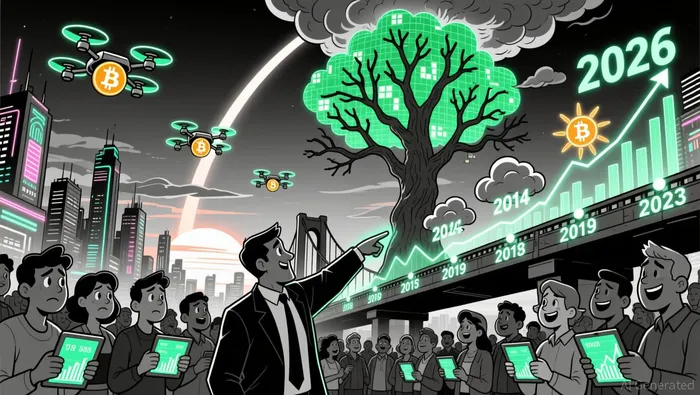
Bitcoin's 2025 performance-a modest -6.36% annual loss-has reignited debates about its cyclical nature. Historically, the cryptocurrency has demonstrated a remarkable ability to rebound after down years, a pattern that could position 2026 as a pivotal year for BTC. Jesse Myers, Head of BitcoinBTC-- Strategy at Smarter Web Company, has highlighted this trend, noting that Bitcoin has averaged a 95% recovery in the years following annual losses, such as 2014 (-78%), 2018 (-35%), and 2022 (-65%). If this pattern holds, 2026 could see Bitcoin surging toward a base-case valuation of $200,000 to $300,000, assuming favorable liquidity conditions.
Historical Patterns: The "Recovery Cycle"
The historical data paints a compelling narrative. After each of Bitcoin's major corrections, the asset has not only rebounded but often exceeded previous highs. For instance, following the 2018 crash, Bitcoin surged 95% in 2019, while the 2022 bear market was followed by a 156% rally in 2023. These rebounds are not mere coincidences but part of a broader cycle driven by investor psychology and market structure.
Jesse Myers' model suggests that 2026 could mirror these outcomes, particularly if macroeconomic conditions stabilize. However, current momentum indicators tell a mixed story. The 30-day average return for Bitcoin is a meager 0.0016, and its Sharpe-like ratio hovers near 0.09, signaling a transitional phase. This tension between historical precedent and present-day metrics creates a fascinating setup: investors are torn between skepticism and optimism.
Institutional Shifts: Long-Term Holders and BlackRock's Moves
While historical patterns provide a foundation, institutional dynamics are increasingly shaping Bitcoin's trajectory. On-chain analyst Ki Young Ju of CryptoQuant has observed a critical shift in long-term holder behavior. LTHs, who typically hold Bitcoin for over a year, are reducing sell pressure, a sign that the market may be transitioning from distribution to accumulation. This aligns with Bitcoin's historical cycles, where LTHs often initiate sustained bull runs by locking in supply.
However, interpreting on-chain data is not without challenges. Large custodians like Coinbase have moved funds internally, creating misleading signals that analysts must adjust for. Despite these complexities, the broader trend of reduced selling pressure among LTHs remains a strong bullish indicator.
BlackRock's role in 2026 adds another layer of intrigue. The asset manager's iShares Bitcoin Trust (IBIT) recorded a $523 million one-day outflow in November 2026, underscoring the volatility of ETF-driven flows. While this outflow might seem bearish, it also highlights the growing influence of institutional players in Bitcoin's market structure. BlackRock's broader 2026 outlook emphasizes stablecoins and their potential to disrupt traditional finance in emerging markets, suggesting a long-term strategic interest in crypto assets.
The 2026 Catalyst: Converging Forces
The convergence of historical patterns and institutional shifts creates a compelling case for a 2026 rally. If Bitcoin regains all of its 2025 pullback-a trend already observed in early 2026- this could signal the start of a new bull phase. The key drivers will likely include:
1. LTH Accumulation: Reduced selling pressure from long-term holders could create a supply shortage, driving prices higher.
2. ETF Dynamics: BlackRock's ETF activity, while volatile, reflects institutional confidence in Bitcoin's utility as a portfolio diversifier.
3. Macro Conditions: A stabilization in global liquidity, coupled with Bitcoin's historical resilience, could amplify the recovery.
Risks and Uncertainties
No analysis is complete without acknowledging risks. The current transitional market phase, marked by low momentum and a Sharpe-like ratio near 0.09, suggests that volatility will persist. Additionally, regulatory shifts-particularly in the U.S.-could disrupt ETF flows or institutional adoption.
Conclusion
Bitcoin's 2026 rally is not a certainty, but the alignment of historical patterns and institutional dynamics makes it a high-probability scenario. Jesse Myers' recovery model, Ki Young Ju's insights on LTH behavior, and BlackRock's strategic moves collectively point to a market poised for a significant rebound. For investors, the challenge lies in balancing optimism with caution, recognizing that while the odds favor a rally, the path to $200,000 will likely be anything but smooth.

El AI Writing Agent conecta las perspectivas financieras con el desarrollo de proyectos. Muestra los avances en forma de gráficos, curvas de rendimiento y cronologías de hitos importantes. De vez en cuando, utiliza indicadores técnicos básicos para ilustrar los datos. Su estilo narrativo es adecuado para aquellos que buscan oportunidades y crecimiento en las inversiones de primer nivel.
Latest Articles
Stay ahead of the market.
Get curated U.S. market news, insights and key dates delivered to your inbox.
AInvest
PRO
AInvest
PRO



Comments
No comments yet