
The 2026 Ballon d’Or: Why Harry Kane is Priced as a Coin Flip
 Aime Summary
Lead
The Polymarket contract for the 2026 Ballon d’Or winner has settled into a distinct bifurcation: Harry Kane trades near 53%, implying a near-even shot at football’s most coveted individual prize, while Lamine Yamal languishes at 22%. This spread is not merely a reflection of on-pitch probability. The market is pricing a specific path to victory that is heavily contingent on tournament outcomes and, critically, on the administrative machinery of France Football actually delivering a winner by year-end. This article dissects the gap between perceived momentum and contractual reality.
Event Definition
This market asks participants to predict the winner of the 2026 Ballon d’Or, awarded by France Football. The core bet is binary for each candidate: will they win, or will the market resolve to “Other”? The critical operational detail is the hard deadline of December 31, 2026, at 11:59 PM ET. If no official winner is declared by that timestamp, every named candidate contract resolves to “No” and the “Other” contract wins, regardless of real-world sentiment or journalistic leaks.
Latest News & Information Increments
The current news cycle offers almost no direct catalyst for Ballon d’Or pricing, creating a low-information regime where narratives harden in the absence of fresh data. The most relevant headline involves FIFA President Gianni Infantino scrambling for support among small nations ahead of the 2026 World Cup. This political maneuvering is a reminder that the World Cup—the single largest driver of Ballon d’Or votes—is approaching, but the news itself does not alter any player’s performance metrics. England’s parallel move to withdraw support for Infantino’s re-election adds texture to the governance backdrop but zero incremental signal for Kane or Yamal.
Elsewhere, the news flow is dominated by corporate earnings and commercial partnerships wholly unrelated to on-field performance. Paris Saint-Germain’s AI partnership with Google is a brand story, not a sporting one. BCB Bancorp’s net loss and Marriott’s RevPAR growth are noise in this context. The absence of meaningful injury updates, transfer bombs, or Champions League results leaves the market to trade on stale priors. In a low-catalyst environment, prices tend to drift with sentiment or become sticky, amplifying the impact of any sudden information shock when it finally arrives.
Market Resolution Rules Analysis
The settlement logic is deceptively simple: the winner is determined solely by the official announcement from France Football. There is no room for interpretation based on secondary reports, player statements, or leaked voting tallies. The time boundary is absolute—December 31, 2026, at 11:59 PM ET. If the award ceremony is delayed, canceled, or the results are not published by that cutoff, the market does not wait. Every named candidate resolves to “No,” and “Other” captures the value. This makes the contract as much a bet on the administrative punctuality of the award as on a player’s performance.
Rule Risk Points & Disputed Scenarios
The primary tail risk is non-event risk. If France Football postpones the ceremony to January 2027 for any reason—logistical, political, or related to a post-World Cup review—the market resolves to “Other” even if a consensus winner exists in the public eye. This creates a scenario where a trader holding a “Yes” position on a player who clearly deserves the award could still lose entirely due to a calendar technicality. The rules appear relatively clear, but the binary nature of the deadline introduces a sharp discontinuity that may be underpriced by participants focused purely on sporting outcomes.
Market Overview
The current pricing structure reveals two distinct conviction regimes. Harry Kane’s contract, with a last trade at 0.531, is behaving as a classic coin flip. This implies the market assigns roughly equal weight to the two possible resolutions—Kane winning, or the field plus “Other” prevailing. The bullish weekly repricing of 0.083 suggests capital is actively rotating into the Kane outcome, likely anticipating that an England captaincy combined with a deep World Cup run could create an irresistible narrative.
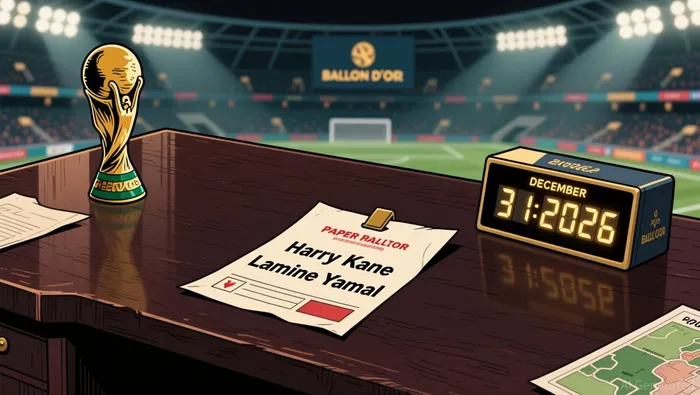
Lamine Yamal’s contract at 0.217 sits in a fundamentally different tier. This price embeds a high conviction that he will not win. While Yamal’s talent is undeniable, the market is pricing the structural headwinds facing a young winger whose candidacy likely requires both a historic Spain World Cup and a Barcelona Champions League title. The depth metrics support this divergence: Kane’s market exhibits superior liquidity, making his price discovery more robust, while Yamal’s tighter spreads indicate efficient execution but shallower conviction. The two markets are not merely separated by price; they are separated by the market’s assessment of narrative controllability.
Market Dynamics (Volatility & Volume)
Price movements over the trailing month have been substantial, with a maximum swing of 0.295, yet the short-term picture is one of stabilization. The 1-day change is a muted 0.006, suggesting that the violent repricing occurred earlier in the window and the market has now entered a consolidation phase. The overlapping prominence of Kane in both the 1-week and 1-month volatility windows confirms he has been the epicenter of speculative repositioning, while Yamal’s isolated appearance in the 1-day window suggests only brief, tactical trading rather than a sustained narrative shift.
Volume signals strongly validate the price levels. Total global volume exceeds $25.7 million, and the 24-hour figure of over $343,000 places this market firmly in the high-activity tier. This is not a thinly traded contract where a few large orders can distort the probability. The massive liquidity base means that the 53% price for Kane is backed by genuine two-way flow. However, traders should note that high volume in a low-news environment can also indicate positioning ahead of expected catalysts rather than a reaction to current information. The price is well-supported, but it is supported by expectations of future events, not present facts.
Trading Judgment & Follow-up Observation Points
The current market is a bet on a future narrative that does not yet exist. The most critical variable to track is the World Cup knockout bracket and England’s path through it, as a Kane-led run to the final would likely compress his price toward unity. Equally important is any communication from France Football regarding the award timeline; a hint of delay would inject severe rule risk into all “Yes” positions. For Yamal, the observation framework is simpler: unless Spain wins the World Cup and Yamal is the protagonist, his price is unlikely to escape the low-probability tier. The market is not mispriced—it is priced for a story that has not yet been written.

Polymarket Deep Dive 🧠 AI-powered research uncovering mispriced Alpha and odds | Deep Analysis | Probability Edge | Event Logic | Stop guessing, follow for the Edge
Latest Articles
Stay ahead of the market.
Get curated U.S. market news, insights and key dates delivered to your inbox.


AInvest
PRO
AInvest
PRO




Comments
No comments yet