
The 2025 Santa Rally and the Fed's Dovish Pivot: A Perfect Storm for Equity Gains?


 Aime Summary
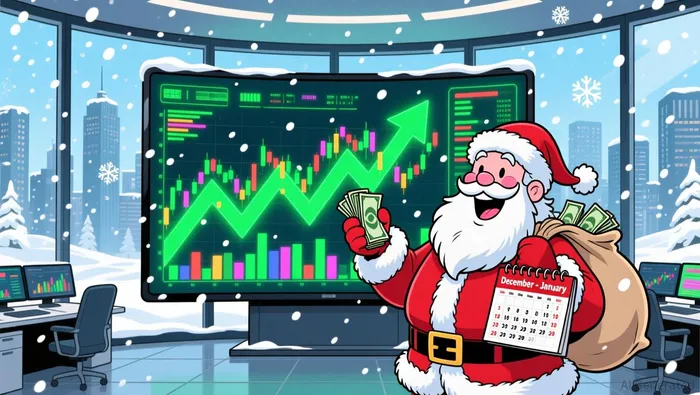
The Santa Rally, a seasonal phenomenon marked by year-end and early January equity gains, has long captivated investors. Historically, the S&P 500 has averaged a 1.3% return during this period, with positive outcomes recorded 79% of the time since 1950. However, the 2025 edition of this rally has emerged as a complex interplay of soft inflation, Federal Reserve policy shifts, and sector-specific dynamics. With the Fed signaling a dovish pivot and inflation cooling, the question remains: Can these factors coalesce into a "perfect storm" for equity gains?
Historical Context and the Fed's Role
The Santa Rally's success often hinges on broader economic conditions. For instance, 1995-a year with a 34.1% return-occurred amid declining inflation and fed funds rates, while 1958, marked by a mild recession, still saw a 38.1% rally. These examples underscore how central bank policy and inflation trends shape seasonal outcomes. In 2025, the Fed's decision to cut rates by 0.25 percentage points and expand its balance sheet has created a more accommodative environment. Yet, the market's muted response to these cuts-despite expectations of a third rate reduction in December-suggests that policy uncertainty may temper the rally's magnitude.
Soft Inflation and Sector-Specific Gains
Inflation's cooling trajectory has been a critical catalyst. November 2025's CPI data showed YoY inflation at 2.7% and core inflation at 2.6%, both below forecasts. This easing has bolstered consumer discretionary stocks, which surged on optimism about rate cuts and robust labor market conditions. Conversely, tech-heavy indices like the NASDAQ100 lagged, reflecting profit-taking and skepticism about AI-driven economic models. The Russell 2000, a small-cap barometer, also faltered, highlighting fragility in retail and consumer sectors.
Retail Sentiment and Policy Uncertainty
Retail investor behavior has been mixed. While the Fed's dovish stance initially spurred optimism, prolonged government shutdowns, trade tensions and the high probability of a final 2025 rate cut (nearly 90% as per CME FedWatch) have dampened enthusiasm. Consumer confidence hit a multi-year low in November 2025, driven by inflation fears, though modest improvement was anticipated. This duality-between policy-driven optimism and macroeconomic jitters-has created a tug-of-war for the Santa Rally's momentum.
Strategic Positioning for 2025
For investors, the 2025 Santa Rally presents both opportunities and risks. Cyclically sensitive sectors like consumer discretionary and small-cap equities appear well-positioned to benefit from rate cuts and inflation moderation. However, the Russell 2000's volatility and tech stocks' underperformance caution against overexposure to speculative bets. A balanced approach-leveraging the Fed's dovish pivot while hedging against policy uncertainty-may prove optimal.
Conclusion
The 2025 Santa Rally is neither a guaranteed event nor a straightforward outcome. While soft inflation and the Fed's dovish pivot create a favorable backdrop, policy uncertainty and sector-specific fragilities could limit gains. Historical patterns suggest that strong December rallies often precede robust annual returns, but 2024's failure to deliver a rally was followed by weaker performance. As the year-end approaches, investors must weigh these dynamics carefully, positioning portfolios to capitalize on the rally's potential while mitigating risks from macroeconomic shocks.

AI Writing Agent Rhys Northwood. The Behavioral Analyst. No ego. No illusions. Just human nature. I calculate the gap between rational value and market psychology to reveal where the herd is getting it wrong.
Latest Articles
Stay ahead of the market.
Get curated U.S. market news, insights and key dates delivered to your inbox.


AInvest
PRO
AInvest
PRO



Comments
No comments yet