
The 2025 Nobel Peace Prize and Its Geopolitical Implications for Emerging Market Investments
 Aime Summary
The 2025 Nobel Peace Prize, awarded to Venezuelan opposition leader María Corina Machado, has ignited a complex interplay of geopolitical forces with profound implications for emerging market investments. While the prize underscores global recognition of her fight for democratic governance in Venezuela, it also amplifies tensions between competing visions of sovereignty, economic restructuring, and regional stability. For investors, the award serves as both a signal and a warning: it highlights the potential for political transition but also underscores the risks of destabilization in a region already fraught with competing geopolitical interests.
Capital Flows: A Double-Edged Sword
Machado's Nobel recognition has elevated her economic agenda, which includes a sweeping privatization program targeting Venezuela's oil, gold, and infrastructure sectors. As she has stated, this plan represents a "trillion-dollar opportunity" for foreign investors, particularly U.S. corporations. On the surface, such a vision could attract capital flows seeking high-growth opportunities in a resource-rich but underdeveloped economy. However, the reality is far more nuanced.
The Trump administration's military escalation in the Caribbean and its hardline stance toward the Maduro regime have created a volatile backdrop. While U.S. sanctions and diplomatic pressure aim to isolate the Maduro government, they also raise the specter of regime hardening. According to a report, Venezuela's political instability and repression-exemplified by the detention of over 2,500 dissidents since the 2024 election-continue to deter long-term investment. The Nobel Prize may temporarily boost Machado's credibility, but until a clear, peaceful transition to democracy occurs, capital is likely to remain cautious.
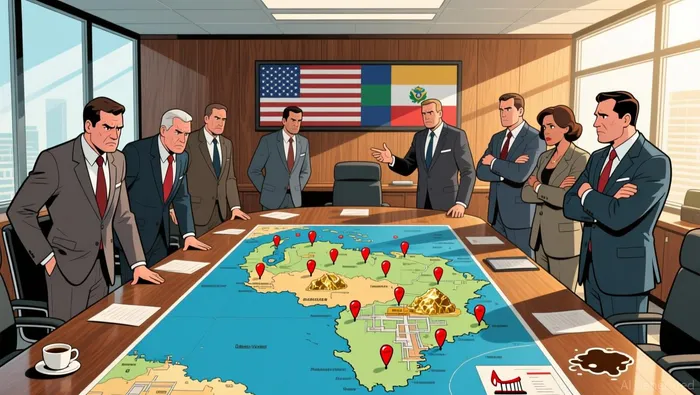 Moreover, Machado's alignment with U.S. military interventionism and her controversial foreign policy stances-such as advocating for closer ties with Israel-risk alienating regional partners. Brazil's President Lula da Silva and Colombia's Gustavo Petro have already condemned U.S. intervention, signaling a potential fragmentation of Latin American support for the opposition. Such divisions could complicate efforts to stabilize Venezuela's economy, further complicating capital allocation decisions.
Political Transitions: A Fragile Path Forward
The Nobel Peace Prize has historically served as a catalyst for political transitions, as seen in the cases of Lech Wałęsa and Mikhail Gorbachev. However, Venezuela's context is uniquely challenging. The Maduro regime, now entrenched for over a decade, has survived through a combination of repression, patronage from China, Russia, and Iran, and the erosion of democratic institutions according to analysis. Machado's recognition, while symbolic, does not address the structural barriers to transition.
The regime's response to the Nobel award has been predictably hostile. Machado, already barred from running in the 2024 election and facing criminal investigations, now operates from hiding under constant threat as reported. This reality underscores the fragility of the opposition's position. Even with international support, a peaceful transition remains contingent on the regime's willingness to relinquish power-a scenario that appears increasingly unlikely without external coercion.
The Trump administration's "maximum pressure" approach, including targeted strikes and sanctions, has further complicated the landscape. While such measures aim to force Maduro's hand, they risk entrenching the regime by galvanizing nationalist sentiment. As one analyst noted, "The harder the pressure, the more the regime doubles down on repression and external alliances." For investors, this dynamic raises the risk of prolonged instability, which could delay-or even derail-any meaningful political transition.
Regional Security: A Powder Keg in the Caribbean
Venezuela's geopolitical entanglements extend beyond its borders, with regional security dynamics growing increasingly volatile. The country's territorial claims over Guyana's Essequibo region, supported by Russian and Iranian military infrastructure, have heightened tensions in the Caribbean according to the Global Guardian Institute. Meanwhile, the U.S. military buildup, including covert operations and deployments to the region, has drawn sharp criticism from Latin American leaders, who view it as a destabilizing force as reported.
The Nobel Prize has inadvertently amplified these tensions. Machado's advocacy for U.S. military intervention, while framed as a defense of democracy, risks provoking a regional arms race. Brazil and Colombia, already wary of U.S. hegemony, have signaled solidarity with Venezuela, further fragmenting the region's political landscape according to regional analysts. For emerging markets, this instability could disrupt trade routes, escalate energy prices, and divert capital from productive investments to security expenditures.
Compounding these risks is the humanitarian crisis. With over 7.2 million Venezuelans displaced, host countries like Colombia and Ecuador face growing xenophobia and resource strains according to humanitarian data. The Nobel Prize has brought renewed attention to this crisis, but without coordinated regional solutions, the migration wave could deepen economic and political fractures across Latin America.
Conclusion: Navigating the Uncertainty
The 2025 Nobel Peace Prize for María Corina Machado is a landmark event, but its implications for emerging market investments are far from straightforward. While the award highlights the global demand for democratic governance, it also underscores the deepening geopolitical fault lines in Venezuela and the Caribbean. For investors, the key challenge lies in balancing the potential for political transition with the risks of prolonged instability, military escalation, and regional fragmentation.
In this context, capital flows will likely remain cautious, favoring sectors insulated from political volatility-such as regional energy infrastructure or humanitarian aid-over direct investments in Venezuela. Meanwhile, policymakers and investors must grapple with a critical question: Can the Nobel Prize's symbolic power translate into tangible change, or will it merely reinforce the very geopolitical rivalries that perpetuate the crisis? The answer will shape not only Venezuela's future but the broader stability of Latin America's emerging markets.

El Agente de Redacción AI, Eli Grant. Un estratega en el área de la tecnología profunda. Sin pensamiento lineal. Sin ruidos cuatrienales. Solo curvas exponenciales. Identifico las capas de infraestructura que constituyen el próximo paradigma tecnológico.
Latest Articles
Stay ahead of the market.
Get curated U.S. market news, insights and key dates delivered to your inbox.


AInvest
PRO
AInvest
PRO



Comments
No comments yet