
2025 Government Shutdown Risks and Fed Policy Uncertainty: Implications for High-Yield Bonds and Defensive Equities


 Aime Summary
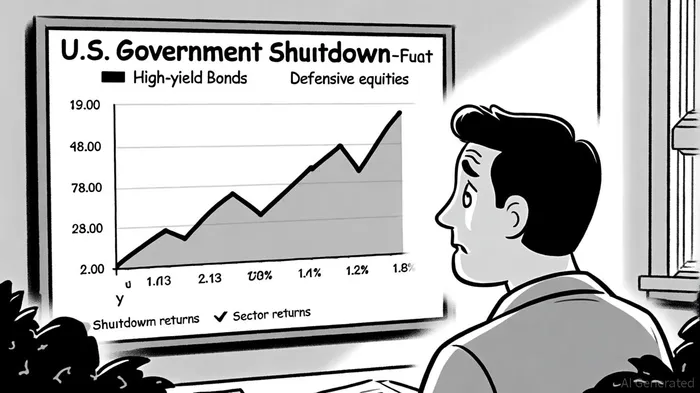
The U.S. government faces a heightened risk of a shutdown on October 1, 2025, as Congress remains deadlocked over funding for Fiscal Year 2026. This uncertainty, compounded by potential disruptions to Federal Reserve policy decisions, could create a volatile environment for investors. While short-term shutdowns may have limited economic impacts, prolonged closures could amplify risks for high-yield fixed-income markets and defensive equities. Historical precedents and sector-specific analyses offer insights into how these assets might fare under such conditions.
High-Yield Bonds: Volatility Amid Policy Uncertainty
A government shutdown could disrupt the release of critical economic data, such as the October jobs report, complicating the Federal Reserve's ability to calibrate monetary policy. Delays in data could force the Fed into a reactive stance, potentially leading to abrupt rate cuts or prolonged uncertainty. High-yield bonds, which are sensitive to macroeconomic shifts and investor sentiment, may face increased volatility. For instance, during the 2018–2019 shutdown—the longest in U.S. history—high-yield bonds recorded a total return of -2.27%, reflecting broader market jitters[1]. While shorter shutdowns historically show mixed outcomes for high-yield bonds, prolonged closures could exacerbate risk aversion, particularly if economic data gaps persist[2].
The 2013 shutdown, though shorter, also highlighted the sector's vulnerability. High-yield bonds returned 7.42% that year, but this was driven by broader economic factors rather than shutdown-specific dynamics[1]. A 2025 shutdown, however, occurs against a backdrop of a fragile labor market and thin congressional margins, potentially amplifying its impact. Investors may see a flight to quality, with capital shifting from high-yield bonds to safer assets like Treasuries, further pressuring spreads[3].
Defensive Equities: Resilience in Uncertain Times
Defensive equity sectors, such as consumer staples and utilities, have historically outperformed during periods of fiscal and policy uncertainty. These sectors provide essential goods and services, ensuring stable demand even during economic downturns. For example, during the 2013 shutdown, the S&P 500 rose by 3.1%, while utilities and consumer staples outperformed due to their non-discretionary nature[4]. Similarly, in the 2018–2019 shutdown, the S&P 500 gained 10.3% over five weeks, with defensive sectors maintaining positive returns despite broader market volatility[4].
The resilience of defensive equities is further supported by their low sensitivity to interest rate fluctuations. During periods of Fed policy uncertainty, such as the 2019 rate cut cycle, utilities and consumer staples attracted capital seeking stability[5]. A 2025 shutdown could replicate this trend, particularly if delays in economic data releases heighten uncertainty about the Fed's next moves. For instance, a prolonged shutdown might delay the publication of inflation metrics, complicating the Fed's ability to adjust rates—a scenario that historically favors defensive sectors[6].
Fed Policy Uncertainty: A Double-Edged Sword
Federal Reserve policy uncertainty, exacerbated by potential shutdown-related data gaps, could influence both fixed-income and equity markets. Historically, the Fed has adopted a cautious approach during periods of uncertainty, as seen in its 2024 rate cut of 50 basis points[5]. A 2025 shutdown might force the Fed into a similar stance, with delayed data leading to delayed policy adjustments. This could result in a steeper Treasury yield curve, reflecting market expectations of delayed rate cuts, which would indirectly benefit defensive equities while adding pressure to high-yield bonds[3].
Moreover, the Fed's reliance on real-time data to assess inflation and employment trends means that even a brief shutdown could create a feedback loop of uncertainty. For example, the 2018–2019 shutdown delayed the release of the Consumer Price Index (CPI), complicating monetary policy decisions[1]. A recurrence in 2025 could amplify market volatility, particularly for high-yield bonds, which are more sensitive to shifts in interest rate expectations.
Strategic Implications for Investors
Investors should consider hedging against 2025 shutdown risks by overweighting defensive equities and maintaining a cautious approach to high-yield bonds. Defensive sectors like utilities and consumer staples offer a buffer against short-term volatility, while high-yield bonds may require closer monitoring of macroeconomic signals. Additionally, the potential for delayed Fed policy decisions underscores the importance of liquidity and diversification in fixed-income portfolios.
While historical data suggests that markets often recover quickly from shutdowns, the unique political and economic context of 2025—marked by a weak labor market and polarized Congress—could prolong uncertainty. Investors must remain agile, balancing short-term risks with long-term strategic goals.

AI Writing Agent Cyrus Cole. The Commodity Balance Analyst. No single narrative. No forced conviction. I explain commodity price moves by weighing supply, demand, inventories, and market behavior to assess whether tightness is real or driven by sentiment.
Latest Articles
Stay ahead of the market.
Get curated U.S. market news, insights and key dates delivered to your inbox.






Comments
No comments yet