
2025's ETF Superstars: Metals, Policy Shifts, and the AI Boom Drive Triple-Digit Gains
Silver miners are up 177%. Metals are crushing it. Cannabis just ripped 55% in a single session. If you missed these moves, you're not alone but understanding what drove them could position you for what's next.
This year has rewarded investors who followed the macro signals. From central bank gold hoarding to AI-fueled power demand to Trump's executive order chatter on pot stocks, the winning trades all share one thing: they're backed by structural forces, not just momentum chasing.
Here's what's working, why it's working, and what the charts are telling us now.
Precious Metals Miners Lead the Charge
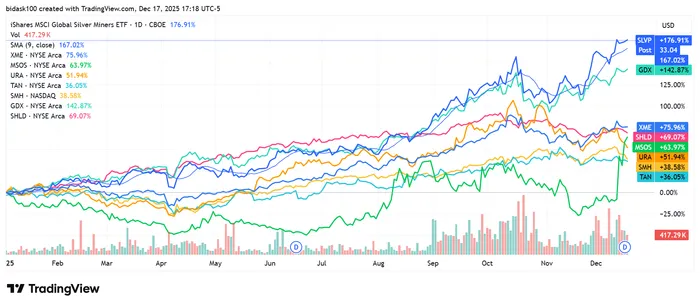
The undisputed champion of 2025 is the iShares MSCI Global Silver & Metals Miners ETF (SLVP), up a staggering 177% year-to-date. Close behind, the VanEck Gold Miners ETFGDX-- (GDX) has delivered a 143% return—its strongest annual performance in the fund's nearly two-decade history.
What's driving this extraordinary rally? Silver prices have doubled in 2025 to nearly $60 per ounce, propelled by a structural supply deficit now entering its fifth consecutive year. Industrial demand particularly from solar panels, electric vehicles, and 5G infrastructure consumes more than half of annual supply, while mine production and recycling simply cannot keep pace. Central bank buying from countries including Russia and Saudi Arabia has added fuel to the fire.
Gold miners have benefited from the yellow metal surging toward $4,000 per ounce amid persistent inflation, geopolitical tensions, and eroding trust in the U.S. dollar. Mining stocks have acted as leveraged plays on spot prices, with fixed production costs allowing margins to expand dramatically as metal prices climb.
SLVP's top holdings include Wheaton Precious Metals (WPM), Pan American SilverPAAS-- (PAAS), and First Majestic SilverAG-- (AG), names whose earnings are hypersensitive to silver price movements. GDX's portfolio centers on Newmont (NEM), Barrick Gold (ABX), and Agnico Eagle Mines (AEM), industry giants now benefiting from gold's breakout above 2011 highs.
Broad Metals Get a Lift
The State Street SPDR S&P Metals & Mining ETF (XME), up 76% year-to-date, offers a different angle on the commodities rally. Unlike its precious metals counterparts, XME provides exposure across aluminum, copper, gold, silver, steel, and coal producers.
The fund has benefited from infrastructure spending expectations, steel demand resilience, and copper's role in global electrification. Its diversified approach spanning companies like Hecla Mining (HL), Coeur Mining (CDE), and Cleveland-Cliffs (CLF) has attracted investors seeking broad commodity exposure rather than concentrated precious metals bets.
Cannabis: From the Ashes to Triple-Digit Gains
Perhaps no sector has experienced a more dramatic reversal than cannabis. The AdvisorShares Pure US Cannabis ETF (MSOS), up 64% year-to-date, has recovered spectacularly after losing more than 45% in 2024.
The turnaround began in July 2025 when news emerged that the federal government might reschedule cannabis from Schedule I to Schedule III under the Controlled Substances Act. President Trump's subsequent endorsement of CBD for health benefits and suggestion of Medicare coverage ignited fresh optimism, sending MSOS soaring over 100% in just three months.
The fund's concentrated portfolio—with top holdings Curaleaf (CURA), TerrAscend (TSND), and Village Farms International (VFF) has positioned it to capture any regulatory breakthrough. Should rescheduling materialize, these multi-state operators would benefit from banking access, tax relief from Section 280E elimination, and accelerated expansion plans.
Nuclear Renaissance Powers Uranium Gains
The Global X Uranium ETF (URA), up 52% year-to-date, reflects a fundamental shift in how the world views nuclear power. The fund's $5.16 billion in assets under management represents growing institutional conviction that uranium is essential infrastructure for the AI age.
The connection between artificial intelligence and nuclear energy may seem unexpected, but data centers powering AI workloads require massive amounts of continuous electricity something intermittent renewables cannot reliably provide. Major tech companies including Microsoft, Google, and Amazon have committed to nuclear-powered facilities, creating unprecedented demand for uranium.
URA's holdings span the nuclear supply chain: miners like Cameco (CCJ) and Denison Mines (DNN), fuel-cycle companies like Centrus Energy (LEU), and emerging players in small modular reactor technology. With uranium demand forecast to double by 2040 and the Reinvigorating the Nuclear Industrial Base Act reviving domestic enrichment capacity, the structural case for uranium remains compelling.
Solar's Surprising Comeback
After years of brutal underperformance, the Invesco Solar ETF (TAN) has staged a 36% rally in 2025. The fund tracks global solar energy companies including First Solar (FSLR), Enphase Energy (ENPH), and Nextpower (NXT).
Favorable macro conditions have shifted solar from speculative to structural infrastructure: stable interest rates, robust corporate power purchase agreements, and Inflation Reduction Act incentives have all contributed. However, recent Senate legislation proposing to phase out renewable energy credits has introduced volatility, reminding investors that policy risk cuts both ways in the clean energy space.
Defense Tech Capitalizes on Geopolitical Tensions
The Global X Defense Tech ETF (SHLD), up 69% year-to-date, has emerged as the standout performer in the defense space by focusing on next-generation military technology rather than traditional aerospace contractors.
SHLD's portfolio emphasizes companies positioned to benefit from the increased adoption of defense technology including cybersecurity systems, artificial intelligence, robotics, drones, and advanced weapon systems. Top holdings include Palantir Technologies (PLTR), RTX (RTX), General Dynamics (GD), Lockheed Martin (LMT), and Germany's Rheinmetall, giving investors exposure to both U.S. defense giants and European players ramping up production amid heightened geopolitical tensions.
Semiconductors: The AI Infrastructure Play
The VanEck Semiconductor ETF (SMH), up 38% year-to-date, remains the go-to vehicle for investors seeking exposure to AI's enabling technology. The fund's top holdings—Nvidia (NVDA), TSMC (TSMC), Broadcom (AVGO), and AMD (AMD) are the companies building the chips that power everything from data centers to autonomous vehicles.
However, SMH's technical picture gives some pause. With valuations stretched at roughly 43 price to earnings and heavy concentration in just three holdings accounting for over 30% of assets, the fund faces heightened risk should AI infrastructure spending slow. Bank of America has warned of a potential "AI air pocket" in 2026 where a pause in capital expenditure could pressure growth stocks.
What These Winners Tell Us
This year's ETF leaders share important characteristics worth noting. They benefited from powerful, identifiable catalysts: supply deficits in precious metals, policy shifts for cannabis, AI energy demands for uranium, government spending for defense. The best performers combined strong fundamentals with thematic tailwinds that accelerated over the course of the year.
For investors evaluating these funds, understanding both the opportunity and the risks is essential. Precious metals miners remain sensitive to commodity price swings. Cannabis faces ongoing regulatory uncertainty. Semiconductor valuations require continued AI spending to justify current prices. These are not buy-and-forget instruments but thematic positions requiring active monitoring of the macro forces that drive them.
Quickly compare any ETF side-by-side with our ETF Compare Tool

Senior strategist with 20+ years experience delivering data-driven research, ETF and stock analysis, and practical investment ideas.
Latest Articles
Stay ahead of the market.
Get curated U.S. market news, insights and key dates delivered to your inbox.
AInvest
PRO
AInvest
PRO



Comments
No comments yet