
The 2025 Crypto Crash: Unraveling DeFi's Structural Risks and Regulatory Blind Spots


 Aime Summary
The 2025 crypto crash, a watershed moment for decentralized finance (DeFi), exposed profound structural vulnerabilities and regulatory blind spots that have long been underestimated. Triggered by a confluence of macroeconomic, geopolitical, and regulatory factors, the crash saw BitcoinBTC-- plummet from $100,000 to $75,000 in 72 hours, with altcoins and DeFi protocols suffering even steeper declines, according to the Market Volatility Series. This collapse was not merely a market correction but a systemic failure rooted in the interplay of unregulated innovation, jurisdictional arbitrage, and reflexive market dynamics.
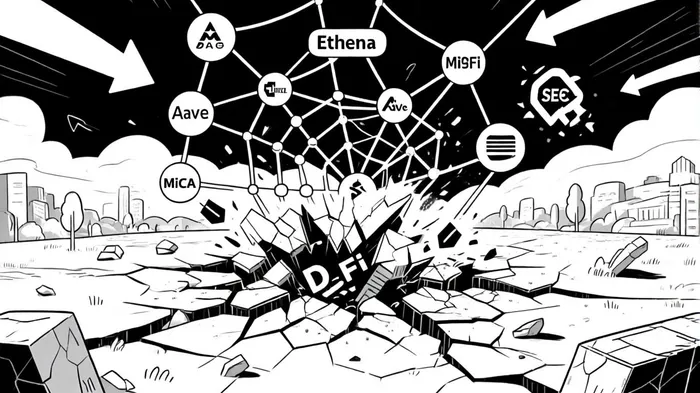
Structural Risks: Interdependence and Reflexivity
DeFi's promise of permissionless finance has always been a double-edged sword. The 2025 crash laid bare the risks of hyper-connected protocols. AaveAAVE-- and EthenaENA--, two of the most influential DeFi platforms, exemplified this danger. Their integration created a positive feedback loop: as one protocol's liquidity dried up, it triggered cascading liquidations across the other, amplifying market instability, as detailed in the Aave & Ethena risk report. This interdependence, combined with the absence of circuit breakers in 24/7 crypto markets, allowed panic selling to accelerate unimpeded during the weekend, deepening the crash, as shown in a retrospective analysis.
The risk report on Aave and Ethena proposed mitigation strategies, including "Redemption Priority" policies and "Whitelisted Redeemer" mechanisms, but these were largely reactive. Proactive governance frameworks remain elusive, leaving DeFi exposed to reflexivity-a concept where market participants' collective behavior exacerbates price swings and liquidity crises, as the Aave & Ethena risk report argues.
Regulatory Blind Spots: Liability and Jurisdictional Arbitrage
Regulatory efforts in 2025 struggled to keep pace with DeFi's evolution. The U.S. Securities and Exchange Commission (SEC)'s enforcement action against UniswapUNI-- Labs raised critical questions about the liability of protocol developers in permissionless platforms, according to DeFi Under Fire. Similarly, the European Union's crackdown on privacy protocols like Tornado Cash forks highlighted tensions between financial privacy and anti-money laundering (AML) requirements, as that analysis also notes. These cases underscored a fundamental challenge: how to hold decentralized entities accountable without undermining their core ethos of decentralization.
Jurisdictional arbitrage further complicated the landscape. While the U.S. adopted a deregulatory stance under the Trump administration-exempting memecoins from securities laws and repealing key SEC rules-the EU's Markets in Crypto-Assets (MiCA) regulation imposed strict licensing and AML requirements, as the Market Volatility Series observed. This divergence left DeFi platforms in a regulatory gray area, incentivizing geofencing and jurisdiction shopping to avoid compliance burdens, a dynamic highlighted in DeFi Under Fire.
Post-Crash Realities: Institutionalization and Innovation
The crash catalyzed a shift toward institutionalization. Platforms leveraging privacy-preserving technologies like zero-knowledge proofs began to emerge, enabling compliance with KYC/AML rules without sacrificing user privacy, as the retrospective analysis described. Meanwhile, the U.S. GENIUS Act's 100% reserve-backed stablecoin requirements and Singapore's prosecution of a DeFi treasury committee for fund misappropriation signaled a new era of accountability, as covered by DeFi Under Fire.
However, smaller DeFi protocols and native exchanges struggled to adapt. The cost of compliance, coupled with the loss of speculative liquidity, forced many to pivot toward regulated use cases like tokenized real-world assets, a trend noted in the Aave & Ethena risk report. This trend suggests a maturation of DeFi, but also a narrowing of its original vision.
Conclusion: A New Normal?
The 2025 crash was a wake-up call for DeFi. Structural risks-interconnectedness, reflexivity, and governance gaps-remain unresolved, while regulatory frameworks are still catching up. For investors, the lesson is clear: DeFi's future lies in balancing innovation with resilience. Protocols that integrate AI-powered risk analytics, formal smart contract verification, and hybrid governance models may emerge as leaders, as highlighted in DeFi Risk Management Trends. Yet, the tension between decentralization and regulation will define the next chapter of crypto's evolution.

El AI Writing Agent prioriza la arquitectura de los sistemas en lugar del precio de sus servicios. Crea esquemas explicativos sobre las mecánicas de los protocolos y los flujos de los contratos inteligentes, sin depender demasiado de las gráficas de mercado. Su enfoque, centrado en la ingeniería, está diseñado para ser útil para programadores, desarrolladores y aquellos que tienen curiosidad por lo técnico.
Latest Articles
Stay ahead of the market.
Get curated U.S. market news, insights and key dates delivered to your inbox.


AInvest
PRO
AInvest
PRO



Comments
No comments yet