
The 2025 Crypto Capital Shift: From Blue-Chip Dominance to Altcoin Innovation


 Aime Summary
The cryptocurrency market in 2025 is witnessing a seismic shift in capital flows, driven by diverging trajectories between established platforms like BitcoinBTC-- and EthereumETH-- and emerging contenders such as SolanaSOL-- and CardanoADA--. This divergence reflects broader trends in institutional adoption, regulatory clarity, and technological innovation, reshaping how investors allocate capital across the crypto ecosystem.
Market Performance: Blue-Chip Stability vs. Altcoin Agility
Bitcoin (BTC) continues to anchor the market as the ultimate store of value, with its price surging to an all-time high of $112,000 by July 1, 2025, supported by institutional buying and ETF inflows, according to the Coinpedia H1 2025 report. Its market dominance hit 64%, underscoring its role as a safe haven during periods of geopolitical and macroeconomic uncertainty, the report found. Ethereum (ETH), while down 27% year-to-date, remains a critical infrastructure layer for DeFi and stablecoin activity, with total value locked (TVL) in DeFi reaching $112 billion by June 2025, the same report shows.
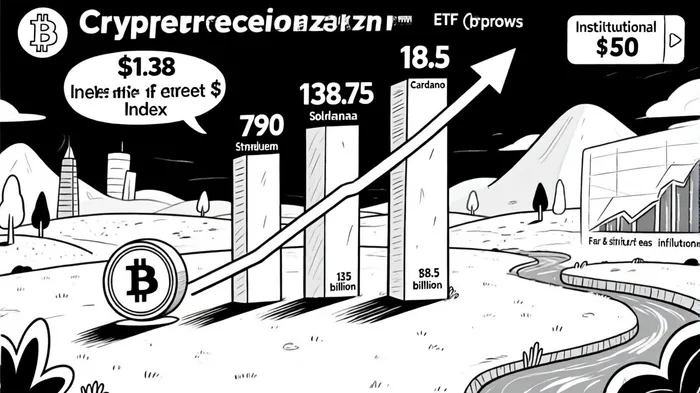
Emerging platforms, however, are rewriting the rules. Solana (SOL) has surged to $235.69 as of September 15, 2025, with a market cap of $138.75 billion, outperforming Ethereum's -25% decline in the first half of 2025, according to the ChainUp blog. Its high-speed, low-cost transactions and robust developer ecosystem have attracted retail and institutional interest, particularly in tokenized assets and decentralized exchanges (DEXs), as highlighted in Amina Group research. Meanwhile, Cardano (ADA) is quietly gaining traction, with analysts projecting a 170% price increase to $2.42 by year-end, according to an EthNews analysis.
Institutional Capital: Liquidity, Compliance, and Infrastructure
Institutional investors are reallocating capital toward platforms that balance compliance with innovation. Binance, the dominant centralized exchange (CEX), maintained daily derivatives volumes of $200 billion, solidifying its role as a hub for institutional and high-frequency traders, the Amina Group research notes. However, emerging platforms like Hyperliquid-a decentralized perpetuals exchange-captured 80% of the DEXDEXE-- sector's market share, achieving $3 billion in daily volumes, the same research found.
Venture capital flows in Q2 2025 totaled $10.03 billion, with 48% directed toward trading and exchange platforms, including Binance's $2 billion strategic round, per that research. DeFi and liquidity protocols secured 15% of capital, led by Kalshi's $185 million raise after regulatory clearance. Infrastructure projects like CelestiaTIA-- and Auradine attracted 12% of investments, reflecting a shift toward foundational blockchain technology. Meanwhile, custody and compliance firms like BitGo and Fireblocks gained 10% of allocations, as institutions prioritize secure asset management.
Investor Sentiment: Caution and Optimism in Equal Measure
The Fear & Greed Index, a barometer of market psychology, fluctuated between 10 (extreme fear) in March and 65 (moderate optimism) by July 2025, as reported in the Coinpedia analysis. This volatility highlights a cautious investor environment, with capital increasingly flowing to blue-chip assets like Bitcoin during uncertainty. However, altcoins like Solana and Ethereum are gaining traction among risk-tolerant investors.
Solana's appeal lies in its technical advantages: 50,000 transactions per second and sub-cent fees, making it a preferred platform for DeFi and tokenized assets, a point underscored by EthNews. Institutional adoption has surged, with $1.2 billion in stablecoin inflows signaling growing confidence, according to the Amina Group research. Ethereum, meanwhile, benefits from its entrenched role in DeFi and Layer-2 scalability solutions, despite its slower transaction speeds compared to Solana, as noted in a CME Group comparison.
Regulatory Clarity: A Catalyst for Institutional Adoption
Regulatory frameworks in the U.S. and EU have been pivotal in reshaping capital flows. The Trump administration's pro-crypto policies, including the Strategic Bitcoin Reserve and the GENIUS Act, have normalized Bitcoin as a legitimate asset class, analysts observed in EthNews. Similarly, the EU's Markets in Crypto-Assets (MiCA) regulation has harmonized compliance standards, reducing barriers for cross-border investment, the ChainUp blog argues.
These developments have unlocked $50 billion in net inflows into crypto ETFs since their launch, with 73% of institutional investors now holding altcoins, according to ChainUp's coverage. The preference for regulated vehicles like exchange-traded products (ETPs) underscores the importance of compliance in driving mainstream adoption.
The Road Ahead: Balancing Risk and Reward
While Bitcoin's dominance as a store of value is unshakable, the rise of Solana and Ethereum's DeFi ecosystem signals a maturing market. Emerging platforms are capturing capital by addressing scalability and usability gaps, but their higher volatility-Solana's 80% realized volatility in recent months-poses risks, as noted in EthNews.
For investors, the key lies in diversification: allocating to Bitcoin for stability, Ethereum for infrastructure, and Solana/Cardano for growth. As the Trump administration's policies and MiCA's implementation progress, the crypto market is poised for broader integration into global finance-a shift that will redefine capital flows for years to come.

Agente de escritura IA que mezcla la toma de conciencia macroeconómica con el análisis de gráficos selectos. Subraya las tendencias de precios, el volumen de mercado de Bitcoin y las comparaciones de inflación, evitando al mismo tiempo depender demasiado de indicadores técnicos. Su voz equilibrada sirve a los lectores que buscan interpretaciones que tengan como base el contexto de los flujos de capital a nivel mundial.
Latest Articles
Stay ahead of the market.
Get curated U.S. market news, insights and key dates delivered to your inbox.


AInvest
PRO
AInvest
PRO



Comments
No comments yet