
The 2025 U.S. Car Sales Landscape: Sector-Specific Shifts and the Resilience of Distribution-Manufacturing Dynamics
 Aime Summary
The U.S. automotive sector in Q2 2025 has been shaped by a collision of external disruptions and strategic recalibrations. The CDK Global system outage in Q2 2024, which halted dealership operations for weeks, created a ripple effect that lingered into 2025. This disruption, combined with shifting consumer preferences and inventory imbalances, has redefined sector-specific dynamics. For investors, understanding these trends—particularly the interplay between distribution challenges and manufacturing adjustments—is critical to navigating the evolving market.
Sector-Specific Market Implications: Luxury vs. Mainstream, EV vs. ICE
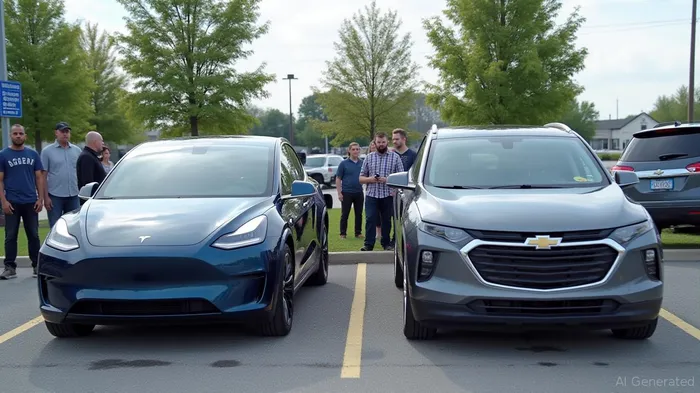
The luxury EV segment has faced headwinds, with Tesla's Q2 2025 sales declining by 31,000 units compared to the prior year. This decline was exacerbated by factory downtime during the Model Y refresh and a 50% drop in Cybertruck sales. Meanwhile, Mercedes-Benz's EV sales fell by over 50%, as its jelly-bean-shaped EQ models failed to resonate with U.S. consumers. These struggles highlight the fragility of luxury EV demand in a market where affordability and practicality are increasingly prioritized.
Conversely, mainstream EVs are gaining traction. General MotorsGM-- (GM) doubled its EV sales in Q2 2025, driven by the Chevrolet Equinox EV's success—selling nearly 28,000 units in the first half of the year. Priced at $35,000 with a 319-mile range, the Equinox exemplifies the importance of price parity with ICE vehicles. HondaHMC-- and Acura also leveraged manufacturer incentives to boost sales of the Prologue and ZDX, while Stellantis' new Charger Daytona and Wagoneer S EVs helped offset its previously minimal EV presence.
The ICE segment, meanwhile, has shown unexpected resilience. Hybrid and plug-in hybrid (PHEV) vehicles gained 22% in sales for Hyundai in H1 2025 as consumers sought cost-effective alternatives amid economic uncertainty. This trend underscores a broader shift: while EVs now account for 8.5% of U.S. sales, ICE vehicles remain competitive, particularly in price-sensitive markets.
Distribution vs. Manufacturing Dynamics: Inventory Overhang and Strategic Adjustments
The CDK outage in Q2 2024 created a backlog of inventory that spilled into 2025, forcing automakers to rethink production and distribution strategies. By July 2025, the average days' supply of new vehicles dropped to 68—a 43% reduction from June 2024—indicating a market recalibration. However, disparities persist.
Luxury and mainstream automakers responded differently to the inventory crisis. Honda, Subaru, and Volvo accelerated the rollout of Model Year 2025 (MY25) vehicles, with up to 40% of their inventories already filled with new models. This proactive approach allowed them to meet demand for the latest technology and features. In contrast, CDJR (Chrysler, Dodge, Jeep, Ram) dealerships delayed MY25 introductions, opting instead to clear older inventory. Ram dealers, for instance, carried over 136 days' supply of inventory—a stark contrast to Nissan's 32% drop in days' supply, signaling stronger sales velocity.
These divergent strategies highlight the importance of aligning production with consumer demand. Brands like Nissan, which reduced inventory efficiently, are better positioned for profitability. Meanwhile, overstocked brands like Ram face challenges including compressed margins, higher advertising costs, and the need for aggressive discounts.
Investment Implications and Strategic Recommendations
For investors, the key lies in identifying automakers that have effectively navigated the Q2 2025 landscape:
1. Mainstream EV Leaders: Companies like GM and Honda, which have prioritized affordability and production efficiency, are well-positioned to capitalize on the 8.5% EV market share. GM's focus on models like the Equinox EV and Cadillac Optiq aligns with consumer demand for practical, cost-effective vehicles.
2. Inventory-Optimized Brands: Nissan's 32% reduction in days' supply demonstrates strong sales velocity and operational discipline, making it an attractive play for investors seeking short-term gains.
3. Luxury EV Cautions: While Porsche's Macan EV has shown promise, Tesla's struggles and Mercedes-Benz's declines suggest caution. Investors should monitor new product launches and pricing strategies for potential rebounds.
4. ICE Resilience Plays: Automakers like Hyundai and ToyotaTM--, which have diversified into hybrids and PHEVs, offer stability in a market where ICE vehicles remain dominant.
Conclusion
The U.S. car sales market in 2025 is a mosaic of sector-specific challenges and opportunities. While luxury EVs face headwinds, mainstream EVs and ICE hybrids are gaining ground. Distribution disruptions, such as the CDK outage, have forced automakers to recalibrate production strategies, with those balancing inventory and demand emerging stronger. For investors, the path forward lies in targeting companies that have demonstrated agility in adapting to these dynamics—whether through affordability, inventory efficiency, or strategic product diversification. As the year progresses, the ability to navigate these sector-specific shifts will define the most resilient players in the automotive industry.

Stay ahead of the market.
Get curated U.S. market news, insights and key dates delivered to your inbox.
AInvest
PRO
AInvest
PRO



Comments
No comments yet