
The 2025 Auto Industry Crossroads: Tariffs, EV Slumps, and What's Next for Retailers and Investors


 Aime Summary
2025 has been a pivotal year for the automotive industry, with shifting trade policies, rising interest rates, and the expiration of creating a complex environment for manufacturers, dealers, and investors. Retailers are adapting to declining EV demand, while new vehicle sales have shown resilience despite a challenging backdrop. At the same time, M&A activity is on the rise as companies consolidate to navigate the uncertainty. For investors, understanding the current dynamics is key to spotting opportunities and mitigating risks.
The automotive retail sector is facing a perfect storm of external pressures. Tariff uncertainty and the expiration of EV tax credits have led consumers to delay purchases of 2026 models, pushing up demand for 2025 models before expected price increases 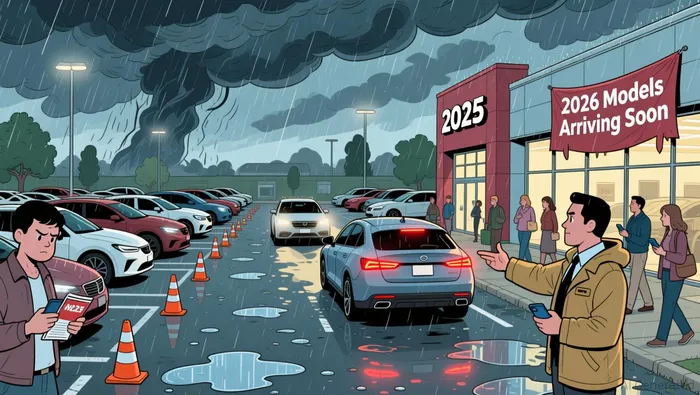 . As a result, , according to Cox Automotive. However, this optimism is tempered by a sharp decline in electric vehicle sales, , accounting for only 6% of total sales according to a report.
is also facing a significant headwind. The U.S. is expected to see a nearly 40% drop in EV sales in Q4 2025, according to a forecast. TeslaTSLA--, the market leader in the EV space, , potentially gaining market share from more deeply affected brands according to a forecast. Meanwhile, , compared to 56 models with internal combustion engines, making affordability a critical issue for mass adoption according to a forecast.
Despite the challenges, according to a report. This was largely driven by consumers accelerating purchases of new vehicles before anticipated . Dealers have also adapted by enhancing the and diversifying revenue through service offerings, which have become increasingly important in a slower new vehicle sales environment.
Looking ahead, the U.S. automotive landscape remains uncertain. In 2026, , primarily due to slower economic growth and the absence of EV tax incentives . Used car inventories, already below historical averages, are unlikely to improve until the market stabilizes. Additionally, rising interest rates are affecting consumer financing, making it more expensive to buy new cars. These factors suggest that the industry may not return to pre-2025 growth levels any time soon.
From an M&A perspective, the automotive and transportation sector is seeing increased activity. According to a report from Dykema, according to Dykema. This is being driven by , technological advances, and . However, , highlighting the ongoing uncertainty caused by and high interest rates according to financial data. Still, , showing that while smaller deals have become more common, larger, strategic transactions remain significant.
For investors, understanding the risks and opportunities in the is essential. The sector is facing a mix of : on one hand, , , and high financing rates are pressuring profitability. On the other, companies that can adapt through innovation, M&A, and may emerge stronger. The transition to , while still uncertain, could also reshape the industry in the coming years.
Looking further ahead, the forecast for 2026 is mixed. While North America and Europe are expected to see modest declines in 2025, their 2026 outlook is more optimistic according to a forecast. In contrast, , with Brazil and Argentina facing the most significant reductions according to a forecast. Meanwhile, according to a forecast.
In summary, the automotive industry in 2025 is at a crossroads. While new vehicle sales have held up relatively well, the is struggling, and remains a wildcard. Dealers and automakers are adapting to these challenges through and customer-focused improvements. For investors, the key takeaway is to stay informed and flexible. The sector is likely to see continued volatility, but for those who can identify companies with strong fundamentals and , there may still be opportunities for growth.

Delivering real-time insights and analysis on emerging financial trends and market movements.
Latest Articles
Stay ahead of the market.
Get curated U.S. market news, insights and key dates delivered to your inbox.
AInvest
PRO
AInvest
PRO



Comments
No comments yet