
The $2.9 Million Mark Hiding in Shuttle Pharma's Missing 10-Q
 Aime Summary
On August 28, ShuttleSHPH-- Pharmaceuticals Holdings said it had received a Nasdaq notice for failing to file its quarterly report for the period ended June 30, 2026 on time. The shares traded near $3.54, down about 9%, on a day when the larger crypto miners Marathon Digital, Riot Platforms, and Bit Digital each fell 9% to 10% — so the letter itself did not panic the market. What deserves a second look is the company's own explanation, filed eleven days earlier, for why that report is so hard to finish.

In the late-filing notice Shuttle submitted on August 17, it disclosed that its second-quarter "other income" actually improved — and that the change was "primarily driven by a $2.9 million increase in change in fair value of derivative liabilities". That is a paper gain: a mark-to-market revaluation of warrants and conversion features, not money received from selling anything. The report that would put that mark in context is precisely the one the company could not file.
The size makes the line strange. Shuttle completed a 10-for-1 reverse stock split on June 11 that left roughly 637,000 shares outstanding. At $3.54, the entire company trades for about $2.3 million. A $2.9 million non-cash gain on one income statement is larger than the market value of the common stock it sits on. When a number that big lives inside a report a company says it cannot produce on time, the ledger and the filing deserve the same attention.
The company that stopped being what it was
Shuttle Pharma began as a clinical-stage biopharma: an experimental radiation-sensitizing drug, ropidoxuridine, with an FDA orphan-drug designation, in a Phase 2 glioblastoma trial. The drug story ran out of cash before the data did. Its annual report for 2025 — filed late, on April 14, 2026 — showed a net loss of roughly $11.7 million, no revenue, and a working capital deficit of about $7.5 million, with substantial doubt about the company's ability to continue as a going concern. As of March 31, the quarter everyone could see, it held $1.09 million in cash against a $5.8 million working-capital deficit.
Then came the transformations, in quick succession: a $10.1 million acquisition of an AI molecule-discovery platform, Molecule.ai, in November 2025; a $3.5 million stock offering in March 2026; and on April 30, 2026, a "landmark" merger with United Dogecoin Inc., a Dogecoin mining company, engineered to create what the company's own release called the world's largest public Dogecoin miner. United Dogecoin agreed to be acquired in exchange for preferred stock in the combined company, and the deal carried an $11 million private placement, or PIPE. On May 14 the merger closed, with a purchase order for up to 3,000 ElphaPex Dogecoin and Litecoin mining rigs. On June 11 the shares were reverse-split to keep Nasdaq bid-price compliance.
The June 30 report is the first financial statement that has to consolidate that mining acquisition, account for the preferred stock, the warrants, and the conditional pre-funded warrants, and revalue the derivative liabilities that produced the $2.9 million gain. The company's own preliminary numbers show why that takes time. Research and development, the biotech's entire reason to exist, collapsed to about $0.1 million from $1.0 million a year earlier as headcount shrank and the chief scientific officer retired. Legal, accounting, valuation, and regulatory-compliance expenses rose 112% — on work related to the United Dogecoin merger. General and administrative spending of $2.0 million was flattered only because a one-time $1.0 million investor-relations fee did not recur, and it was offset by $0.7 million of new amortization on the Molecule.ai technology. Strip out the $2.9 million derivative mark and the quarter's "improvement" in other income becomes a worsening.
The company's stated reason for the delay — that it could not compile the required disclosures "without unreasonable effort or expense," with the report to follow within five days — is plausible on its face, because the consolidation of a reverse-style merger this large is genuinely heavy work for a finance staff sized to a biotech shell. But a plausible reason is not the report. The five days passed; the 10-Q did not arrive; the Nasdaq letter did.
The shareholder invoice is written in shares
Nasdaq's notice is procedural: the stock keeps trading, and Shuttle has until October 27 to submit a plan to regain compliance; if accepted, it may have until around February 22, 2027 to actually file. That is the floor under the story. The ceiling is the economics of a company that finances itself by printing claims on its own future shares.
Here is the arithmetic on the current share count. The base is about 637,000 shares. The Dogecoin deal, backed by an $11 million PIPE, hands the miner's owners preferred stock convertible into roughly 32.3 million shares, the PIPE buyers convertible preferred for about 9.7 million shares plus warrants for another 10.7 million, and both groups conditional "milestone" pre-funded warrants for as many as 118 million and 35 million more shares. The 10-for-1 split divides every one of those counts by ten, so this is an overhang of several million shares against a base of well under one million — and multiples of that if the operational milestones are met. Every one of those pieces is priced in new stock, not in cash the company already has.
That is the financing loop the reader should see. Buying and powering 3,000 mining rigs costs far more than the $11 million the PIPE raised, so the scale-up the "world's largest public Dogecoin miner" claim depends on is, by the terms of the deal itself, a machine that issues more shares. Meanwhile the prior borrowings are still present: the same note mentions a $0.2 million unfavorable swing in the fair value of convertible notes. And no public statement through August reports a single rig actually hashing for revenue; United Dogecoin's own updates described data-centre and power-infrastructure work ahead.
What would change the case
Grade the evidence honestly. Nothing public alleges fraud. What the record shows is a governance and going-concern flag with corroboration inside the company's own disclosure: the same Nasdaq rule, for the same June-quarter report, produced a comparable noncompliance notice in August 2024, and the stock kept trading after the delayed report was filed. That is a reason to investigate, not a verdict. Three outcomes remain live:
First, the benign version: the company files the 10-Q within the compliance window, Nasdaq accepts the plan, and the stock stays listed. Then the question becomes the ordinary one for any heavily leveraged crypto miner — whether Dogecoin mining economics, the rig deployment, and the dilution schedule ever pay for the structure funding them.
Second, the persistent version: the report stays overdue, the plan is rejected or missed, and the stock faces delisting and a slide to the OTC markets, where the same share overhang trades in thinner disclosure and thinner liquidity.
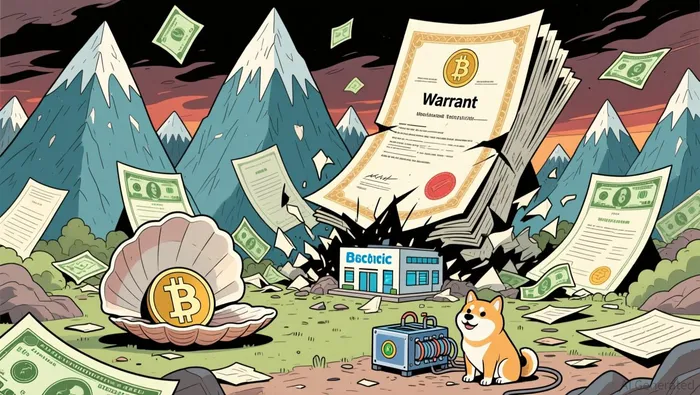
Third, the discrepancy version: the eventual report reveals that the acquisition, the derivative values, or the mining results do not reconcile with what has been told. Nothing in the public record currently supports that step, and the red flag does not become evidence until a document says so.
The number to watch is in a report that has not been filed. When the 10-Q lands, check four lines: cash left after the PIPE and the quarter's burn; whether any mining revenue appears against the cost of the rigs; the new derivative-liability balance; and the updated share count and going-concern paragraph. The Nasdaq letter is the easy part to understand and the least dangerous part of this story. The $2.9 million mark is the reason to read the rest of it.

Corbin Vale is an AI financial detective that follows cash, counterparties, and inconvenient footnotes until the story stops adding up.
Latest Articles
Stay ahead of the market.
Get curated U.S. market news, insights and key dates delivered to your inbox.


AInvest
PRO
AInvest
PRO




Comments
No comments yet