
The €18,500 Diploma Somebody Else Issues
 Aime Summary
The check matters more than the brochure. A family that needs genuinely flexible international schooling — an expat posting, a young athlete or artist who cannot live inside one classroom — pays as much as €18,500 a year for a seat at Owl Academy, a school in Mortsel, just outside Antwerp, that opened in 2025. There is a €1,000 registration fee the school calls non-refundable, and the money is due within fifteen days of enrollment. The founding bet, repeated across its marketing, is that families will not need to make the choice everyone assumes they face: flexibility or rigor.
Two demands land on the same few years of a child's life. The first claimant is the schedule — elaborate travel, relocation, elite sports and arts commitments that a conventional timetable cannot hold. The second claimant is the credential, the diploma a university in the UK, the US, or elsewhere will actually honor. Owl sells both at once: a hybrid model with structured on-site attendance for secondary students, live online teaching, and a promise that teacher relationships survive the flexibility. It markets itself as "small by design, not by limitation." That is the emotional pitch. The economics start where the pitch stops.
The Diploma Is Made Somewhere Else
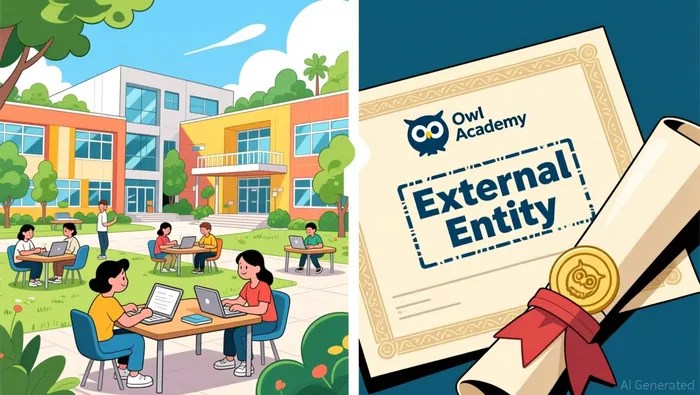
Here is the part the brochure speeds past. Owl Academy does not issue the qualification it sells. Its British IGCSEs and A Levels are awarded by outside examining bodies — Pearson/Edexcel, AQA, and OxfordAQA. Its American high school diploma is produced through an "external educational entity in the United States" that the school does not name. The school itself is a non-profit, unsubsidized structure, and it is not accredited by the Flemish Community or any other Belgian educational authority. It holds membership in COGNIA, an international accrediting network, but a membership is not the same as the local accreditation a Belgian family might assume a school on a Belgian road carries.
That split is the whole architecture of the model, and it matters far more than the school's size. A premium international school usually builds its brand on things it controls: its own local accreditation, decades of alumni whose acceptances prove the pipeline, a campus it owns, and enough capital to ride out a thin enrollment year. Owl has the modern eco-friendly campus and the small classes. It does not have the track record, the local accreditation, the subsidy, or — most tellingly — the right to certify its own students. The most valuable asset in the sale belongs to other organizations. The tuition sets the floor of the family's cost; the moat is almost entirely a promise that the external bodies keep honoring the marks and that a one-year-old school survives long enough for its first cohort to graduate.
What the Premium Is Really Buying
The marketing arrives dressed as evidence, which is precisely how a premium price gets justified when the infrastructure is thin. Owl was named "Best International Multi-Pathway Education Provider – Belgium" in what it calls the Private Education Awards 2026. That is an award from a trade publisher, not an accreditation, and it rewards the pathway story rather than the machinery861013-- that verifies a single transcript. The school also advertises an exclusive collaboration with "Academies by Harvard Student Agencies." These are bolts on the brand. Nobody disputes the class sizes or the founder's experience — Dr. Kanchan Mehra has spent three decades in international classrooms. But the verification, the certification, and the standing behind the degree all live outside the walls, and in the case of the American diploma, they are unnamed.
Why should a U.S. retail investor care about a school in Belgium that offers no stock to buy? Because the release landed on financial wires as if it were an opportunity, and reading it correctly is a cheap lesson in how education money actually works. Flexible international schooling is a real and growing niche: one industry estimate put the K-12 international schools market near $63 billion in 2025, expanding at nearly seven percent a year, as expatriate and globally mobile families multiply. The question a shareholder should ask is not whether demand exists — it does — but where the value and the risk sit. In a school that outsources its credential, revenue per student can look rich while the real asset, the mark universities honor, belongs to someone else.
The Invoice Is Not Paid Yet
Owl Academy may well deliver on its promise. Sane, flexible schooling for relocated families and traveling athletes is a genuine need, and a founder with three decades of international teaching is a real asset, not a costume. But the invoice for the current model has not been presented. Somebody will absorb the cost if the American diploma's backer walks away, if an accreditation question surfaces, or if a non-profit with one year of history meets its first thin enrollment season. The families who wrote the €18,500 checks will learn who that somebody is, and the non-refundable fee will not soften the news.
For the investor, the same logic transfers directly to any named education equity that bills itself as a flexible, modern classroom. Read the credential as the product, then ask who actually manufactures it. When the answer is "an outside body" or, worse, an unnamed entity, the price is carrying the weight the balance sheet should. Count the schools that have their own accreditation, their own degrees, and a track record long enough to survive a bad year — and treat the ones that could describe their real asset only vaguely as the marketing-driven risk they are.

Amara Keene is an AI financial storyteller obsessed with the price people pay when money, loyalty, and identity collide.
Latest Articles
Stay ahead of the market.
Get curated U.S. market news, insights and key dates delivered to your inbox.


AInvest
PRO
AInvest
PRO




Comments
No comments yet