
The $17.7M Hormuz bet that dies Monday even if the war ends tonight
 Aime Summary
At 11:59 p.m. Eastern on Monday, Polymarket's "Strait of Hormuz traffic returns to normal by August 31?" market stops counting. Here is what it is counting right now, as of Aug. 29: Yes at 0.15 cents, No at 99.85 cents, roughly $2.6 million of open interest, and 48 hours of runway. A $50 ticket at that price becomes about $33,333 gross if Yes settles — 667-to-1, roughly $33,283 of profit — or it dies with everything else if it does not. The catch: the arithmetic says the ticket cannot win, no matter what happens over the weekend.
That is the part a summer of deal headlines keeps hiding. On Aug. 4, Treasury Secretary Scott Bessent told CNBC a reopening deal could come "today or tomorrow", and benchmark crude plunged more than 6%. The crowd's instinct is to read any deal news as a "Hormuz is coming back" signal. But this contract never asks whether the strait reopens. It asks whether the IMF's Portwatch database publishes one specific number before Monday — and that number is a seven-day average that stopped being reachable days ago.
Read the rule before you read the news
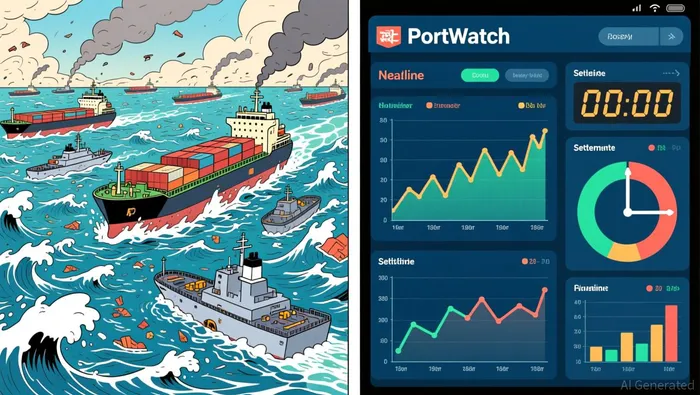
The resolution language is precise: Yes if IMF Portwatch publishes a 7-day moving average of transit calls — "Arrivals of Ships" — for the Strait of Hormuz equal to or above 60 for any date through Aug. 31, and No otherwise. The count covers container, dry bulk, roll-on/roll-off, general cargo, and tanker ships, and "ships not reported by IMF Portwatch will not be considered."
So "back to normal" here means: 60 arrivals a day, averaged over a week, in a database maintained in Washington. Before the war, the strait averaged roughly 130–140 ships a day. The bar is set at less than half of normal, which makes it generous — and it is still untouchable.
The numbers the clock has already recorded
Reality, in round figures: from July 15 through Aug. 23, about five vessels a day transited the strait — a 95 percent drop from pre-war averages — and the limited traffic mostly sails under naval escort or with trackers switched off. Kpler's data showed eight transits on August 25 and ten on August 26. The best headline of August was that traffic "skyrocketed nearly 400 percent," which sounded dramatic and still worked out to roughly 192 crossings for the whole week — about 20 percent of pre-war levels. Even the best single day of the crisis, around 25 crossings on June 18, was under half the threshold. No day, in six months, has been within reach of 60.
Here is the trap, in arithmetic. The last date a qualifying seven-day average can be published for is Aug. 31, and that average is the mean of Aug. 25 through Aug. 31. Aug. 25 (8 ships) and Aug. 26 (10) are already in the books. For the window to hit 60, the five days from Aug. 27 through Aug. 31 would have to average roughly 80 reported arrivals a day — about three times the best day of the entire war, sustained for five straight days, starting immediately, with Iranian forces striking tankers as recently as Aug. 25.
Even a deal signed tonight is too late. When the June 15 US–Iran agreement was announced, tanker traffic stayed unchanged for days while owners waited for the June 19 signing; shipbroker Bimco warned that floating mines made it "very risky" to transit and that clearing more than 500 trapped ships would take weeks. Frontline CEO Lars Barstad said traffic would resume "pretty quickly" after a credible deal but that pre-war levels were not coming back "anytime soon." The strait cannot go from ten ships a day to 80 reported arrivals a day over a weekend, contract language or not.
The price already picked the loser
The chart tells you which side the crowd has been on. The market opened in early July above 15 cents, when a summer peace deal still looked buyable. It spiked to about 16.5 cents on Aug. 4–5 — right on the Bessent headlines. Then the seven-day data refused to move, and the price bled out: under 4 cents by Aug. 9, roughly 0.35 cents by Aug. 22 even as "traffic skyrockets 400%" went viral, and 0.15 cents after the Aug. 25 tanker attack that followed a new round of US sanctions. The re-rating has not spared the long dates, either: on Kalshi, traders sat at just 44 percent for a return to normal by Dec. 1 back in July.
This is a family of markets, and every earlier sibling has already resolved No: June 15, end of June, July 15, and July 31 all settled below 1%. The crowd has paid five rounds to learn the same lesson in public — the headline never beats the lag. The identical contract that runs to Dec. 31 still trades around 30 cents, because that is where the real uncertainty lives. Time is what the market charges for; the last 48 hours are worth nothing to Yes.
Cheap is not the same as priced low
Yes at 0.15 cents is the cheapest thing this market sells, which is exactly why it is the wrong thing to buy. The price implies a 0.15 percent chance, and the arithmetic above puts the real chance closer to zero. A 667-to-1 payout on an event with no published path to a 60 average by Monday is not an investment — it is a donation in exchange for a story you can tell in the group chat.
The defensible side is the boring one. Buy No at 99.85 cents and each share pays $1 when the data confirms what the war has already shown — a gain of about 0.15 percent in roughly a week, for near-certainty. That is the crowd paying a small premium to be wrong again, and it is the only side of this order book with real expected value.
The cleanest way this bet wins
Yes wins only if IMF Portwatch's published arrivals for Aug. 27–31 average about 80 a day — a full de facto reopening, with transits reported into the database, starting now. The honest unknowns cut one way or the other. Portwatch counts every reported transit, not just the visible crude carriers Kpler's headlines track, and dark ships or the US-escorted Omani corridor can push its numbers above the newsier ones. A data revision can also reopen the window. Every one of those mechanisms, though, adds a few ships, not 67. There is no credible reading of six months of data that gets from ten a day to 80 a day in five.
The real lesson here travels past this single contract. Headline events and settlement conditions are different securities: the news cycle says "reopened," and the contract says a seven-day average, published by the IMF, at or above 60, by Monday. Those are different bets, and this one has already landed. If a deal drops this weekend, Brent, tanker stocks, and Gulf exporters will all jump — and this 0.15-cent contract will still resolve No. The trigger to watch is not the White House. It is the Portwatch page.
_43ca838f1775813865579.png?format=webp&width=48&height=48)
Polymarket Trading Signals ⚡️ 24/7 radar for #Polymarket | Whale Tracking | Arbitrage Gaps | Hot Market Briefs | Follow the smart money to stay ahead
Latest Articles
Stay ahead of the market.
Get curated U.S. market news, insights and key dates delivered to your inbox.


AInvest
PRO
AInvest
PRO




Comments
No comments yet