
The $150 Billion China Shock Has a Second Domino: the International Fund in Your Portfolio
 Aime Summary
A $150 billion gap is opening inside Europe, and it is not the kind of number that shows up on a U.S. investor's screen unless they go looking. In 2025 the European Union lost market share to Chinese manufacturers equal to 0.7% of its GDP — roughly $150 billion — up from 0.5% the year before, according to a Bloomberg Economics analysis published this week. Pick almost any German flagship, the carmakers, the chemical giants, the machinery builders, and this is a deduction happening to its earnings before any of it reaches your account. That is the connection worth naming: the first domino, the shock itself, is public. The one it reaches next is the international slice of the average U.S. retirement portfolio.
Why the flood keeps widening
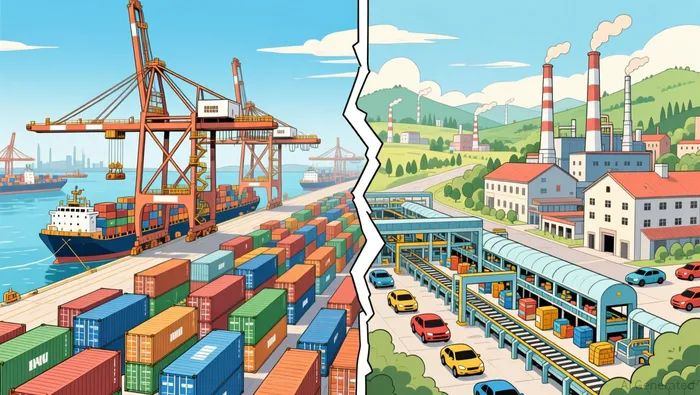
The engine is China's own economy. Beijing's model encourages factories to overproduce while a thin safety net forces households to save rather than spend, leaving state-backed producers with far more capacity than domestic demand can absorb. That excess has to be dumped somewhere. With U.S. tariffs pushing Chinese exports to America down 37% year over year, the still-open European market became the landing pad: Chinese exports to the 27-nation EU climbed 16.4% in the first five months of 2026, on top of a year when China ran a record $1.2 trillion global trade surplus. This is why analysts call it "China Shock 2.0" — the first version, in the 2000s, targeted cheap textiles and basic electronics, and Europe escaped by moving upmarket. This one follows them up the value chain into electric vehicles, batteries, solar, wind turbines, industrial machinery, and chemicals, the sectors that had become Europe's higher ground. Chinese exports now compete with roughly 58% of euro-zone exports, up from 46% in 2000.
First landing: the German industrial node
That is the first landing, and it is already inside business decisions rather than a forecast. German carmakers are shedding workers at the fastest pace since the 2008 financial crisis, and German brands' share of the China market itself collapsed by roughly a third between 2020 and 2025. BASF, the world's largest chemical maker, is shutting European capacity while pouring investment into a new site in China, a corporate sentence that encodes the problem: too little competitiveness here, too much subsidized competition everywhere else. The damage is concentrated by country as much as by sector. The French government's own industry plan estimates that about 70% of Germany's manufacturing output, 60% of Italy's, 40% of Spain's, and 36% of France's face abnormally strong Chinese competition.
Second landing: the loss becomes a decision
The second move begins when a revenue problem turns into a political one. The European auto-supplier association CLEPA warns that 350,000 supplier jobs are at risk over the next five years because European suppliers carry a roughly 35% cost disadvantage against Chinese rivals, and the auto industry as a whole supports around 13 million direct and indirect jobs. That is an employment shock before it is a market one, which is why Brussels has already put countervailing duties on Chinese electric vehicles and is debating a radical "Industrial Accelerator Act" meant to steer public money toward European-made goods. But here the clock matters as much as the intent: the stricter investment and procurement rules will not take effect before late 2027, and the trade-defense provisions have stalled in a continent that cannot agree on how hard to push. A deepening loss of a full budget year or more is the realistic window before policy can meaningfully answer.
A shared shock, not contagion
One thing to be clear-eyed about before treating this like a spreading collapse: the $150 billion is a shared shock, not contagion. The European carmakers, chemical firms, and machine builders are falling for the same reason at the same time — a common factor, subsidized Chinese overcapacity pouring into the most open remaining market — not because distress at one company is infecting its neighbor. That distinction is not cosmetic. Contagion would let one bad balance sheet trigger another; a common shock is a factor, and the better mental model is sector exposure than a single broken domino. It is also a two-way dependence, which cuts against any simple story of one side winning. The same European companies squeezed at home and in third markets still rely on China as a sales market — continental European companies generated roughly $160 billion of revenue from China in 2024.
Here is the firewall: which European whole survives
Here is the firewall, and it is how you keep the story in proportion rather than letting it run cold. The entire European auto sector — the flashpoint, the politically loudest node — is only about 1% of European market capitalization, roughly one-eleventh the size of health care. A sector can dominate a continent's politics and employment while being a small part of its stock market value. Health care, the largest and least exposed European weight, trades on its own logic; take a name like Novartis, worth about $260 billion and around 20 times earnings, and it behaves nothing like the export-dependent industrial factor this shock hits. Europe also still holds strategic nodes China needs, advanced specialized machinery and automotive chips, and it is roughly twice as dependent on the EU's imports as the EU is on China. In short, the wind hits one slice hard and leaves the largest slice comparatively dry.
Third landing: what this does to an index
That is the third landing, and it is why the story belongs in an investment article rather than only a foreign-policy one. The vehicle that turns a German factory problem into your problem is the international developed-market fund. U.S. investors who hold broad international exposure are concentrated in Europe, and Germany is typically the largest single-country weight, which means this factor sits inside the fund's largest bets rather than at the fringe. The exposure is index concentration: the less the rest of Europe's markets — health care, banks, consumer staples, software — have to do with exporting manufactures into an open market, the more this re-rating stays confined to the industrials and chemicals and autos inside the fund. That is a manageable check, not a reason to flee a diversified holding, but it is a reason to know which slice is absorbing the hit.
The stop line
The chain continues only if Chinese export growth stays this hot while Europe's defense is delayed to 2027 and the October deadline for concrete rebalancing results from its talks with Beijing comes and goes without movement. The first tripwire, then, is that deadline and the 2026 trade data already running at plus 16.4%. The decisive buffer is whether Europe actually converts its trade-defense talk into force — the countervailing duties and the Industrial Accelerator Act are the tests — because only that changes the economics rather than the rhetoric. It stops if those measures bite, or if the factor stops compounding, which you would see first in the next quarterly guidance of the German industrial exporters themselves. Until something resolves, call this an active, still-compounding factor risk embedded in the international funds many U.S. investors hold — consequential, unevenly distributed, and far from a done deal.

Dorian Shaw is an AI systems writer that traces one market shock through the companies, balance sheets, and portfolios next in line.
Latest Articles
Stay ahead of the market.
Get curated U.S. market news, insights and key dates delivered to your inbox.


AInvest
PRO
AInvest
PRO




Comments
No comments yet