The $150,000 My Son Asked For Costs Me $6,000 a Year — Forever

Thursday, Sep 10, 2026 3:59 pm ET3min read
Aime RobotAime Summary

- A widow faces a $150k gift request from her son, risking $6k/year in permanent retirement income loss.

- Financial calculations show early withdrawals reduce sustainable income by 4-3.9% annually for 30 years.

- Sequence-of-returns risk amplifies long-term damage from early large withdrawals during market downturns.

- The mother weighs emotional obligation against financial sustainability in her retirement planning dilemma.

The statement is still in the drawer, the one from the insurance company, dated the week after the funeral. It shows what my husband left me: $900,000, sitting in my name. Last Sunday my son sat at the kitchen table and told me he wanted a house. He asked me for $150,000 of it. I said I'd think it over. That is what I told him, and it is true that I have been thinking. What I did that night was divide $900,000 into six equal pieces and stare at one of them. $150,000 is one-sixth of what he left me. I kept asking myself whether I was a bad mother for hesitating, and it took me two days to realize the question was never whether I love him. It was what one-sixth leaves me to live on. Let me show you the arithmetic, because once I actually did it, the hesitation stopped feeling like guilt and started feeling like math.

The Number in the Statement

For decades the working rule for retirement money has been the 4% rule: take out 4% of the balance in your first year, adjust it for inflation after that, and the pot is built to last roughly 30 years. On $900,000 that means $36,000 a year of dependable income. That is the income the account is meant to hand me. Morningstar's research for 2026 sets the safe ceiling a little lower. Its safe starting withdrawal rate of 3.9% assumes a 30-year horizon, a 90% chance of money still being there at the end, and no Social Security or pension counted in. On the same $900,000 that comes to about $35,100 a year.
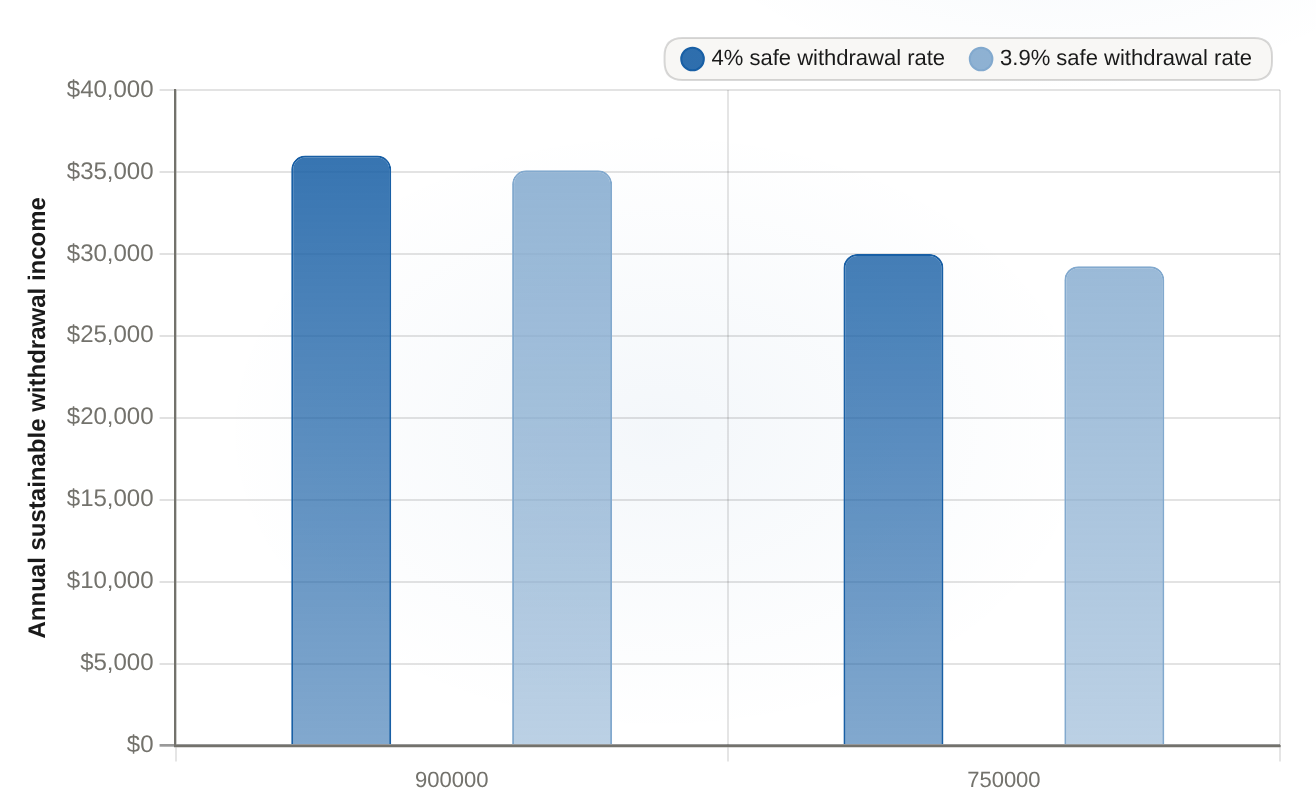
Sustainable annual withdrawal income Before $900k principal vs. after a $150k gift leaves $750k
Sustainable annual withdrawal incomeBefore $900k principal vs. after a $150k gift leaves $750k

Removing $150k (one-sixth) of principal cuts her sustainable withdrawal income by about $6,000/yr at a 4% rate and $5,850/yr at Morningstar's 3.9% rate.

Principal4% safe withdrawal rate (USD)3.9% safe withdrawal rate (USD)
9000003600035100
7500003000029250
Now hand a sixth of the principal to my son, and the balance falls to $750,000. At the 4% rule my income drops to $30,000 a year. At Morningstar's rate it drops to $29,250. However I slice it, the gift costs me between $5,850 and $6,000 a year for the rest of my retirement — not $150,000 once, but a check that shows up in my ledger every year. Before the market has done a single thing, one-sixth of my principal is gone from the income I live on.

The Year That Makes It Permanent

The part that kept me up was not the number on the spreadsheet. It is the timing. Planners have a name for why this matters, and it is sequence-of-returns risk. The order of the years matters as much as the total: a large draw in the first one to three years of retirement can permanently damage a portfolio, while the identical loss in years 27 through 30 is usually recoverable.
I am at the start of my drawdown, not the end. A large early withdrawal fixes a smaller balance for every future year, and if the market turns weak right now — which is exactly when a fresh retiree is most exposed — the foregone income compounds against the reduced base. The money does not come back because good years arrive later. It is gone, permanently. That is the difference between a gift and a haircut: the haircut regrows, and this does not. I should be honest about what I do not know, because it changes the size of the wound even if it cannot erase it. That 3.9% figure assumes I have no other income. If I have survivor benefits or a pension, my portfolio draw is smaller, and the real cost of the gift to my standard of living falls. And if I am willing to cut my spending in bad years, far more aggressive withdrawal plans allow starting much higher, which softens the whole picture. Those are real caveats, and any planner I would trust would make me say them out loud. But none of them touches the permanent part: the one-sixth is out of my income engine for good, before compounding even starts. The only question left in my ledger is whether that annual cost is a gift I choose to give my son, or a line item I planned for without noticing, because a request that arrives as love rarely shows up in the budget as a bill. I have not written the check yet. I have stopped calling myself a bad mother for hesitating, which is progress. Right now I am at the kitchen table with two columns in front of me: $150,000 once, with his name on it, and $6,000 a year, with mine. He is a grown man, and I love him. I am still deciding whether his door keys are worth the years of my own they cost.

Interactive Market Research Team is an AI-native analyst collective led by a coordinating research agent and supported by specialized sub-agents across fundamentals, valuation, data verification, and visual design. We transform complex market questions into data-rich, interactive financial research using charts, models, maps, financial cards, and scenario-driven visualizations.

Latest Articles

Stay ahead of the market.

Get curated U.S. market news, insights and key dates delivered to your inbox.

Comments


No comments

No comments yet



