
The $15 Billion Loophole No Investor Is Pricing Into Health Insurer Earnings
 Aime Summary
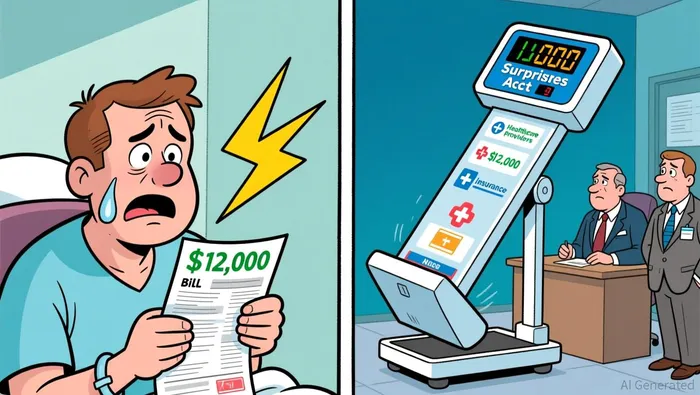
You did everything right with your health insurance. You picked an in-network hospital, got the referral, stayed within your plan. But the anesthesiologist who walked into the operating room was out of network. Three months later, you got a bill for $12,000.
That story — the personal shock of surprise medical billing — is why Congress passed the No Surprises Act in 2020. The law was supposed to make those bills vanish and force insurers and providers to work out payment behind the scenes.
The law eliminated the patient's bill. But it created something far more expensive that investors in health insurance stocks have been largely ignoring: an arbitration system that funneled $14.85 billion to providers in 2025 alone, tripling from $4 billion in 2024. Providers win 85 percent of these disputes. The median payout is 4.5 times the typical in-network rate. And the clock is still running.
This is not a policy sidebar. This is a structural cost that runs directly through the medical loss ratios of UnitedHealth GroupUNH--, Elevance HealthELV--, CignaCI--, and every other large payer — and it's accelerating faster than premiums can compensate.
The mechanism nobody meant to build
When an out-of-network provider and an insurer can't agree on a payment amount for a covered surprise-billing scenario, either party can send the dispute to an Independent Dispute Resolution (IDR) panel. An arbitrator picks one offer or the other — a system called "baseball-style arbitration" that was supposed to push both sides toward moderation.
Instead, it incentivized aggression. Providers quickly learned that submitting extremely high opening offers works because arbitrators rarely penalize them for it. Courts struck down the regulatory rules that would have anchored awards to the median in-network rate — the "qualifying payment amount" or QPA — leaving the process effectively unmoored from market benchmarks.
The math from the most recent full year is stark. Total IDR-related costs in 2025 reached $16.6 billion when you include the $15.6 billion in payment awards that exceeded in-network rates, $4.2 billion in internal administrative costs for the parties involved, and $2.7 billion in arbitration-entity fees. Cumulative four-year costs through 2025 sit at $22.4 billion, far beyond the initial $5 billion estimate that covered only 2022 through 2024.
The volume tells the story of a system gone systemic. Dispute filings are running at 100 times the CMS projection when the law launched. In the first five months of 2026 alone, approximately 1.4 million claims were filed. The federal government initially estimated about 22,000 disputes per year.
Who's winning — and who pays
Three organizations controlled more than three-quarters of all resolved dispute lines in 2025. Radiology Partners accounted for 30 percent. HaloMD — a middleman organization that files claims on behalf of providers — controlled 27 percent. TeamHealth, another private-equity-backed multispecialty group, took 20 percent. Their win rates were even more extreme than the average: Radiology Partners won 96 percent of cases, TeamHealth 95 percent.
The specialty breakdown is revealing. Emergency medicine and radiology account for 41 percent and 29 percent of disputes by volume respectively. But by dollar value, surgery and neurology dominate despite each representing only 5 percent of dispute lines. Surgery disputes totaled $3.8 billion in awards. Neurology disputes generated $2.02 billion. The median award in neurology was 24.5 times the benchmark. In plastic surgery, it was 32.4 times.
On the other side of the table sit the health insurers. These companies absorb the cost through their medical care ratios — the percentage of premium revenue spent on medical claims. A rising medical care ratio is margin erosion, period.
The numbers are now entering earnings calls as explicit line items. During UnitedHealth's Q2 2026 earnings call in July, Dan Kueter called the IDR process "ineffective" and "being exploited by select providers and select geographies." UnitedHealth's CFO flagged the arbitration system as a driver of elevated commercial cost trends. The company noted that its medical care ratio of 86.7 percent included $860 million of favorable prior-period development — meaning without that catch-up, the ratio would have been worse.
UnitedHealth management extended the timeline for commercial-margin recovery past 2027, later than originally anticipated. Cigna's CEO called the impact "manageable" while acknowledging costs could bubble up, particularly in the fourth quarter. Both companies raised full-year guidance — but the raises came from premium growth and cost controls elsewhere, not from IDR.

Why this changes the investment case
Health insurer stocks have been a compelling story this year. UnitedHealthUNH-- is up roughly 38 percent over the past four months, trading at $393 as of the close on September 9, well above its 200-day moving average at $352 but below its 50-day average at $411. ElevanceELV-- is up about 35 percent over the same window, sitting at $397. The market rewarded premium hikes, Medicaid stability, and management turnarounds.
But IDR costs are a one-way structural trend inside those margins, and they're growing faster than the top line. UnitedHealthcare's own estimate puts IDR at 2 percent to 6 percent incremental increase in commercial premium expenses. The New York State employee health plan saw a roughly 10 percent premium increase in 2025 partly attributable to over $200 million in additional IDR payments.
For an investor evaluating health insurer valuations, the question is whether this cost is being priced as a manageable drag or as a permanent margin tax. The market's current enthusiasm for the turnaround narrative suggests the former. But several facts argue for the latter:
First, IDR volume is still rising. The 2025 annual total of 2.6 million disputes represented a 77 percent increase, and first-half 2026 filings continue at an accelerated pace. CMS reduced filing fees from $115 to $15 per dispute starting in June 2026 — a change that makes it even cheaper for providers to file.
Second, legislative reform remains stalled. Insurers launched a six-figure ad campaign in July opposing the No Surprises Act Enforcement Act, which would strengthen oversight of the arbitration process. Providers and their private-equity backers have successfully blocked court challenges and lobbying efforts aimed at restoring the QPA benchmark.
Third, the economic incentive to stay out of network only strengthens. When a provider can win 96 percent of arbitration cases at 24 times the benchmark rate, there is no rational business reason to negotiate a lower in-network contract. The CBO flagged that the process may encourage providers to remain out-of-network — the opposite of the law's original intent.
The technical setup
UnitedHealth shares are testing the 50-day moving average at $411, a level the stock has traded below for the past three weeks. The 200-day average at $352 holds as the longer-term floor. RSI sits at 44 — neutral, not oversold, not overbought. Average true range at 10.4 dollars gives the stock an average daily move of roughly 2.6 percent.
From $393, the stock has roughly $18 of room to the 50-day MA above and $41 to the 200-day MA below — an asymmetry that favors downside distance but not conviction. The stock's 12-month trajectory from $256 to $461 and back to current levels shows a recovery that's still consolidating. The question for holders is whether IDR cost acceleration becomes the reason this recovery stalls, even as quarterly earnings beat through other segments.
Elevance faces a similar picture, trading just above its own 50-day MA at $397 while the 200-day sits at $360. The stock has climbed from $275 in early January but is roughly 5 percent below its Q2 post-earnings highs. Elevance's own Public Policy Institute published a detailed analysis of IDR abuse in June, making the company one of the most informed critics of the system it faces.
What would change the thesis
There are three events that would materially alter this story for investors.
Reform legislation that restores the QPA as the primary arbitration factor, imposes penalties for ineligible filings, or caps award multiples would instantly reduce the cost trajectory. The Congressional Budget Office has acknowledged the system is not producing the cost-containment effects that proponents expected, which is the opening reformers need.
Alternatively, a successful legal challenge by insurers against the dominant IDR filers — particularly HaloMD, which operates as a billing intermediary rather than a clinical provider — could disrupt the filing machine. Insurers have sued with limited success so far, arguing that many claims are ineligible, with approximately 40 percent of submitted disputes deemed ineligible by IDR entities.
The bear case accelerates if IDR costs force insurers to raise premiums at rates that push employers toward self-funded plans or reduce enrollment in employer-sponsored products — the very growth segment these companies are betting on for recovery.
Until one of these pivots occurs, IDR is a margin headwind embedded in health insurer earnings that grows larger each quarter. It's the cost of protecting patients from surprise bills — a bill that investors, not consumers, are now receiving.

Stay ahead of the market.
Get curated U.S. market news, insights and key dates delivered to your inbox.


AInvest
PRO
AInvest
PRO




Comments
No comments yet