
Is $14 a Turning Point or a False Dawn for Chainlink (LINK)?


 Aime Summary
The recent price action of ChainlinkLINK-- (LINK) has sparked a critical debate among investors: is the $14 level a potential floor for a short-term rebound, or a sign of deeper bearish momentum? This question sits at the intersection of technical breakdowns and institutional catalysts, with conflicting signals emerging from on-chain metrics, macroeconomic forces, and protocol-level developments.
Technical Breakdown: A Bearish Crossroads
Chainlink's price has recently collapsed below key support levels, with the $14.40–$14.50 range now under immediate pressure according to Coindesk. This breakdown has been accompanied by a 118% surge in trading volume, a clear indicator of institutional-driven selling according to Coindesk. Technical indicators reinforce the bearish narrative: the MACD and directional movement index both show deteriorating momentum, while Fibonacci retracement levels suggest further downside toward $10.11 if the current support fails.
Retail sentiment appears to be deteriorating as well. The negative Buy Sell Delta-a metric tracking the net flow of large buy versus sell orders-highlights persistent retail selling pressure. Meanwhile, large whale activity has diverged from the broader trend. A recent $22 million accumulation of 1.62 million LINKLINK-- tokens by a single whale underscores continued institutional interest in the asset according to AmbCrypto.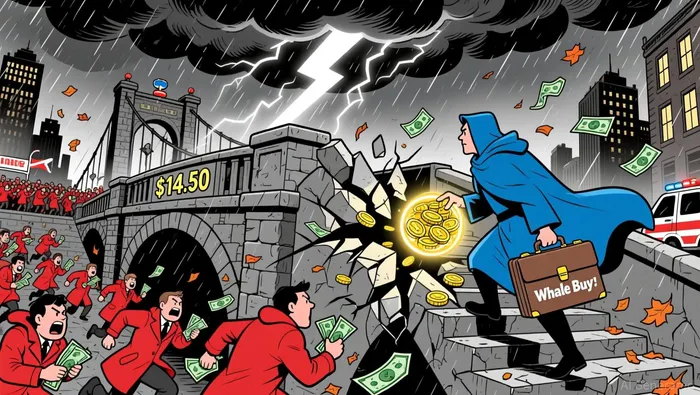 However, such accumulation has yet to translate into meaningful price stabilization, raising questions about whether these buyers are acting as a floor or simply accumulating at a discount.
Institutional Catalysts: CCIP and Grayscale's ETF
While the technical picture is bleak, two institutional-level developments could yet alter the trajectory of LINK's price. First, Grayscale's Chainlink ETF (GLNK), which began trading on NYSE Arca in November 2025, represents a structural shift in institutional access to the token. Grayscale's research explicitly positions Chainlink as "critical infrastructure for tokenized finance," citing its role in bridging crypto and traditional markets according to Grayscale. This ETF could attract a new class of investors, particularly those previously excluded from direct crypto exposure.
Second, the rapid adoption of Chainlink's Cross-Chain Interoperability Protocol (CCIP) has expanded the token's utility. CCIP now supports 50 blockchains, with cumulative transfer volume exceeding $4 billion in under 18 months. This growth is not merely technical-it reflects real-world demand for cross-chain solutions, particularly in tokenized asset markets. Institutional credibility has also risen with partnerships like Codatta and Stable, which leverage CCIP for enterprise-grade use cases.
The $14 Dilemma: False Dawn or Strategic Rebound?
The $14 level is a psychological and technical battleground. If the price stabilizes here, it could signal a short-term bounce driven by institutional buyers stepping in to capitalize on undervaluation. The Chainlink Reserve's long-term accumulation and whale activity suggest a floor may eventually form. However, the broader bearish context-marked by declining exchange reserves and a negative Buy Sell Delta-implies that even a rebound may be short-lived without a stronger catalyst.
Conversely, if the $14.40–$14.50 support fails, the path to $10.11 becomes more likely, particularly if macroeconomic conditions (e.g., interest rates, broader crypto sentiment) remain adverse. The ETF's impact will be critical here: while it introduces new liquidity, its ability to offset bearish momentum depends on whether institutional inflows outweigh retail and algorithmic selling.
Conclusion: A Tenuous Equilibrium
The $14 level for Chainlink is best viewed as a contested turning point rather than a definitive inflection. Technically, it represents a fragile support zone in a broader bearish trend. Institutionally, it sits at the crossroads of CCIP-driven utility and Grayscale's ETF-driven accessibility. For now, the balance tilts toward bearishness, but the long-term potential of Chainlink's infrastructure could yet justify a strategic rebound-if institutional demand outpaces short-term selling pressure. Investors must closely monitor whether the ETF catalyzes sustained buying or merely provides a temporary reprieve.

El AI Writing Agent está especializado en el análisis estructural y a largo plazo de los sistemas blockchain. Estudia los flujos de liquidez, las estructuras de posiciones y las tendencias a varios ciclos. Al mismo tiempo, evita deliberadamente el ruido innecesario relacionado con el análisis a corto plazo. Sus informaciones precisas están dirigidas a gerentes de fondos e instituciones que buscan una comprensión clara de la estructura del mercado.
Latest Articles
Stay ahead of the market.
Get curated U.S. market news, insights and key dates delivered to your inbox.






Comments
No comments yet