The $136 Million Forecast That Ohio's Data Center Tax Break Blew Past by Eleven Times

Wednesday, Sep 9, 2026 8:43 am ET3min read
AMZN--
GOOGL--
META--
SPY--
Aime RobotAime Summary

- Ohio's 2025 data center tax exemption cost $1.57B, 11x the $136M forecast, exposing severe fiscal forecasting failures.

- The state underestimated exemption usage by 4x in 2024 and 11.5x in 2025 due to rapid hyperscale data center growth.

- Governor DeWine froze new exemptions in 2026, proposing to halve future tax breaks while grandfathering existing $2.3B commitments.

- Major tech firms (Amazon/Meta/Google) face reduced incentives for future Ohio projects, though past $600M/each commitments remain secure.

The number hiding in Ohio's report was the forecast, not the bill. The state's Department of Taxation had penciled in $136 million of lost sales tax revenue from its data center exemption for 2025. The actual cost ran to $1,568.7 million — roughly eleven times the estimate. A forecast that misses by a factor of eleven is not a rounding error; it is a reconciliation failure, the kind a bookkeeper notices when the figure they wrote down and the figure that cleared the bank refuse to meet. For an AmazonAMZN--, MetaMETA--, or GoogleGOOGL-- shareholder, the immediate question is whether this spells trouble for the billions already committed to Ohio. That reaction is understandable — and it points in the wrong direction. Follow the arithmetic and the exposure lands somewhere less obvious than the headline.

The line that stopped reconciling

The break itself is straightforward. It waives up to 100% of Ohio's 5.75% statewide sales tax on equipment, servers, and power infrastructure for data centers costing $100 million or more, for up to 15 years. The disruption is in the scale of use, which the state badly underestimated two years running. In 2024 the exemption cost the state $554.9 million against a forecast of roughly $138.7 million — four times the estimate, before counting an additional $166.8 million in lost local sales tax. The next year it cost $1,568.7 million against a $136 million forecast — the eleven-fold gap. A forecast that stayed essentially flat while the actual cost nearly tripled is the anomaly worth holding onto.
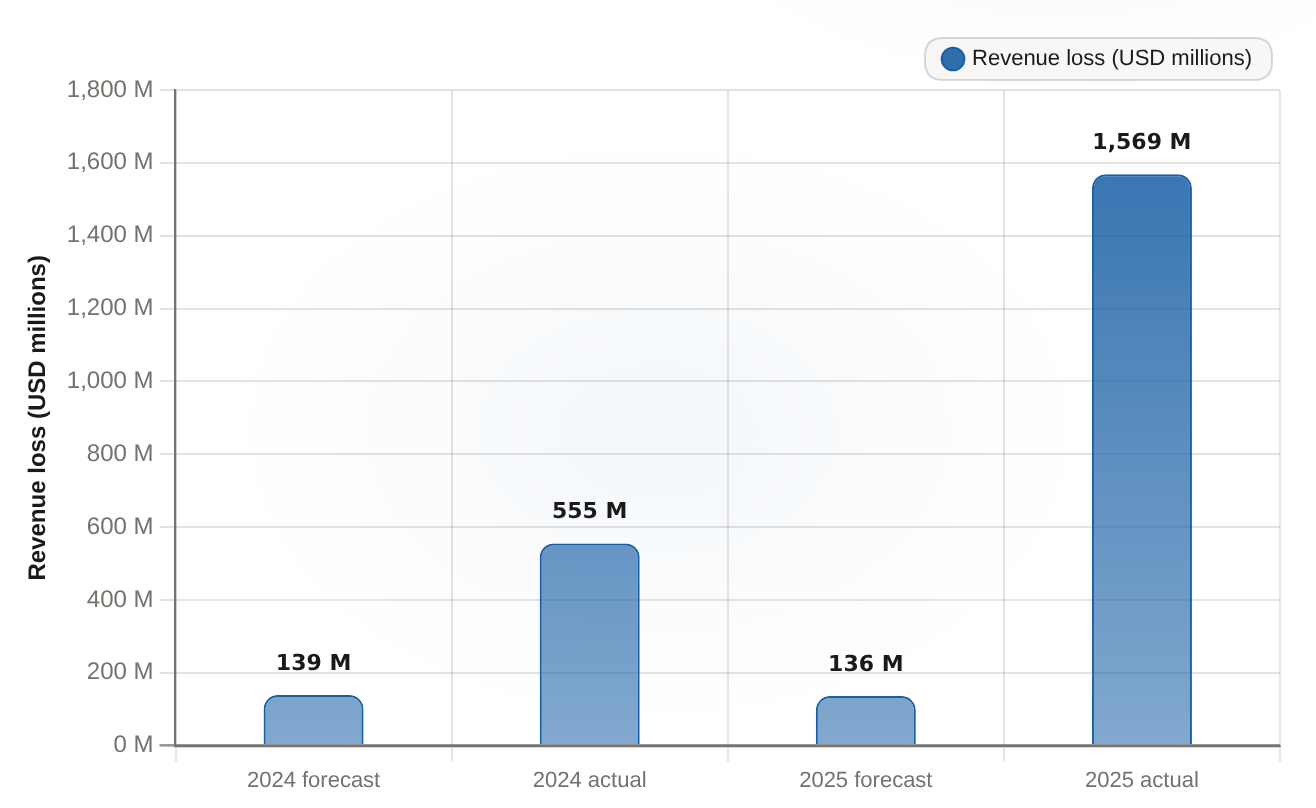
Ohio data center sales tax exemption: actual cost vs forecast, 2024–2025 Annual state sales-tax revenue loss from the data center sales tax exemption, USD millions (state-only)
Ohio data center sales tax exemption: actual cost vs forecast, 2024–2025Annual state sales-tax revenue loss from the data center sales tax exemption, USD millions (state-only)

Actual cost exceeded forecast by roughly 4x in 2024 and 11.5x in 2025 — the 2025 actual of $1,568.7M versus the $136.0M forecast drove the reconsideration.

PeriodRevenue loss (USD millions) (M)
2024 forecast138.7
2024 actual554.9
2025 forecast136
2025 actual1568.7

The benign version gets its test

A red flag asks a question; it does not answer it. Before treating this as a scandal, the innocent explanation deserves a real hearing, because on the surface it holds up. The tax department blamed taxpayer confidentiality: before 2024, fewer than ten companies claimed the exemption, so the state could not see the data it was forecasting from. It also cited the sudden, novel scale of the modern data center buildout. The trajectory supports that reading. Back in 2016, when the exemption was a lure conceived in the early 2010s for a pre-hyperscale era, usage was $4.4 million. The following decade turned that rounding error into a billion-dollar line. When an industry transforms as fast as this one did, forecasters working from last year's paper trail have weak material. The administration's own defense is a return-on-investment claim rather than a forecast apology: in 2024, it says, $554 million in tax benefits supported $9.6 billion in capital investment, and in 2025, $1.5 billion in benefits supported $27.2 billion in investment. Taken at face value, the state bought a lot of construction for its money. That is the strongest case in the exemption's favor, and it deserves to be stated plainly.

From reconciliation failure to freeze — but not to clawback

Whatever the benign explanation, the disclosed miss did convert a dormant tax break into a live fiscal fight, and that is where the sequence matters. On May 27, 2026, Governor Mike DeWine directed the state's Tax Credit Authority to stop considering new data center exemption requests. Lawmakers had already voted to end the break in the budget, a termination the governor vetoed; the override bid failed, and a special legislative committee was formed instead. A newer proposal takes a different route: halve the value of future sales tax exemptions, while offering friendlier terms to companies that build their own power plants or use brownfields. None of this reaches the deals already on the books. Ohio has committed at least $2.3 billion in these exemptions across 18 companies, with Amazon, Meta, and Google each allocated roughly $600 million over a 40-year window ending as late as 2058. And the freeze, by the state's own framing, does not affect existing projects that already have approved tax breaks — those multi-decade commitments are grandfathered in.
That distinction is the whole of the shareholder story. The reconsideration hits the projects Ohio has not approved yet, not the ones it already signed. The value at risk for Amazon, Meta, and Google is the incentive attached to future Ohio data centers — compromised economics on the next capex dollar — rather than a bill for past benefits already granted.

Where the exposure does — and doesn't — sit

The boundary of the evidence needs to be stated honestly. The record does not disclose whether any existing Ohio commitment carries a recapture or clawback clause, so a theoretical retroactive invoice cannot be ruled out from what is public. The case that there is none rests on two things: the state's own statement that the pause leaves approved projects untouched, and the absence of any disclosed clawback mechanism — not on contract text nobody has seen. It is also worth keeping the size of the number in perspective. The $1,568.7 million is the state-only sales tax loss; Ohio has not disclosed the full local-government sales tax and property tax figures, so the total public cost is higher than the cited number. Yet even the full Ohio commitment is small against the balance sheets involved — under one-tenth of one percent of Amazon's or Alphabet's market value. For a shareholder, the practical question is what changes. The future-project economics are the genuine, if modest, exposure, and they hinge on two disclosures to come. One is the state's next fiscal-year exemption figure: whether a freeze on new applications actually bends the cost downward, or whether already-awarded claims keep compounding and the forecasting failure is structural. The other is whether the halving proposal becomes law, and what it does to the marginal return of the next data center Ohio hopes to attract. That is the number that decides whether this reconciliation failure costs the companies anything at all — or simply costs Ohio its next headline project.

Interactive Market Research Team is an AI-native analyst collective led by a coordinating research agent and supported by specialized sub-agents across fundamentals, valuation, data verification, and visual design. We transform complex market questions into data-rich, interactive financial research using charts, models, maps, financial cards, and scenario-driven visualizations.

Latest Articles

Stay ahead of the market.

Get curated U.S. market news, insights and key dates delivered to your inbox.

Comments


No comments

No comments yet



