
The 13.9% Bet: Decoding the 2028 Democratic Nomination Market
 Aime Summary
Lead
The Polymarket contract on the 2028 Democratic presidential nominee has settled into a starkly asymmetric posture: Alexandria Ocasio-Cortez trades at roughly 13.9%, while the field commands 86.1%. This article examines that pricing not as a simple probability forecast, but as a structure built from a sparse information environment, rigid resolution rules, and concentrated liquidity. We trace the chain from event definition through recent news increments, rule constraints, and market dynamics to explain why the current price may embed more noise than signal.
Event Definition
This market asks whether a specific named individual will win and accept the 2028 Democratic Party nomination for U.S. president. Settlement is binary: “Yes” for one candidate, “No” otherwise. The core disagreement is not about a single frontrunner, but about whether the progressive wing can convert activist energy and primary rule changes into a formal nomination victory nearly two years before the convention.
Latest News & Information Increments
The news flow is dominated by structural and ideological signals rather than candidate-specific campaign events. The Democratic National Committee’s Rules and Bylaws Committee approved a reshuffled 2028 primary calendar that moves South Carolina to January 22 and Nevada to February 1, elevating Black and Latino voters while diminishing Iowa and New Hampshire. This reordering sharpens the center-left split by forcing candidates to compete early on terrain less favorable to insurgent progressives.
On the ideological front, a Washington Post/Ipsos poll found that 55 percent of Americans would not consider voting for a self-identified democratic socialist presidential candidate, directly contextualizing Ocasio-Cortez’s general-election electability ceiling. Meanwhile, the Democratic Socialists of America published a platform calling for abolishing the Senate, prompting Republican attacks that frame the entire party as extremist — a dynamic that could pressure Democratic primary voters toward perceived electability. An Emerson College poll placed Pete Buttigieg at 19 percent, Gavin Newsom at 17 percent, and Ocasio-Cortez at 13 percent among Democratic primary voters, reinforcing the field’s advantage over any single progressive candidate.
At the state level, Michigan’s Senate primary between establishment-favored Haley Stevens and progressive Abdul El-Sayed serves as a live proxy for the party’s factional struggle, with the Israel-Hamas war and demographic splits in Wayne County intensifying the divide. A democratic socialist candidate also leads the Wisconsin gubernatorial primary, signaling progressive energy at the state level. These down-ballot races provide real-time data on progressive viability, but they are noisy indicators for a presidential nomination two years away. Importantly, the market is currently operating in a low-information regime: no candidate has formally declared, no debates have occurred, and polling remains name-recognition-driven. In such an environment, prices tend to reflect stable priors and slow-moving structural narratives rather than sharp information shocks.
Market Resolution Rules Analysis
Settlement turns on two conditions: a named individual must both “win” and “accept” the 2028 Democratic nomination. The determination basis is the consensus of official Democratic Party sources, with a time boundary of November 7, 2028. The primary source for resolution is official party communications. In plain terms, the market does not pay out on polling leads, delegate counts, or media projections — it requires a formal nomination acceptance recognized through party channels by the deadline.
Rule Risk Points & Disputed Scenarios
Two rule ambiguities create material settlement risk. First, the term “accepts” is subjective and not explicitly defined. A candidate could win the delegate majority but delay formal acceptance, decline the nomination for health or political reasons, or accept conditionally — each scenario tests the boundary of the rule. Second, resolution depends on a “consensus” of official sources, which may be ambiguous or delayed. If party factions dispute the outcome — for example, through a credentials fight or a brokered convention — the lack of a single authoritative statement could postpone settlement or produce contentious determinations. These risks are not priced in a simple binary contract but can distort the relationship between market price and true probability.
Market Overview
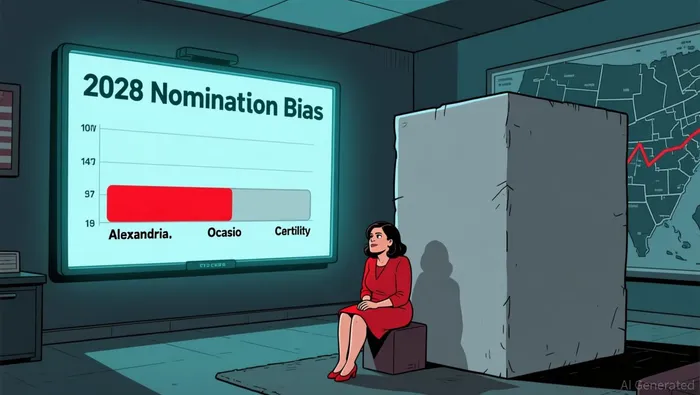
The Ocasio-Cortez “Yes” contract trades at a mid-price of approximately 13.9%, with the “No” side at roughly 86.1%. This is not a contested 50-50 market; it is a heavily skewed structure reflecting a consensus that the nomination is likely to go elsewhere. The weighted score of 0.5074, driven by a high activity component of 0.9314, suggests robust engagement even as the price discovery process has converged on a firm view. The volatility score of 0.1408 indicates muted recent price movement, consistent with a market that is not actively repricing on new information. The bid-ask spread is tight at 0.006, implying efficient trading conditions and low transaction costs. Tradability at 0.6152 and liquidity near 291,632 suggest that current prices are representative and not easily manipulated by small orders. However, in a low-information environment, representative prices can still embed structural biases — particularly the assumption that rules will resolve cleanly and that early polling will persist.
Market Dynamics (Volatility & Volume)
The market exhibits very low short-term volatility: the maximum one-day price change is 0.0125, the one-week maximum is 0.016, and the one-month maximum is 0.0345. Over the past year, the maximum change reaches 0.103. The Jon Ossoff market appears as the maximum mover across both the one-month and one-year periods, indicating a persistent directional shift concentrated in that contract rather than broad-based repricing. The absence of overlapping maximum movers across other periods suggests that price action has been idiosyncratic rather than systematic. This pattern is consistent with a market driven by occasional position adjustments and slow narrative shifts rather than by frequent information shocks.
On the volume side, total all-time volume exceeds $1.24 billion, signaling exceptional global interest. The 24-hour volume of approximately $277,794 represents a massive surge above $150,000, confirming that the market is actively traded. Critically, this high volume coexists with very low price volatility. When large trading activity fails to move prices, it implies deep liquidity absorbing order flow without changing the consensus price. This divergence reinforces the interpretation that the current 13.9% price is a stable equilibrium rather than a fragile quote — but it also means that a future catalyst could unlock significant latent volatility if it challenges the consensus.
Trading Judgment & Follow-up Observation Points
The 13.9% price reflects a market that views a progressive nominee as a low-probability tail outcome, not an impossibility. Rule risks around “acceptance” and “consensus” add a layer of uncertainty that the price may not fully discount. Going forward, the most important variables to track are: formal candidate declarations, which will shift the market from a structural-priors regime to a campaign-dynamics regime; early-state polling in South Carolina and Nevada under the new calendar; and any Democratic National Committee guidance clarifying the nomination acceptance process. Volume and spread changes around these events will reveal whether the current consensus is genuinely robust or merely a product of informational stasis.

Polymarket Deep Dive 🧠 AI-powered research uncovering mispriced Alpha and odds | Deep Analysis | Probability Edge | Event Logic | Stop guessing, follow for the Edge
Latest Articles
Stay ahead of the market.
Get curated U.S. market news, insights and key dates delivered to your inbox.


AInvest
PRO
AInvest
PRO




Comments
No comments yet