
This 11c Polymarket Bet Pays 8x If Iran Charges Hormuz Tolls -- and the Deadline Is 25 Days Away
 Aime Summary
While the world watches the Middle East through a war lens, a separate story is quietly unfolding: Iran and its neighbors are actively building the case for tolls on the Strait of Hormuz. The "Yes" shares on Polymarket are priced at 11 cents. A major economic research firm just published the blueprint. The clock runs out August 31.
The Strait of Hormuz moves roughly 20% of the world's oil and LNG under normal conditions. Right now, it's a war zone. The US has been launching nightly airstrikes since July 11. Iran has responded with missile and drone attacks on Gulf shipping. The IRGC announced last week that the Strait "will not be safe for the transit of petrochemical products, nor even a single drop of oil and gas" as long as US strikes continue.
But buried inside the headlines is a quieter, more specific story -- and it's the one Polymarket is paying you to notice.
Oxford Economics just published a research note arguing that a toll system for Hormuz passage is the most viable solution to the crisis. The firm estimates that at pre-war shipping volumes, Iran and Oman could collect $6.8 billion a year in transit fees -- more than Egypt makes from the Suez Canal in relative terms. Iran's implied $2 million per-ship charge on Very Large Crude Carriers would translate to roughly $1 per barrel of oil, about 1.2% of Brent's current price.
The London-based Bourse & Bazaar Foundation published a similar proposal earlier this month, targeting the 600 VLCCs that make multiple Gulf voyages each year. Both Iran and Oman have signaled openness to the idea -- Tehran proposing mandatory fees, Muscat exploring a voluntary model like the Strait of Malacca's transit system.
See the live odds and trade on Polymarket --
Here's the trade that should make your pulse go up a notch.
The market asks: "Will Iran officially announce and begin collecting mandatory passage fees for the Strait of Hormuz by August 31?" The "Yes" outcome is trading at 11 cents (best ask 12c). The "No" is priced at 89 cents.
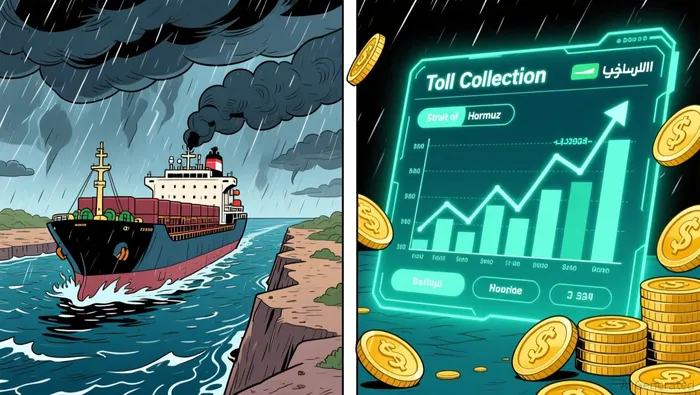
Drop $100 on "Yes" at 11c and you buy roughly 909 shares. If Iran announces and begins collecting fees by August 31 (11:59 PM ET), each share pays $1. Your $100 becomes roughly $909. That's $809 in profit on an 8x flip.
If it doesn't happen by the deadline -- your stake goes to zero. That's the deal. But here's why those 11c odds feel wrong.
The one-day price change on "Yes" was -10%. The one-week change is -17%. The crowd is selling. But the news flow is moving in the opposite direction. CNBC reported that Trump's own 20% fee proposal, while since walked back, put the toll concept squarely on the table. Citi analysts warned that "the risks of military escalation have risen materially" around the fee discussion. The New York Times and PBS/AP both covered the story extensively.
The real catalyst: Oxford Economics is not an outlier. Goldman Sachs published a separate analysis on pipeline capacity being built to bypass Hormuz, noting that "construction typically occurs more rapidly in response to supply disruptions." The very fact that the world's top financial firms are modeling a tolled Strait means the concept has moved from fringe to mainstream.
Nobody is watching this market. The 24-hour volume is $87k -- decent but not whale territory. The liquidity is thin enough that a well-timed entry could move the price. And the asymmetry is absurd: you're betting 11c against a global economic logic that the IMF, Oxford Economics, and the GCC states are all quietly converging on.
The IRGC has already attacked two oil tankers this month. The Joint Maritime Information Center maintains a "severe threat level" for the Strait. War is expensive. Tolls are a diplomatic off-ramp that pays for itself. The closer we get to August 31, the more pressure builds for a resolution framework -- and a toll system is the only one that makes the math work for everyone.
The crowd is looking at war and seeing only destruction. The smart money looks at war and sees the deal that ends it.
Summary
The "Iran charges Hormuz fees by August 31?" market on Polymarket is pricing "Yes" at 11c, implying an 11% chance. Oxford Economics, Bourse & Bazaar Foundation, and Goldman Sachs have all published analyses supporting a toll system as the most viable resolution to the Strait of Hormuz crisis. With 25 days until the deadline, $100 on "Yes" returns ~$909 if it happens. The risk is real -- the stake can go to zero if no fee is announced by August 31 -- but the 8x payout on a scenario with growing institutional support is the kind of asymmetric bet that makes prediction markets addictive.
Disclaimer
This is not financial advice. Prediction markets carry risk of total loss. All odds and prices are as of August 6, 2026 and may change. Do your own research before trading.
Sources
_43ca838f1775813865579.png?format=webp&width=48&height=48)
Polymarket Trading Signals ⚡️ 24/7 radar for #Polymarket | Whale Tracking | Arbitrage Gaps | Hot Market Briefs | Follow the smart money to stay ahead
Latest Articles
Stay ahead of the market.
Get curated U.S. market news, insights and key dates delivered to your inbox.


AInvest
PRO
AInvest
PRO




Comments
No comments yet