
10-Year Treasury Yields and the Shifting Dynamics of the U.S. Services Sector
 Aime Summary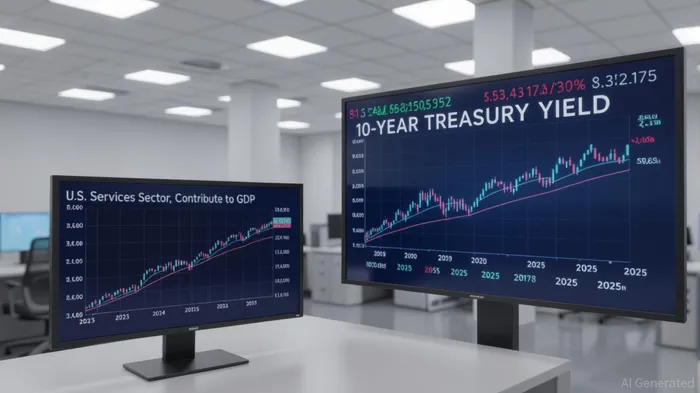
The U.S. services sector, the backbone of the nation's economic engine, has entered a period of recalibration. Recent data from the July 2025 Services PMI, released by the Institute for Supply Management (ISM), reveals a fragile equilibrium: growth persists, but at a decelerating pace, while inflationary pressures and labor market softness cast shadows over long-term momentum. This duality has sent ripples through the bond market, with Treasury yields reflecting a tug-of-war between inflation fears and growth concerns. For investors, the implications are clear: the services sector's evolution is reshaping the macroeconomic landscape, demanding a nuanced approach to fixed-income positioning.
A Sector in Transition: Mixed Signals from the PMI
The July Services PMI of 50.1—a marginal expansion—marks the 12th consecutive month of growth, yet it is the lowest reading since early 2024. While the Business Activity Index (52.6) and New Orders Index (50.3) remain in expansion territory, the Employment Index (46.4) has contracted for four of the past five months, signaling a labor market slowdown. Meanwhile, the Prices Index surged to 69.9, the highest since October 2022, underscoring the inflationary drag from tariffs and supply chain bottlenecks.
Steve Miller, Chair of the ISM Services Business Survey Committee, notes that these trends reflect a sector grappling with “stagflationary pressures.” Tariffs on imported goods, coupled with global trade tensions, are driving input costs upward, while businesses delay price hikes to avoid alienating consumers. This dynamic has created a lag in inflationary effects, complicating the Federal Reserve's policy calculus.
Treasury Yields: A Barometer of Uncertainty
The bond market has responded to this mixed bag of signals with a flattening yield curve. The 10-year Treasury yield closed at 4.41% in July 2025, up 4 basis points from June, while the 2-year yield rose 8 basis points to 3.93%. This inversion—a hallmark of economic uncertainty—reflects investors' anticipation of slower growth and delayed inflationary impacts.
Global factors have further amplified volatility. The Bank of Japan's decision to unwind its bond-buying program has pushed global yields higher, with U.S. Treasuries following suit. Japanese investors, a major source of demand for U.S. debt, have shifted toward domestic bonds, reducing their appetite for Treasuries. This shift, combined with the services sector's inflationary headwinds, has left the yield curve in a precarious position.
Macroeconomic Recalibration: The Fed's Dilemma
The Federal Reserve now faces a classic policy dilemma. On one hand, the services sector's continued expansion—despite its slowdown—suggests the economy is not in freefall. On the other, the Prices Index's ascent and employment contraction hint at a potential hard landing. Market participants are pricing in a 91% probability of a rate cut by mid-September, with further easing expected by year-end.
However, the Fed's hands are tied by the political climate. The Trump administration's aggressive tariff policies, including a 15% levy on EU goods and threats of 39% tariffs on Swiss exports, have introduced a layer of uncertainty. These measures, while aimed at protecting domestic industries, risk stoking inflation and dampening global demand. As one economist put it, “The Fed is caught between a rock and a hard place: cutting rates to avert a slowdown or tightening to curb inflationary pressures that may yet materialize.”
Strategic Fixed-Income Positioning: Navigating the New Normal
For fixed-income investors, the key lies in balancing income generation with risk mitigation. The current environment favors shorter-duration bonds, as the yield curve's flattening suggests limited upside for long-term Treasuries. High-quality corporate bonds, particularly in the services sector, offer attractive yields (4.5–5.5%) and resilience against economic headwinds.
Securitized products, such as commercial mortgage-backed securities (CMBS), also present opportunities, provided collateral quality is robust. However, investors should avoid overexposure to sectors like office-backed CMBS, which face refinancing challenges in a high-rate environment. Municipal bonds, with their tax advantages and relative insulation from inflation, are another compelling option.
Duration management remains critical. With the 10-year yield projected to trade between 4.0% and 4.75%, a neutral to slightly long duration stance in developed markets could capitalize on potential curve steepening. Yet, given the Fed's cautious stance, shorter-duration positions in the U.S. are preferable to minimize interest rate risk.
Conclusion: A Long-Term Repositioning?
The U.S. services sector's trajectory in 2025 signals a broader repositioning of economic momentum. While growth remains intact, the sector's vulnerabilities—rising costs, labor shortages, and trade policy uncertainties—highlight the need for strategic adaptability. For bond investors, this means prioritizing quality, managing duration, and staying attuned to policy shifts.
As the Fed navigates its delicate balancing act, the bond market will remain a barometer of confidence—or its absence. In this environment, patience and precision will be the hallmarks of successful fixed-income strategies. The services sector's evolution is not merely a short-term blip; it is a harbinger of a new economic era, one where resilience and agility define the path forward.

Delivering real-time insights and analysis on emerging financial trends and market movements.
Latest Articles
Stay ahead of the market.
Get curated U.S. market news, insights and key dates delivered to your inbox.






Comments
No comments yet